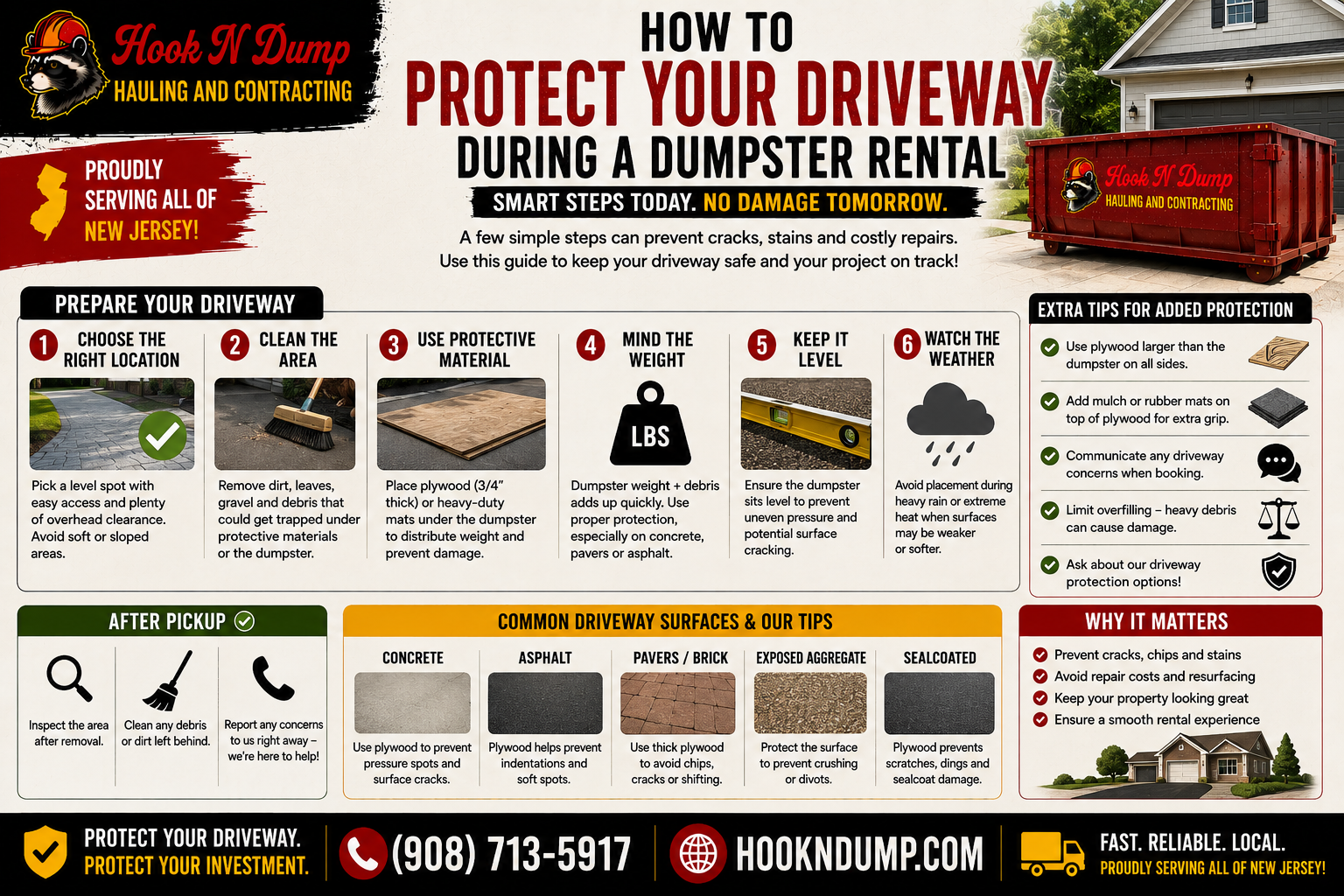
The best way to protect your driveway during a dumpster rental is to request driveway protection before delivery, disclose the driveway material and condition, choose a firm level placement area and prevent the container from becoming overloaded.
Hook N Dump currently lists driveway protection as an optional add-on on its dumpster product pages. Its current site also asks customers to provide a clear truck route with at least 10 feet of width and 14 feet of overhead clearance. The exact space needed should be confirmed for the assigned container and delivery truck.
No protection method can guarantee that a weak, cracked, newly installed or poorly supported driveway will remain unchanged. The customer should tell the rental company about existing damage, soft areas, drainage problems, recent paving and buried structures before scheduling delivery.
Driveway-protection checklist
- Request Hook N Dump’s driveway-protection option.
- Identify whether the surface is concrete, asphalt, pavers or gravel.
- Photograph the driveway before delivery.
- Report cracks, settlement, soft spots and recent repairs.
- Select a firm, level placement area.
- Keep the delivery route clear.
- Keep debris within the approved weight and fill line.
- Prevent unauthorized dumping.
- Clear access before collection.
- Inspect the surface after pickup.
Why a Dumpster Can Affect a Driveway
A roll-off dumpster transfers weight through a limited number of contact points.
The final load can include:
- The empty steel container
- Household junk
- Furniture
- Construction debris
- Roofing shingles
- Flooring
- Wood
- Drywall
- Yard waste
- Dense materials approved for loading
A driveway may experience more pressure when:
- The container is heavily loaded.
- Weight is concentrated at one end.
- The pavement base is weak.
- Asphalt is warm or recently installed.
- Concrete has not fully cured.
- Pavers are loose or poorly supported.
- The surface is cracked or uneven.
- The driveway sits above utilities or drainage structures.
- The container remains loaded for an extended period.
The Asphalt Institute notes that asphalt deformation under concentrated loads depends on factors including pavement stiffness, age, temperature, load and the duration of loading. It also states that rigid plates can distribute point loads across a wider area.
Does Hook N Dump Offer Driveway Protection?
Yes. Hook N Dump’s current 10, 15, 20 and 30-yard product pages list driveway protection as an optional add-on for paved surfaces.
Ask these questions when ordering:
- Is driveway protection included or added separately?
- What type of boards or pads will be used?
- Will protection be placed under every container contact point?
- Is my driveway material suitable for dumpster placement?
- Does the proposed location have enough room?
- Is there another placement area with lower risk?
- Does the protection remain in place until pickup?
- Are there surface conditions that would prevent delivery?
Confirm the protection option when booking rather than waiting for the truck to arrive.
How Driveway Protection Works
A protection system usually places rigid boards or approved pads between the dumpster and the driveway.
Its purpose is to:
- Spread concentrated weight across a larger area
- Reduce direct steel-to-pavement contact
- Reduce scraping during placement and collection
- Help protect decorative or finished surfaces
- Create a barrier between the container and pavement
The delivery driver should position the protection according to the container and truck setup.
Do not place random scraps of wood in the delivery area without approval. Thin, damaged or uneven boards can split, move or create an unstable support point.
Prepare the Driveway Before Delivery
Inspect the surface
Walk the full delivery route and proposed placement area.
Look for:
- Existing cracks
- Crumbling concrete
- Asphalt depressions
- Loose pavers
- Raised edges
- Drainage channels
- Soft shoulders
- Patched areas
- Oil damage
- Recent sealcoating
- Recent paving
- Uneven transitions
- Low tree branches
- Overhead wires
Tell Hook N Dump about anything that could affect delivery or placement.
Take photographs
Photograph:
- The full driveway
- The proposed placement area
- Existing cracks
- Patched sections
- Garage entrance
- Sidewalk crossing
- Curb
- Drainage areas
- Nearby walls or landscaping
Use date-stamped photographs where possible.
These images document the condition and can also help the company review access before delivery.
Remove obstacles
Move:
- Cars
- Trailers
- Basketball hoops
- Garbage cans
- Planters
- Children’s toys
- Contractor equipment
- Building materials
- Low-hanging decorations
- Temporary fencing
Hook N Dump currently advises customers to provide at least 10 feet of unobstructed width and 14 feet of overhead clearance.
Mark sensitive areas
Tell the driver about:
- Septic tanks
- Septic fields
- Drainage pipes
- Dry wells
- Underground utilities
- Irrigation lines
- Thin concrete aprons
- Vaults
- Retaining walls
- Recently repaired pavement
- Unsupported driveway edges
A dumpster or delivery truck should not be positioned over a buried system unless the responsible contractor confirms that it can carry the load.
Choose the Safest Placement Area
The safest location is usually:
- Firm
- Level
- Free from major cracks
- Away from unsupported edges
- Clear of overhead obstacles
- Accessible to the delivery truck
- Large enough for the container
- Large enough to open the rear door
- Accessible again on pickup day
Hook N Dump states that a clear, level area slightly larger than the dumpster is typically required and that its team can help determine placement before delivery.
Avoid placing the dumpster:
- On a steep slope
- Across a large crack
- On loose or sinking pavers
- Over a drain or utility cover
- On a recently installed surface without approval
- At the unsupported edge of a driveway
- Where the truck must cross soft lawn
- Under low wires or branches
- Where parked vehicles will block pickup
Protecting a Concrete Driveway
Concrete is rigid and can support substantial loads when properly designed, installed, cured and supported. It can still crack or chip when the base is weak, the slab is thin, existing cracks are present or weight is concentrated near an edge.
Before delivery
Tell Hook N Dump:
- Approximate driveway age
- Whether concrete was recently poured
- Existing cracks
- Patched sections
- Decorative finishes
- Stamped or colored areas
- Thin aprons or walkways
- Unsupported slab edges
Use rigid protection
Ask for approved boards or pads beneath the dumpster’s contact points.
Protection can reduce direct contact and distribute the load, but it cannot repair a weak slab or guarantee that an existing crack will not move.
Avoid newly poured concrete
Concrete gains strength while curing. The American Concrete Institute states that early curing allows concrete’s internal structure to develop strength and that moisture and temperature control help reduce cracking and other unwanted volume changes.
Do not place a dumpster on new concrete until the paving contractor or responsible engineer confirms that the slab is ready for the expected truck and container load.
Avoid relying on a universal waiting period. Concrete mixtures, slab thickness, reinforcement, weather, base preparation and load requirements differ.
Stay away from slab edges
The edge near a lawn, sidewalk or street apron may have less support than the center of the driveway.
Where possible, position the container on a sound interior section while preserving truck and garage access.
Protecting an Asphalt Driveway
Asphalt is flexible and can be more sensitive to concentrated loads, warm temperatures, weak base material and extended loading.
The Asphalt Institute states that indentation risk depends on pavement stiffness, age, temperature, load and how long the load remains in place.
Request driveway protection
Rigid boards or approved pads can spread the load and reduce pressure at individual contact points.
Report recent paving or sealcoating
Tell Hook N Dump when the driveway:
- Was recently paved
- Was recently patched
- Was recently sealcoated
- Has visible rutting
- Has soft spots
- Has oil or fuel damage
- Becomes soft during hot weather
Recently installed or repaired asphalt should not receive a loaded container until the paving contractor confirms that it is ready.
Consider hot weather
Asphalt can become more susceptible to deformation as pavement temperature rises. A heavily loaded container sitting in one location for several days can create more risk than a brief, light load.
Discuss another location when:
- High temperatures are expected.
- The asphalt is visibly soft.
- The surface already has tire impressions.
- The driveway base appears unstable.
- The project includes dense debris.
Prevent fuel and chemical spills
Keep paint, solvents, gasoline, oil and other prohibited liquids out of the dumpster and away from the driveway.
The Asphalt Institute identifies fuel and oil exposure as a pavement-maintenance concern.
Protecting a Paver Driveway
Paver driveways require extra review because individual units can:
- Shift
- Settle
- Crack
- Chip
- Separate
- Develop uneven joints
Risk depends on:
- Paver thickness
- Base preparation
- Joint condition
- Edge restraint
- Existing settlement
- Dumpster weight
- Truck movement
- Placement duration
Before scheduling:
- Send clear photographs to Hook N Dump.
- Identify loose or sunken pavers.
- Ask whether driveway protection is suitable.
- Confirm the plan with the paver installer when the driveway is new or costly.
- Consider another paved area or approved street placement when risk is high.
Do not assume boards will prevent every paver from moving. The base beneath the pavers must also support the load.
Protecting a Gravel Driveway
Gravel does not crack like concrete, but a truck or loaded dumpster can still cause:
- Rutting
- Displacement
- Sinking
- Mud mixing
- Edge damage
- Drainage changes
- Uneven settling
A gravel placement area should be:
- Firm
- Level
- Well compacted
- Free from deep mud
- Away from drainage ditches
- Accessible during wet weather
- Strong enough for the delivery truck
Tell Hook N Dump when the site has:
- Loose fill
- Recent grading
- Soft soil
- Standing water
- Steep slopes
- Narrow shoulders
- Septic or drainage systems
Additional stone or site preparation may be needed before delivery.
Can You Put Plywood Under a Dumpster?
Do not place ordinary plywood under a dumpster without discussing it with the rental company.
Thin or damaged plywood can:
- Crack
- Split
- Slide
- Warp
- Create uneven support
- Fail under concentrated weight
Use the protection system approved and positioned by the delivery company. Hook N Dump’s product pages provide a dedicated driveway-protection option, which is safer than improvising after the truck arrives.
The protection should be placed under the correct container contact points without obstructing the delivery equipment.
Does Dumpster Size Affect Driveway Risk?
A larger dumpster has more volume, but container size alone does not determine driveway risk.
The main factors are:
- Empty-container weight
- Final debris weight
- Weight distribution
- Surface condition
- Base strength
- Protection setup
- Placement duration
- Temperature
- Delivery and pickup movement
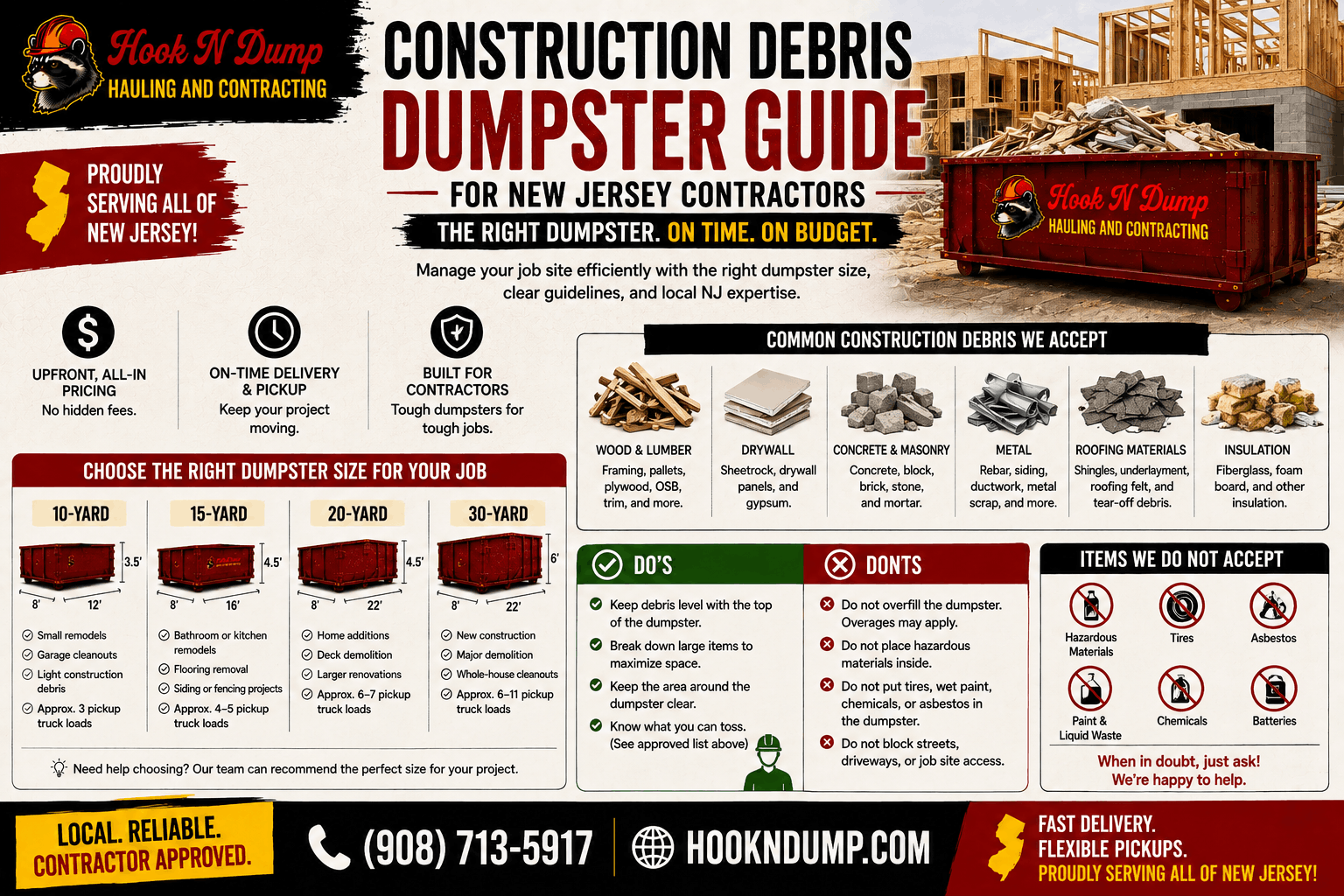
Hook N Dump’s current containers range from 10 to 40 cubic yards, with published included-weight allowances from 3,000 to 9,000 pounds.
| Dumpster Size | Current Starting Price | Included Debris Weight | Typical Project Category |
|---|---|---|---|
| 10-yard | $475 | 3,000 lbs. | Small cleanouts |
| 15-yard | $550 | 4,000 lbs. | Medium residential projects |
| 20-yard | $625 | 5,000 lbs. | Renovation and roofing |
| 30-yard | $725 | 7,000 lbs. | Large cleanouts and construction |
| 40-yard | $875 | 9,000 lbs. | Major construction and demolition |
The listed weight is an included billing allowance, not the total weight sitting on the driveway. The steel container and delivery equipment also contribute to the surface load.
Choose the right size for the debris rather than ordering a larger container as extra insurance.
Load the Dumpster Evenly
An uneven load can place more weight at one end or on one side.
Spread heavy debris
Distribute approved:
- Roofing shingles
- Tile
- Plaster
- Flooring
- Wet material
- Heavy furniture
- Wood
- Metal
- Construction debris
Do not create one dense pile near the front, rear or one corner.
Place flat material first
Load:
- Plywood
- Doors
- Cabinet panels
- Flooring
- Drywall
- Flat furniture pieces
- Dismantled shelving
Break down bulky items
Reducing furniture, cabinets and framing can prevent large empty gaps and help keep the load balanced.
Follow material-specific limits
Concrete, brick, asphalt, soil and similar dense materials may require a smaller dedicated container, a lower fill line or prior approval. Hook N Dump warns that heavy debris can reach a weight limit before the dumpster is physically full.
Prevent Overloading
Overloading can affect:
- Driveway pressure
- Pickup safety
- Truck operation
- Transportation compliance
- Final rental cost
Keep all material:
- Below the container walls
- Within the approved weight
- Evenly distributed
- Free from prohibited items
- Within any lower heavy-material fill line
Stop loading when instructed, even when physical space remains.
Hook N Dump currently publishes included weight allowances for each size and asks customers to consider both debris volume and material weight when selecting a container.
Prevent Unauthorized Dumping
A container visible from the street may attract:
- Household trash
- Furniture
- Tires
- Mattresses
- Appliances
- Roofing debris
- Paint
- Electronics
- Contractor waste
Unauthorized debris can increase weight, introduce prohibited items and make the load uneven.
Reduce the risk by:
- Choosing a less visible placement area
- Using approved covers where available
- Posting a private-use sign
- Informing neighbors
- Checking the container daily
- Scheduling pickup promptly
- Using job-site lighting or cameras where appropriate
Do not climb into the container to investigate unknown waste.
Keep Liquids and Hazardous Materials Out
Do not place these items into an ordinary Hook N Dump container:
- Liquid paint
- Solvents
- Gasoline
- Diesel
- Motor oil
- Propane tanks
- Hazardous chemicals
- Pesticides
- Flammable liquids
- Medical waste
- Asbestos-containing material
Hook N Dump currently lists hazardous chemicals, paint, solvents, asbestos, fuel, propane tanks, medical waste and flammable products as prohibited or separately handled materials.
Besides violating load rules, leaking liquids can stain or affect the driveway surface.
Do Not Move the Dumpster Yourself
Once the container is placed, do not attempt to move it using:
- A vehicle
- Tractor
- Skid steer
- Forklift
- Jack
- Winch
- Chains
- Construction equipment
Moving it can:
- Shift protection boards
- Scrape the driveway
- Damage the container
- Create an unstable support position
- Block pickup access
- Damage nearby property
Contact Hook N Dump when the placement needs to be changed.
Protect the Driveway During Pickup
Pickup can involve substantial truck movement and a fully loaded container.
Before collection:
- Remove all parked vehicles.
- Clear the approach route.
- Remove tools and building materials.
- Unlock gates.
- Move trailers.
- Clear overhead obstructions.
- Confirm the dumpster door is closed.
- Keep people and pets away.
- Ensure nothing extends above the walls.
- Tell the company about any surface changes.
Do not remove protection boards before the dumpster has been collected. The protection may be needed during both loading and pickup.
Should You Put the Dumpster in the Street Instead?
Street placement may be worth considering when:
- The driveway is newly installed.
- The pavement is badly cracked.
- Asphalt is soft or recently repaired.
- Pavers are loose or expensive to replace.
- The driveway is too narrow.
- The slope is unsafe.
- Buried systems prevent driveway placement.
- The container would block the garage or moving truck.
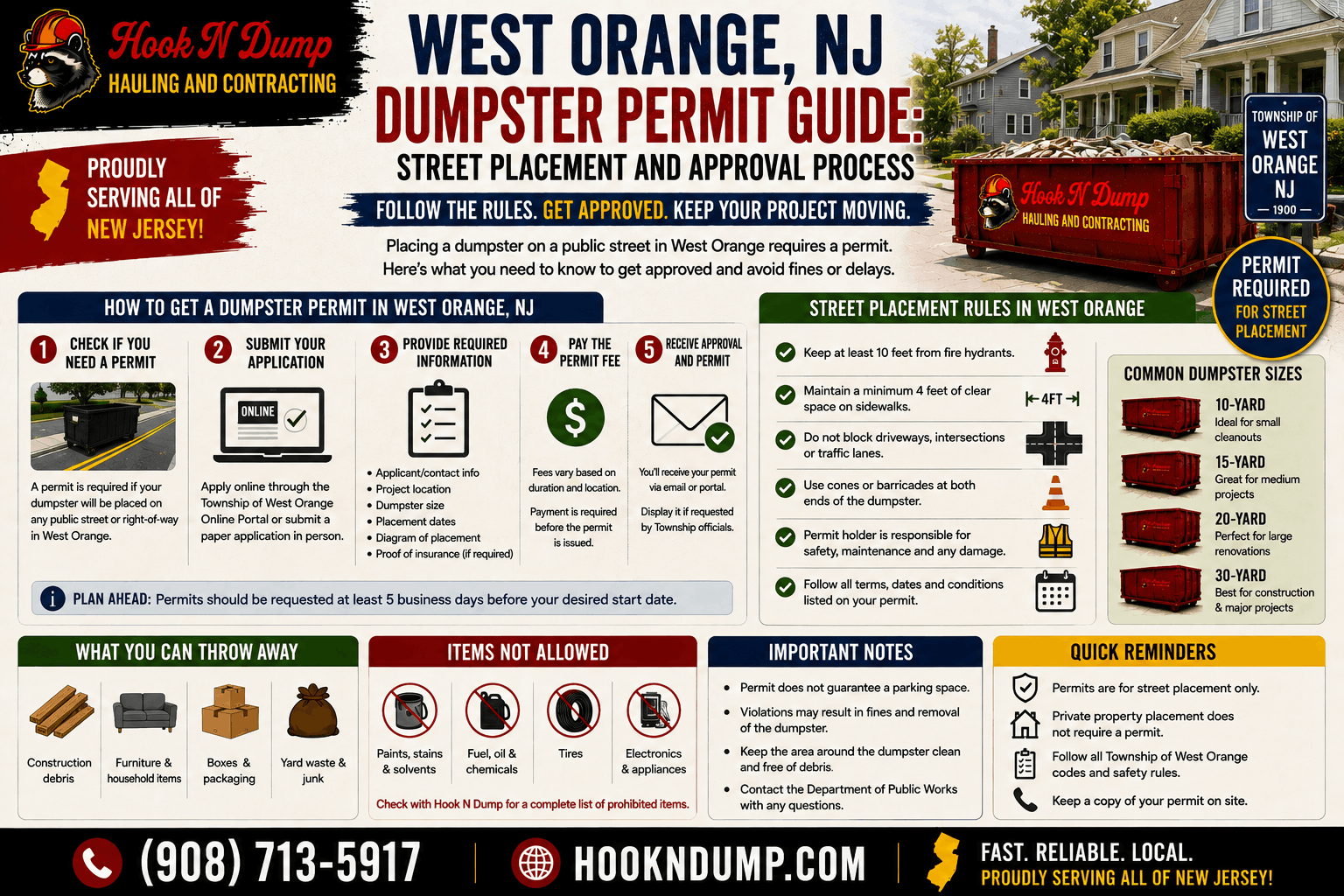
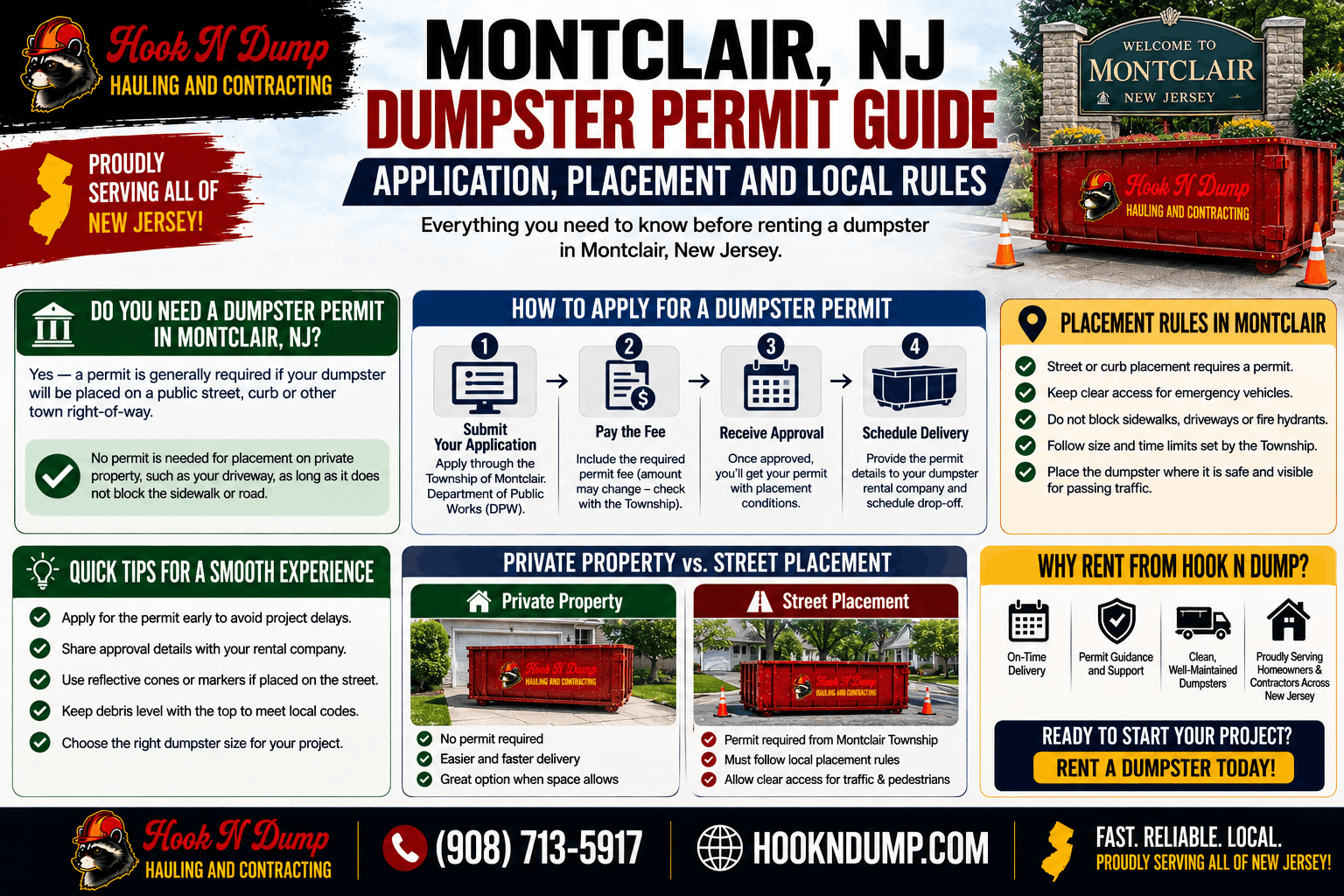
Hook N Dump states that a permit is usually not required for placement on private property, while placement on a street, sidewalk or another public area may require local approval.
Confirm:
- Municipal permit requirements
- Parking restrictions
- Traffic visibility
- Reflector or barricade rules
- Placement dates
- Snow or street-cleaning schedules
- Permit display requirements
- Container removal deadline
Do not schedule street delivery until the required approval is secured.
When to Choose Another Placement Area
Ask about a private parking area, job site or another approved surface when the driveway has:
- Active structural cracks
- Severe settlement
- Crumbling edges
- Fresh concrete
- Fresh asphalt
- Weak pavers
- A steep grade
- Soft subgrade
- Buried septic components
- Drainage structures
- Unsupported retaining walls
- Insufficient truck clearance
Hook N Dump delivers to driveways, private parking areas, properties and job sites when safe access is available.
Common Driveway-Protection Mistakes
Failing to request protection
Do not assume driveway protection is automatically added. Confirm it on the order.
Hiding existing damage
Report cracks, settlement and repairs so the driver can assess the location.
Using weak plywood
Use the rental company’s approved protection setup instead of thin scrap material.
Choosing the edge of the driveway
Edges may have less support than the central paved area.
Ignoring asphalt temperature
Warm or soft asphalt may be more vulnerable to concentrated, long-duration loading.
Placing on new concrete
New concrete is still gaining strength during curing. Get approval from the installer before scheduling a dumpster.
Loading one side heavily
Spread dense materials throughout the container.
Adding concrete or soil without approval
Dense debris may require a lower fill line or another container.
Allowing third-party dumping
Unexpected material can change the weight and load balance.
Blocking pickup access
The truck needs a clear route during both delivery and collection.
Final Driveway-Protection Checklist
Before ordering
- Identify the driveway material.
- Note its age and condition.
- Photograph existing damage.
- List heavy debris.
- Request driveway protection.
- Confirm the exact placement area.
- Ask about the assigned container and truck clearance.
Before delivery
- Move vehicles and trailers.
- Clear at least 10 feet of width.
- Clear at least 14 feet overhead.
- Mark septic, drainage and utility areas.
- Remove obstacles.
- Keep children and pets inside.
- Confirm that the protection option is on the order.
During the rental
- Spread weight evenly.
- Keep debris below the walls.
- Follow heavy-material limits.
- Keep hazardous liquids out.
- Prevent unauthorized dumping.
- Do not move the container.
- Keep the pickup route open.
Before pickup
- Remove parked vehicles.
- Close and secure the dumpster door.
- Remove overhanging debris.
- Unlock gates.
- Keep protection in place.
- Photograph the area.
- Tell Hook N Dump about any access changes.
FREQUENTLY ASKED QUESTIONS
How do I protect my driveway from a dumpster?
Request driveway protection, disclose the surface type and condition, select a firm level placement area, distribute debris evenly and keep the load within the approved weight and fill line.
Does Hook N Dump offer driveway protection?
Yes. Hook N Dump’s current dumpster product pages list driveway protection as an optional add-on for paved surfaces.
Can a dumpster crack a concrete driveway?
A dumpster can increase crack risk when concrete is weak, recently installed, poorly supported or already damaged. Approved boards or pads can distribute the load but cannot guarantee that a weak slab will not move.
Can a dumpster damage an asphalt driveway?
Asphalt can develop marks or indentations when it is soft, warm, recently installed or exposed to a heavy concentrated load for an extended period. Request protection and disclose the asphalt’s condition before delivery.
Should I put plywood under a dumpster?
Do not use ordinary plywood without approval. Ask the rental company to provide or approve rigid protection boards or pads suited to the container and driveway.
Can a dumpster be placed on pavers?
It may be possible, but pavers can shift, settle or crack. Send photographs and obtain approval from the rental company and, where needed, the paver installer.
Can a dumpster be placed on gravel?
It may be placed on firm, level and well-compacted gravel when truck access is safe. Soft, muddy or recently graded areas may rut or sink.
Can a dumpster go on a new driveway?
Do not place a dumpster on recently poured concrete or newly installed asphalt until the paving contractor confirms that the surface is ready for the truck and loaded container.
Does dumpster size affect driveway-damage risk?
Size matters, but final load weight, weight distribution, pavement condition, temperature, protection and placement duration are usually more relevant than cubic-yard capacity alone.
Do I need a permit if the dumpster goes in the street?
Local approval may be required when a dumpster is placed on a public street, sidewalk or right-of-way. Confirm municipal requirements before scheduling delivery.
Protect the Surface Before Delivery
The safest process is:
- Photograph the driveway.
- Report cracks and soft areas.
- Request Hook N Dump’s driveway-protection option.
- Confirm a stable placement location.
- Clear the truck route.
- Distribute debris evenly.
- Keep heavy materials within their assigned limits.
- Maintain clear access until pickup.
Hook N Dump currently offers 10, 15, 20, 30 and 40-yard dumpsters across New Jersey and lists driveway protection as an optional add-on on its product pages.
Call (973) 477-6805 and provide:
- Delivery address
- Driveway material
- Driveway age
- Existing cracks or repairs
- Project type
- Dumpster size
- Heavy debris
- Placement photographs
- Overhead clearance
- Preferred delivery and pickup dates
Need a Driveway-Safe Dumpster Placement?
Send Hook N Dump photos of your driveway and proposed placement area. The team will review access, recommend a container and confirm the driveway-protection option before delivery.