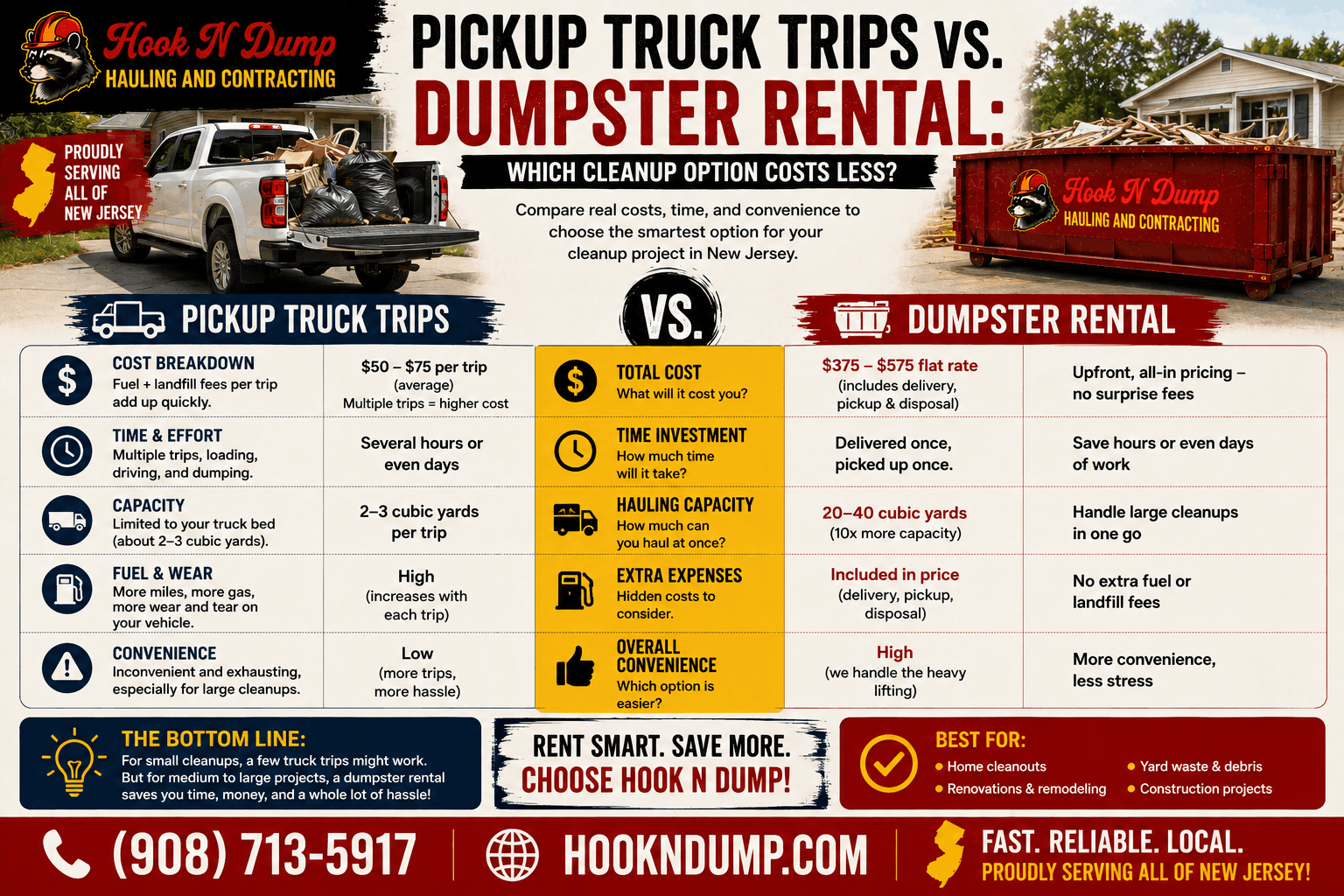
One pickup truck trip will often have a lower cash cost than renting a roll-off dumpster, especially when you already own the truck and are removing a small amount of approved material.
A dumpster rental becomes more competitive when the cleanup requires several truck trips, involves bulky furniture, produces debris over multiple days or requires you to rent a pickup or trailer.
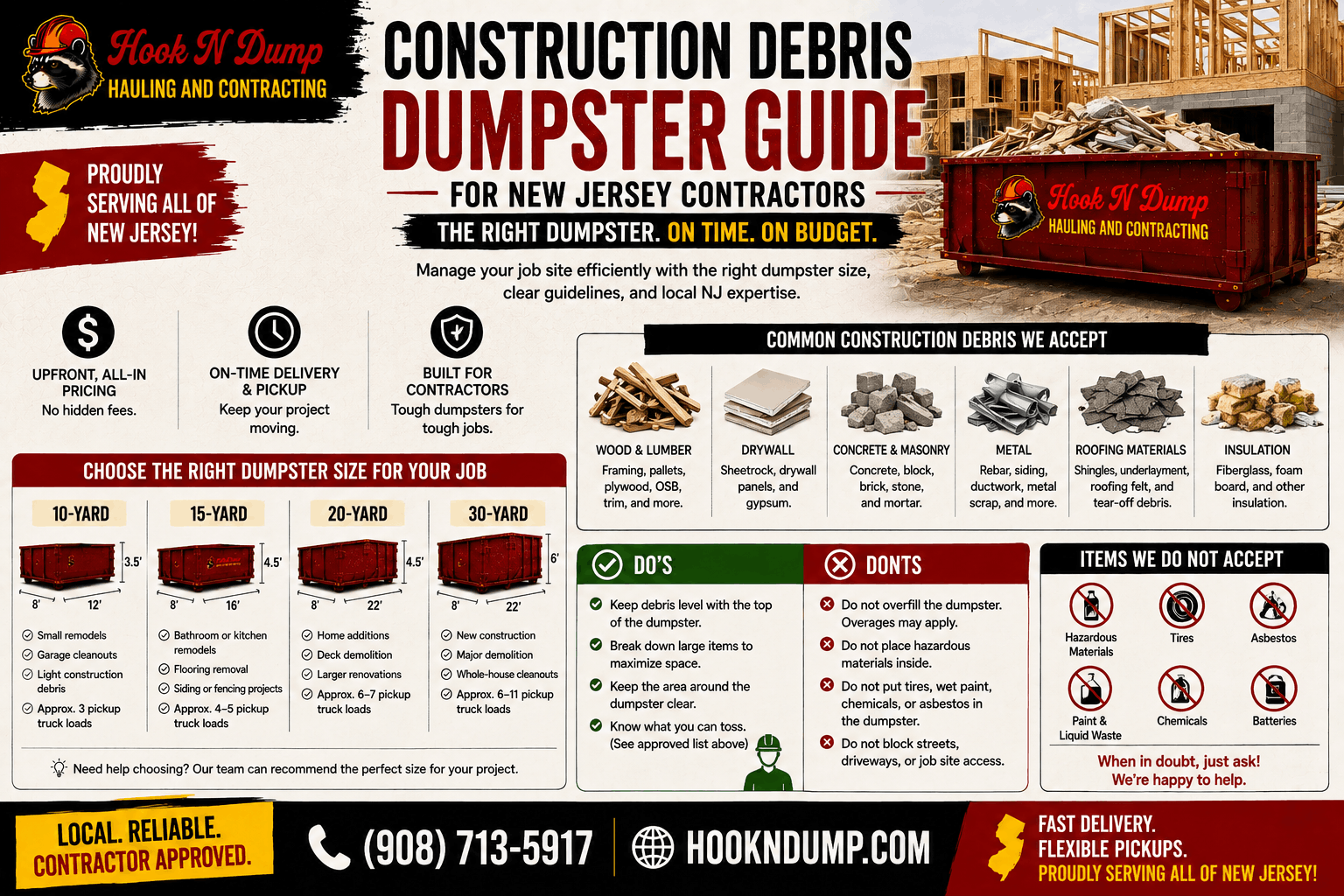
Hook N Dump states that its 10-yard dumpster holds approximately three pickup-truck loads. Its 15-yard dumpster holds around four to five pickup loads, while the 20-yard container holds around six. Actual pickup capacity varies by truck-bed size, payload rating, debris shape and loading method.
Quick answer: Self-hauling usually costs less for one small load. Two loads require a full cost comparison. At three or more loads, a 10 or 15-yard dumpster can become the better choice once disposal fees, fuel, vehicle costs, travel time and unloading work are counted.
Hook N Dump currently lists its 10-yard dumpster at $475 with 3,000 pounds included. The 15-yard option starts at $550 with 4,000 pounds included. Both currently have 3, 7 and 10-day rental selections, with additional days listed at $25 each.
Hook N Dump Dumpster Rental Prices in New Jersey
| Cost or Project Factor | Pickup Truck Trips | Roll-off Dumpster |
|---|---|---|
| Best for | One small load | Medium and large cleanups |
| Upfront payment | Often lower | Higher single price |
| Disposal fee | Paid per trip or load | Included weight is built into rental pricing |
| Fuel | Paid for each round trip | No customer disposal trips |
| Tolls | May apply on each trip | No customer disposal trips |
| Truck rental | May be required | Not required |
| Labor | Load and unload every trip | Load once |
| Travel time | Repeated driving and waiting | Delivery and pickup handled by rental company |
| Capacity | Limited by bed and payload | 10 to 40 cubic yards |
| Bulky furniture | Can require several trips | Better container space |
| Project timing | Must visit facility during operating hours | Load throughout rental period |
| Weight risk | Truck payload must not be exceeded | Included weight and overage terms apply |
| Load security | Customer must tie down and cover debris | Debris remains in a steel container |
| Vehicle cleanup | Truck bed may need cleaning | Container is removed from the property |
| Permit | Usually none for driving the load | May apply for street placement |
| Main cost risk | Underestimating the number of trips | Weight overage, added days or special items |
The cheapest method depends on the full project rather than the first advertised price.
What Counts as a Pickup Truck Trip?
A pickup trip means loading debris into a personal, borrowed or rented truck and taking it to a transfer station, recycling center, landfill or other facility that accepts the material.
The total work includes:
- Sorting the debris
- Loading the truck
- Securing the load
- Driving to the facility
- Waiting for entry or weighing
- Paying the disposal charge
- Unloading the truck
- Driving back
- Cleaning the truck bed
- Repeating the process when debris remains
A “quick dump run” can take much longer than the driving time shown by a navigation app.
Facility hours, public-access rules, material limits and minimum charges can differ. Call the intended facility before loading the truck.
What Does a Dumpster Rental Include?
A roll-off rental places a steel container at the property so approved debris can be loaded throughout the chosen rental period.
Hook N Dump currently provides five sizes:
| Dumpster Size | Starting Price | Included Weight | Approximate Pickup Loads |
|---|---|---|---|
| 10-yard | $475 | 3,000 lbs. | About 3 |
| 15-yard | $550 | 4,000 lbs. | About 4 to 5 |
| 20-yard | $625 | 5,000 lbs. | About 6 |
| 30-yard | $725 | 7,000 lbs. | About 9 |
| 40-yard | $875 | 9,000 lbs. | About 12 |
Hook N Dump publishes the prices and included weights on its current size page. Its product pages provide the approximate pickup-load comparisons.
The starting rental generally covers the container, delivery, collection and the listed debris-weight allowance under the company’s current terms. Address, material type, special items, added days and excess weight can affect the final price.
The Main Cost Difference
Pickup-truck hauling spreads the cost across several smaller transactions.
A dumpster combines much of the hauling and disposal work into one rental.
Pickup Truck Cost Formula
Use:
Disposal fees
+ Fuel
+ Tolls
+ Truck or trailer rental
+ Mileage charges
+ Tarp and tie-down supplies
+ Vehicle cleaning
+ Repairs or damage
+ Value of your time
= Total self-haul cost
Dumpster Rental Cost Formula
Use:
Quoted dumpster price
+ Weight overage
+ Additional days
+ Special-item charges
+ Permit cost when required
+ Failed-pickup or trip charges
= Total dumpster cost
Do not compare a dumpster quote only with one disposal receipt. Compare it with every trip needed to remove the same amount of debris.
One Pickup Truck Load vs. a Dumpster
Self-hauling will usually have the lower cash cost when all of these apply:
- Everything fits into one safe truck load.
- You already own or can borrow the truck.
- The facility accepts the material.
- The facility is reasonably close.
- The disposal charge is manageable.
- You can load and unload without hired help.
- No trailer rental is needed.
- You have straps and a tarp.
- You can complete the trip during facility hours.
- You do not place a high dollar value on your time.
A 10-yard dumpster would likely be larger than needed for one ordinary pickup load. Hook N Dump’s current 10-yard page equates that container to roughly three pickup-truck loads.
Projects that may fit one truck load
- Small closet cleanup
- Limited garage corner
- Several bags and boxes
- One dismantled furniture item
- Small amount of flooring
- Yard debris from light trimming
- Final debris after a larger cleanup
- Minor repair waste
The load still needs to remain within the truck’s payload rating and the facility’s rules.
Two Pickup Truck Loads vs. a Dumpster
Two loads create a closer decision.
Self-hauling may still cost less when:
- Disposal charges are low.
- The facility is nearby.
- The truck is already available.
- The debris is easy to unload.
- Both trips can be completed together.
- No trailer or helper is needed.
A dumpster may be better when:
- Each trip takes several hours.
- The facility has a long wait.
- The material is bulky or difficult to secure.
- You must rent the truck.
- The cleanup will continue for several days.
- More debris may be found after work starts.
- The truck must be cleaned after each trip.
- You cannot unload the items safely.
At two trips, use the worksheet later in this article rather than relying on a general rule.
Three Pickup Truck Loads vs. a 10-Yard Dumpster
Hook N Dump states that its 10-yard container holds about three pickup loads. The current starting price is $475 with 3,000 pounds included.
This creates a useful comparison:
| Factor | Three Pickup Trips | 10-yard Dumpster |
|---|---|---|
| Disposal journeys | 3 | 0 for customer |
| Loading | 3 truck loads | 1 container |
| Unloading | 3 times at facility | Handled after pickup |
| Fuel and tolls | Paid 3 times | Not paid by customer |
| Facility waiting | Up to 3 visits | None for customer |
| Physical capacity | Roughly comparable | 10 cubic yards |
| Current Hook N Dump price | Depends on trip costs | Starts at $475 |
| Included weight | Depends on truck and facility | 3,000 lbs. |
Four or Five Pickup Loads vs. a 15-Yard Dumpster
Hook N Dump states that its 15-yard container holds approximately four to five pickup loads. It currently starts at $550 with 4,000 pounds included.
A 15-yard dumpster often becomes the better operational choice when the cleanup includes:
- Full garage
- Attic
- Several rooms
- Medium basement
- Apartment move-out
- Flooring from several rooms
- Small renovation
- Furniture and boxes
- Garage plus household clutter
Making five dump trips means loading, securing, driving, waiting and unloading five separate times.
Even when self-hauling has a lower direct payment, the saved amount may be small after vehicle and time costs are counted.
Worked Cost Examples
The figures below are examples only. They are not Hook N Dump rates, transfer-station prices or current fuel prices.
Replace every amount with your own quote and local costs.
Example 1: One Pickup Load
Assume:
Disposal charge: $80
Fuel and tolls: $20
Tarp or supplies: $15
Truck rental: $0
Cash cost:
$80 + $20 + $15 = $115
Compared with a $475 starting price for a 10-yard Hook N Dump rental, the pickup trip costs less in this example.
This is the type of project where self-hauling often makes financial sense.
Example 2: Three Pickup Loads, Cash Expenses Only
Assume:
Disposal charge per trip: $80
Fuel and tolls per trip: $20
Tarp and supplies: $15
Truck rental: $0
Calculation:
Three disposal charges: 3 × $80 = $240
Three travel costs: 3 × $20 = $60
Supplies: $15
Total cash cost: $315
The pickup still costs less than the $475 dumpster starting price when personal time, vehicle use and cleanup are not assigned a dollar amount.
Example 3: Three Trips Including Time
Use the same cash expenses and assume each full trip takes three hours.
Cash expenses: $315
Total time: 9 hours
Assigned time value: $20 per hour
Time cost: 9 × $20 = $180
Total economic cost: $495
In this example, the 10-yard dumpster starting at $475 costs slightly less before any dumpster add-ons.
This example shows why two people can reach different answers for the same cleanup. One person counts only receipts. Another counts the day spent loading, driving and unloading.
Example 4: Rented Pickup Truck
Assume a project needs three loads:
Truck rental and mileage: $170
Disposal fees: $240
Fuel and tolls: $60
Supplies: $15
Total cash cost: $485
The self-haul price is now above the current $475 starting price for a 10-yard Hook N Dump dumpster.
Rental trucks can change the calculation quickly, particularly when mileage or extra-day charges apply.
Example 5: Five Pickup Loads
Assume:
Disposal fee per trip: $70
Fuel and tolls per trip: $18
Supplies: $20
Truck rental: $0
Calculation:
Disposal: 5 × $70 = $350
Travel: 5 × $18 = $90
Supplies: $20
Cash total: $460
Hook N Dump’s 15-yard dumpster currently starts at $550 and holds approximately four to five pickup loads.
Self-hauling is still $90 lower in direct cash expenses in this example. Once the time for five trips and vehicle use are counted, the dumpster may provide the lower total cost.
Cost per Trip Break-Even Formula
Use this formula:
Dumpster starting price ÷ Full cost per truck trip
= Approximate break-even number of trips
Example
Assume each self-haul trip costs $125 after disposal, travel and supplies:
$475 ÷ $125 = 3.8 trips
In that example:
- One to three trips may cost less than the dumpster.
- Four trips may cost about the same.
- Five or more trips may cost more.
The result changes when you add truck rental, time, tolls or a higher disposal charge.
Build Your Own Cost Worksheet
Pickup Truck Costs
| Expense | Amount | Number of Trips |
|---|---|---|
| Disposal fee per trip | $ | |
| Total disposal fees | $ | |
| Round-trip miles per trip | ||
| Fuel cost per trip | $ | |
| Tolls per trip | $ | |
| Truck rental | $ | |
| Trailer rental | $ | |
| Mileage charge | $ | |
| Tarp and straps | $ | |
| Helper or labor | $ | |
| Truck-bed cleaning | $ | |
| Other vehicle expenses | $ | |
| Total hours | ||
| Optional value of time | $ | |
| Total self-haul cost | $ |
Pickup Truck Costs
| Expense | Amount |
|---|---|
| Quoted rental | $ |
| Included weight | |
| Expected excess weight | |
| Overage charge | $ |
| Additional days | $ |
| Mattress or appliance fees | $ |
| Permit | $ |
| Other charges | $ |
| Total dumpster cost | $ |
Hidden Pickup Truck Costs
Disposal or Tipping Fees
A transfer station or disposal facility may charge by:
- Vehicle
- Load
- Weight
- Cubic yard
- Material type
- Minimum entry amount
“Tipping fee” is the term used for the price charged by a disposal facility to accept waste, commonly stated by ton or cubic yard.
Call first to confirm:
- Public access
- Accepted materials
- Minimum fee
- Payment method
- Proof-of-residency rules
- Hours
- Last entry time
- Weight procedures
- Unloading requirements
Fuel and Tolls
Every disposal run includes a loaded trip to the facility and an empty return trip.
A five-trip cleanup creates ten driving legs.
Heavy loads can also affect vehicle performance and fuel use. Use your truck’s actual fuel consumption rather than a general internet estimate.
Truck or Trailer Rental
A homeowner without a pickup may need:
- Daily truck rental
- Trailer rental
- Mileage fees
- Fuel replacement
- Insurance
- Deposit
- Added rental day
- Cleaning fee
A project that extends into a second day can make the self-haul price much higher than expected.
Time Spent Driving and Waiting
Count:
- Loading time
- Tie-down time
- Driving
- Facility queue
- Weighing
- Payment
- Unloading
- Return trip
- Truck cleaning
Time has no universal price. The correct amount is what the lost hours are worth to you.
Vehicle Wear or Damage
Cleanup debris can cause:
- Scratched truck beds
- Torn liners
- Punctured tires
- Suspension stress
- Damaged tailgates
- Broken lights
- Interior dirt
- Paint damage
- Odors
Large construction debris may be particularly difficult to carry without a trailer or dedicated work truck.
Loading the Debris Twice
With self-hauling, you load the material at home and unload it again at the facility.
With a roll-off dumpster, you load the container once. Hook N Dump then collects the container and handles the transport.
This matters for:
- Furniture
- Roofing shingles
- Tile
- Drywall
- Lumber
- Wet yard debris
- Heavy bags
- Renovation waste
Hidden Dumpster Rental Costs
Weight Overage
Hook N Dump’s current standard prices include set weight allowances:
- 10 yards: 3,000 pounds
- 15 yards: 4,000 pounds
- 20 yards: 5,000 pounds
- 30 yards: 7,000 pounds
- 40 yards: 9,000 pounds
Added weight charges may apply when the final scale weight exceeds the allowance. Confirm the per-ton or per-pound rate in writing.
Additional Rental Days
Hook N Dump currently lists extra time at $25 per day after the selected rental term.
Schedule the container for the period when workers or family members will actually be available.
Special Items
Added handling may apply to items such as:
- Mattresses
- Box springs
- Tires
- Televisions
- Monitors
- Refrigerators
- Freezers
- Air conditioners
- Dehumidifiers
Ask for every item-specific charge before delivery.
Heavy Debris
Concrete, brick, dirt and asphalt may require:
- Advance approval
- A dedicated load
- A lower fill line
- Material-based pricing
- Another container size
- Separation from household junk
Do not select a large dumpster simply to carry more dense debris.
Permit Cost
A dumpster on a private driveway usually has fewer permit concerns than a container placed on a street or other public area.
Street-placement rules differ by municipality. Confirm them before delivery.
Failed Pickup
A dumpster may not be collected when:
- Debris extends above the walls.
- The load is too heavy.
- The rear door is unsecured.
- A vehicle blocks access.
- A gate is locked.
- Overhead access is obstructed.
- The container contains prohibited materials.
Review any trip or failed-service charge in the rental terms.
Which Option Is Better for a Garage Cleanout?
Choose Pickup Truck Trips When:
- Only one section is being cleared.
- The debris fits in one load.
- Furniture is limited.
- The disposal site is close.
- You already own the truck.
- The material is easy to unload.
Choose a Dumpster When:
- The full garage is packed.
- Shelving and cabinets are being removed.
- A workbench is included.
- Outdoor furniture is included.
- The attic or basement is also being cleared.
- More than two trips are expected.
- Sorting will take several days.
Hook N Dump lists small garage cleanouts for its 10-yard dumpster and garage or attic cleanouts for its 15-yard option.
Which Option Is Better for a Basement or Attic?
A pickup may work for:
- Boxes
- Clothing
- Small household items
- One limited storage area
- Final debris after donation pickups
A dumpster is usually better for:
- Large furniture
- Shelving
- Exercise equipment
- Cabinets
- Years of stored belongings
- Several rooms
- Basement and attic combined
- Debris removed over several days
The physical labor is also different. Pickup hauling requires carrying material from the home, lifting it into the truck and unloading it at the facility.
Which Option Is Better for Furniture?
A pickup truck may be enough for:
- One dismantled table
- Several chairs
- One small dresser
- A limited number of furniture pieces
A dumpster is usually better for:
- Sofas
- Sectional furniture
- Several beds
- Cabinets
- Bookcases
- Dining-room sets
- Outdoor furniture
- Furniture from multiple rooms
Irregular furniture shapes create unused space in a truck bed. They can also be difficult to secure for road travel.
Which Option Is Better for a Home Cleanout?
Pickup Truck
Self-hauling may work for:
- One room
- Final move-out cleanup
- Small apartment purge
- Several boxes and bags
- A partly cleared property
Dumpster Rental
A dumpster is usually better for:
- Several rooms
- Full small house
- Garage and basement
- Fully furnished property
- Move-out with furniture
- Rental-property turnover
- Estate cleanout
Hook N Dump currently lists full-house cleanouts for its 20-yard container and estate cleanouts for its 30-yard option.
Which Option Is Better for Renovation Debris?
Pickup Truck May Work For:
- Small flooring project
- One vanity
- Limited cabinets
- Minor drywall repair
- Short fence section
- Small quantity of lumber
Dumpster Rental Is Better For:
- Full kitchen
- Bathroom demolition
- Several rooms of flooring
- Deck removal
- Roofing
- Drywall and framing
- Siding
- Contractor work over several days
A roll-off keeps debris at the worksite instead of requiring a disposal trip whenever the truck becomes full.
Which Option Is Better for Yard Debris?
Pickup hauling may work for:
- Bagged leaves
- Small branches
- Light garden cleanup
- One short trimming project
A dumpster may work better for:
- Large branch volume
- Several landscaping areas
- Fence or shed debris
- Storm cleanup
- Yard work combined with household junk
Confirm whether the intended disposal facility accepts the exact yard material.
Soil, stone, concrete and large stumps should not be treated as ordinary light yard waste.
Pickup Payload and Safety
Pickup capacity is limited by both bed volume and payload rating.
NHTSA states that vehicles carry a manufacturer-assigned gross vehicle weight rating and gross axle weight ratings, normally displayed on the driver-side door or door jamb. The fully loaded vehicle should stay within those ratings.
Before loading:
- Check the door-jamb label.
- Review the owner’s manual.
- Count passengers, tools and trailer tongue weight.
- Keep material below the safe payload.
- Spread weight between the axles.
- Check tire pressure.
- Avoid loading all weight behind the rear axle.
- Do not guess the weight of concrete, soil or shingles.
A truck bed can run out of legal payload before it runs out of physical space.
Secure the Load Before Driving
New Jersey law requires certain scattering materials extending above a vehicle’s sides, tailgate or rear to be securely covered. The state also points to cargo-security rules intended to prevent material from spilling, blowing, falling or shifting enough to affect vehicle control.
Use:
- Rated ratchet straps
- Cargo net
- Suitable tarp
- Tailgate
- Edge protection
- Flags for approved projecting items where required
Do not rely on:
- Loose rope
- Debris weight alone
- One strap across an unstable pile
- A tarp without tie-down points
- An open tailgate for unsecured waste
Stop and check the load after the first few miles.
Can New Jersey Homeowners Haul Their Own Waste?
NJDEP provides a homeowner-vehicle exemption from waste-transporter registration when the stated conditions are met, including transporting waste generated from the person’s own home in a qualifying vehicle. The exemption does not create permission to collect waste from other people or operate an unlicensed hauling service.
This distinction matters:
- A homeowner hauling waste from their own residence may qualify.
- A contractor carrying customer debris should not rely on the homeowner exemption.
- A person collecting a neighbor’s waste may fall outside the exemption.
- Facility-access and disposal rules still apply.
Companies transporting third-party waste in New Jersey generally need state registration, vehicle decals and applicable licensing.
When Self-Hauling Costs Less
Pickup trips are likely to cost less when:
- Everything fits in one load.
- The truck is already owned or borrowed.
- The disposal facility is nearby.
- There are no tolls.
- Disposal charges are low.
- No helper is needed.
- The material is light.
- The cleanup can be completed in one morning.
- The truck can be loaded and unloaded safely.
- No vehicle damage occurs.
- Your time is not counted as a project cost.
The strongest self-haul case is a small, clearly measured pile.
When a Dumpster Rental Costs Less
A dumpster is more likely to cost less overall when:
- Three or more pickup trips are needed.
- A truck or trailer must be rented.
- The facility is far away.
- Each visit includes a minimum disposal charge.
- The cleanup produces debris over several days.
- Furniture or bulky construction material is involved.
- Several workers need a shared container.
- Time away from work has a real cost.
- A second truck-rental day may be needed.
- The job cannot pause for repeated disposal runs.
- Vehicle damage is a concern.
The strongest dumpster case is a project with several rooms, several pickup loads or ongoing renovation waste.
When Junk Removal May Be Better Than Both
Full-service junk removal may be the better choice when:
- You only have a few bulky items.
- You do not own a truck.
- You cannot perform heavy lifting.
- Items must be carried upstairs or out of a basement.
- The cleanup must be completed quickly.
- There is no space for a dumpster.
- You do not want to visit a disposal facility.
Hook N Dump provides junk removal as well as dumpster rental, allowing customers to compare self-loading with crew-assisted removal.
Ways to Lower Pickup-Truck Costs
- Confirm facility fees before traveling.
- Sort recyclable materials where accepted.
- Break down furniture.
- Flatten cardboard.
- Cut long approved material into safe lengths.
- Combine errands only when the loaded vehicle remains secure.
- Avoid arriving near closing time.
- Use the correct truck rather than overloading a small vehicle.
- Bring approved payment and identification.
- Secure the load properly the first time.
Do not reduce the number of trips by exceeding the truck’s payload or stacking unsafe debris.
Ways to Lower Dumpster Costs
- Choose the correct container size.
- List every material before ordering.
- Break down furniture and cabinets.
- Load flat material first.
- Fill gaps with smaller approved debris.
- Keep dense material separate where required.
- Stay below the included weight.
- Avoid unauthorized dumping.
- Keep prohibited items out.
- Request pickup when work is finished.
- Keep the truck-access route clear.
- Confirm all fees in writing.
A container that is too small can lead to another rental. A container that is much too large can mean paying for unused space.
Decision Guide by Number of Pickup Loads
| Estimated Pickup Loads | Likely Starting Choice |
|---|---|
| Less than 1 | Municipal service, junk removal or one self-haul trip |
| 1 | Pickup truck often costs less |
| 2 | Compare complete costs |
| 3 | Compare with a 10-yard dumpster |
| 4 to 5 | Compare with a 15-yard dumpster |
| Around 6 | Compare with a 20-yard dumpster |
| Around 9 | Compare with a 30-yard dumpster |
| Around 12 | Compare with a 40-yard dumpster |
Final Decision Checklist
Choose pickup truck trips when:
- The debris fits in one safe load.
- You already have a truck.
- The disposal facility accepts the material.
- The facility is close.
- Disposal charges are reasonable.
- You can unload the material.
- The load stays within the truck’s payload.
- You can secure and cover the debris.
- Facility hours fit your schedule.
- You are comfortable doing the driving and unloading.
Choose a roll-off dumpster when:
- Three or more pickup loads are expected.
- Bulky furniture is included.
- Several rooms are being cleared.
- Renovation debris will build up over several days.
- A truck must be rented.
- The facility is far away.
- Multiple workers need one waste container.
- A second truck-rental day may be needed.
- You want to avoid repeated unloading.
- The property has a suitable placement area.
FREQUENTLY ASKED QUESTIONS
Is it cheaper to make dump runs or rent a dumpster?
One pickup load will often cost less than a dumpster rental. A dumpster can cost less overall when three or more trips are needed and disposal fees, fuel, travel, unloading and vehicle use are counted.
How many pickup loads fit in a 10-yard dumpster?
Hook N Dump states that its 10-yard dumpster holds approximately three pickup-truck loads, depending on the truck and loading method.
How many pickup loads fit in a 15-yard dumpster?
Hook N Dump estimates around four to five pickup-truck loads for its 15-yard container.
How much does a 10-yard dumpster cost?
Hook N Dump currently lists the 10-yard dumpster starting at $475 with 3,000 pounds included.
How much does a 15-yard dumpster cost?
Hook N Dump currently lists the 15-yard dumpster starting at $550 with 4,000 pounds included.
What costs should I include when calculating dump runs?
Include disposal fees, fuel, tolls, truck rental, mileage, tie-down supplies, vehicle cleaning, labor, possible repairs and the time spent loading, driving, waiting and unloading.
Does a transfer station charge for every trip?
Fee structures differ by facility. A site may charge by vehicle, weight, cubic yard, material or a minimum entry amount. Confirm the policy before traveling.
Can I haul household junk in my pickup in New Jersey?
A homeowner may qualify for NJDEP’s registration exemption when transporting waste from their own residence and meeting the vehicle and use conditions. The exemption does not cover operating a hauling service for other people.
Do I need to cover debris in my pickup?
Loads that can scatter or extend beyond the truck body may need to be covered and secured under New Jersey rules. All debris should be tied down so it cannot fall, blow out or shift during travel.
Can I fill my pickup truck to the top with concrete?
Do not load based only on bed space. Concrete can exceed the truck’s payload rating quickly. Check the door-jamb ratings and owner’s manual before loading dense material.
Which option is better for furniture?
A pickup may work for one or two dismantled pieces. A roll-off dumpster is usually better for several sofas, beds, cabinets, tables or furniture from multiple rooms.
Which option is better for a garage cleanout?
One pickup may work for a small section. A 10 or 15-yard dumpster is usually better for a full or heavily packed garage.
Which option is better for a renovation?
A pickup may work for a minor repair. A dumpster is usually better for a kitchen, bathroom, flooring, roofing, deck or multi-room renovation that produces debris over several days.
Is my time part of the cost comparison?
It depends on how you judge the project. Count time when the disposal runs replace work, family plans or paid labor. Leave it out when you only care about direct cash payments.
Does a dumpster include disposal?
Hook N Dump’s published rental prices include a stated debris-weight allowance. Added charges can apply for excess weight, extra days, restricted materials or special items.
Is junk removal better than pickup trips or a dumpster?
Junk removal can be better for a few heavy items or when you need a crew to perform the lifting. A dumpster is generally better for a larger project that you can load yourself over several days.
Choose the Lower-Cost Cleanup Method
Use this starting rule:
- One pickup load: Self-hauling usually has the lower cash cost.
- Two loads: Calculate both options.
- Three loads: Compare directly with a 10-yard dumpster.
- Four or five loads: Compare with a 15-yard dumpster.
- Six or more loads: A larger roll-off is usually the more practical choice.
Hook N Dump currently provides 10, 15, 20, 30 and 40-yard containers with published starting prices from $475 to $875 and included weight allowances from 3,000 to 9,000 pounds.
Call (973) 477-6805 or request a quote online. Provide:
- Delivery address
- Project type
- Estimated pickup-load count
- Debris list
- Heavy materials
- Furniture count
- Project photographs
- Preferred rental period
- Placement location
Reviewed by Hook N Dump
Prices, weight allowances, transfer-station fees, facility access and material rules may change. Confirm current costs before choosing either method.
Tired of Making Repeated Dump Runs?
Send Hook N Dump photos of your debris and the estimated number of pickup loads. The team will recommend a container and provide a current quote for comparison.