
Loading a roll-off dumpster may look simple, but throwing everything inside without a plan can waste container space, create an uneven load, block the rear door or push the debris above the permitted fill line.
A better approach is to sort the materials first, place flat and heavy items near the bottom, break down bulky objects, fill empty gaps with smaller debris and keep the final load level across the container.
Weight also matters. A dumpster can look only partly full and still exceed its included allowance when it contains concrete, dirt, brick, roofing shingles, tile, plaster or other dense debris.
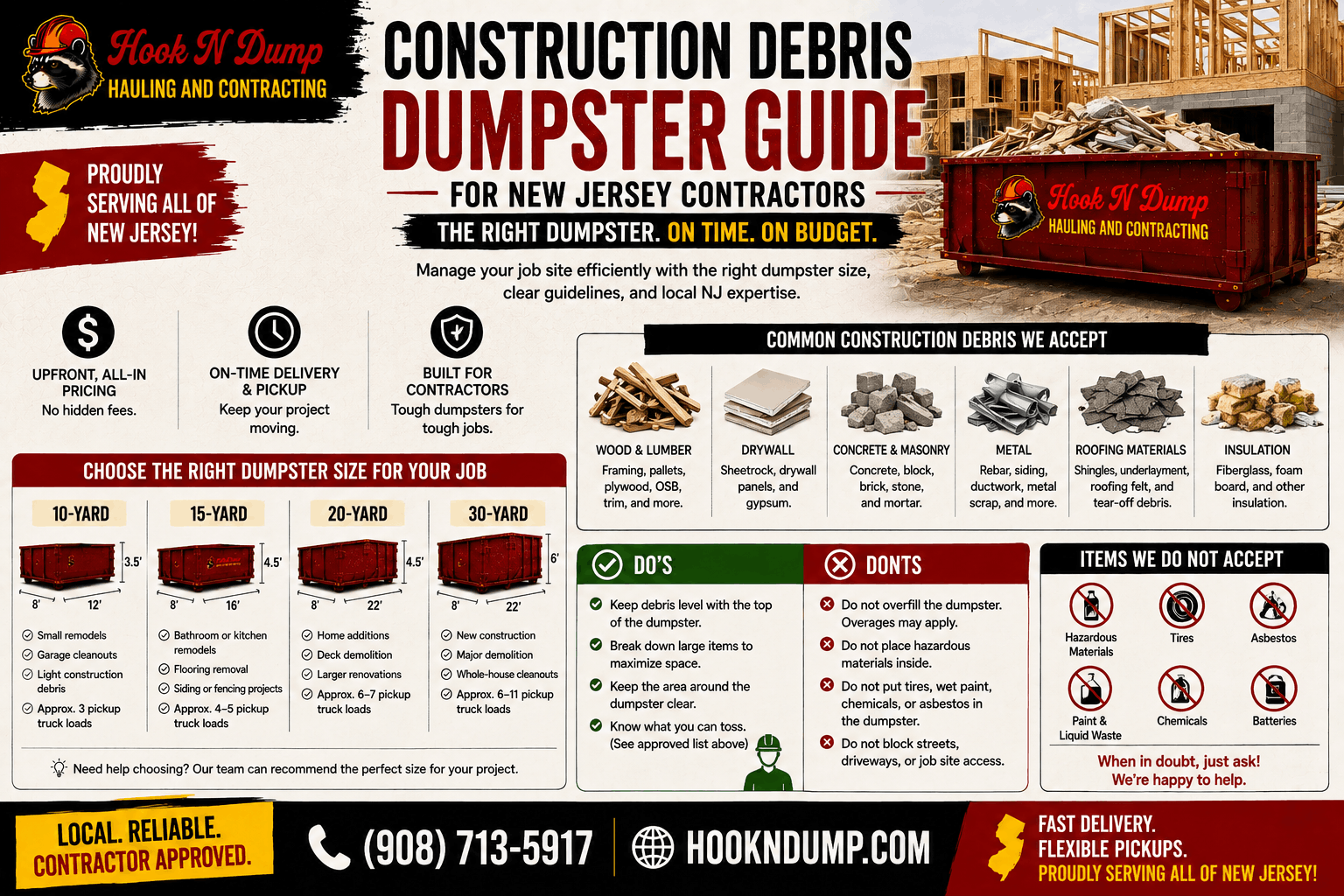
Hook N Dump currently offers 10, 15, 20, 30 and 40-yard dumpsters with included weight allowances ranging from 3,000 to 9,000 pounds. The company permits many forms of household junk and construction debris but restricts hazardous materials and may charge separately for certain items.
Quick answer: Start with flat material, distribute dense debris evenly, place bulky items in the middle, fill gaps with smaller approved waste and keep everything below the top edge. Never hide restricted items, stack debris above the walls or fill a large container with concrete or soil without approval.
Roll-Off Dumpster Loading Checklist
Use this sequence:
- Confirm what materials are accepted.
- Separate restricted and added-fee items.
- Choose the correct dumpster size.
- Clear the truck and container access area.
- Open the rear door where available.
- Load flat material first.
- Spread dense debris evenly.
- Break down furniture and large objects.
- Fill gaps with smaller approved debris.
- Keep all material below the container walls.
- Check the rear door before pickup.
- Remove vehicles and other pickup obstructions.
Hook N Dump asks customers to provide at least 10 feet of clear width and 14 feet of overhead clearance. Its dumpsters are approximately 12 to 16 feet long, depending on the container.
Why the Way You Load a Dumpster Matters
A planned load can help you:
- Use more of the container’s available volume
- Prevent large empty gaps
- Keep the load balanced
- Keep debris below the top edge
- Avoid blocking the rear door
- Reduce the chance of needing another dumpster
- Separate heavy material correctly
- Keep restricted items out
- Prepare the container for pickup
- Reduce the risk of added disposal charges
Poor loading can lead to:
- An overfilled container
- An overweight load
- Debris extending outside the walls
- Unsafe weight distribution
- A blocked rear door
- A delayed pickup
- A request to remove material
- Another rental or haul
- Added disposal or service charges
Hook N Dump’s current website says customers should load approved debris during the rental period and confirms that heavy materials and certain special items may receive added fees.
Understand Volume and Weight Before Loading
Dumpster size and dumpster weight are different measurements.
Volume
Container size is measured in cubic yards.
Hook N Dump offers:
- 10 cubic yards
- 15 cubic yards
- 20 cubic yards
- 30 cubic yards
- 40 cubic yards
A larger cubic-yard number means more physical space.
Weight
The rental also includes a debris-weight allowance.
Dumpster size | Included weight | Equivalent tonnage |
10-yard | 3,000 lbs. | 1.5 tons |
15-yard | 4,000 lbs. | 2 tons |
20-yard | 5,000 lbs. | 2.5 tons |
30-yard | 7,000 lbs. | 3.5 tons |
40-yard | 9,000 lbs. | 4.5 tons |
These are Hook N Dump’s currently published standard allowances.
A 40-yard dumpster provides more space than a 10-yard container, but that does not mean it can be filled to the top with concrete, dirt or brick.
Dense debris may reach a hauling or billing limit while much of the container still appears empty.
Step 1: Confirm What Can Go in the Dumpster
Do not begin loading until you know which materials are approved.
Hook N Dump currently lists these as commonly accepted:
- Household junk
- Furniture
- Appliances, subject to restrictions
- Construction debris
- Flooring
- Roofing shingles
- Doors
- Windows
- Wood
- Drywall
- Yard waste
- General cleanup debris
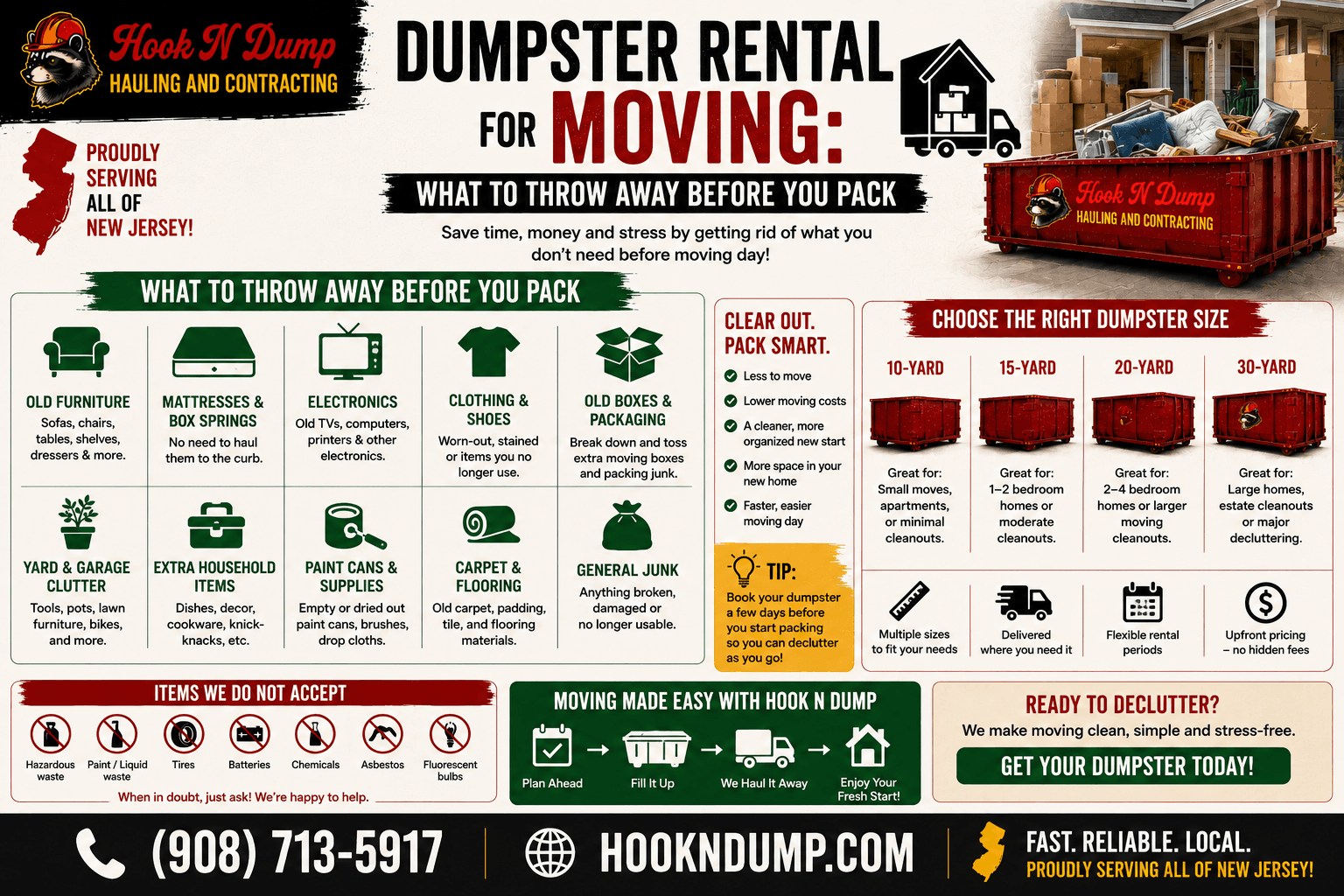
The company lists hazardous waste, chemicals, paint, solvents, asbestos, medical waste, flammable liquids, propane tanks and certain electronics as prohibited or restricted.
Hook N Dump also says these items may require separate disposal fees:
- Mattresses
- Box springs
- Tires
- Televisions
- Monitors
- Appliances containing refrigerant
- Certain heavy materials
Create Three Material Groups
Before the dumpster arrives, divide your debris into:
Approved standard material
Examples:
- Furniture
- Cardboard
- Household clutter
- Wood
- Drywall
- Flooring
- Approved construction waste
Items requiring approval or added fees
Examples:
- Mattresses
- Tires
- Televisions
- Refrigerators
- Air conditioners
- Heavy tile
- Concrete
- Dirt
- Brick
Prohibited or separately managed material
Examples:
- Liquid paint
- Solvents
- Fuel
- Chemicals
- Propane cylinders
- Asbestos
- Medical waste
- Flammable liquids
Keeping these groups separate prevents someone from accidentally placing a restricted item beneath ordinary debris.
Step 2: Choose the Right Dumpster Size
Efficient loading cannot fix a container that is too small for the project.
Hook N Dump currently recommends its sizes for these types of work:
Size | Common project types |
10-yard | Small cleanouts, yard debris and minor room updates |
15-yard | Garage and attic cleanouts, small renovations and flooring |
20-yard | Full-house cleanouts, remodeling and deck or patio removal |
30-yard | Estate cleanouts, construction and large home additions |
40-yard | Major construction, demolition and very large estate cleanouts |
Move up one size when:
- The smaller option would be nearly full
- Several rooms or storage areas are included
- The project contains bulky furniture
- You cannot see all the debris before starting
- Renovation work may uncover more material
- A garage, basement or attic is also being cleared
Do not move up to a large dumpster simply because the project contains dense debris. Heavy material requires a weight-based recommendation rather than extra volume.
Step 3: Prepare the Placement and Loading Area
A clear area makes loading and pickup easier.
Hook N Dump advises customers to provide:
- At least 10 feet of clear width
- At least 14 feet of overhead clearance
- A route free from overhead obstructions
- Enough length for a container measuring roughly 12 to 16 feet
Before delivery:
- Move vehicles
- Unlock gates
- Remove temporary fencing
- Check tree branches
- Check utility wires
- Move basketball hoops
- Clear snow and ice
- Mark weak pavement
- Protect access to the rear door
- Keep the sidewalk and street clear
- Confirm municipal approval where required
Do not store tools, bags or loose debris around the outside of the container. The driver will need access when retrieving it.
Step 4: Plan the Loading Order
Do not start with the easiest items simply because they are closest.
A better loading order is:
- Flat material
- Dense material approved for the load
- Large furniture and bulky objects
- Medium-size debris
- Bags and small items
- Final gap-filling material
This order helps create a stable base and reduces empty space.
Make a Rough Inventory
List:
- Doors
- Cabinets
- Furniture
- Mattresses
- Boxes
- Bags
- Flooring
- Drywall
- Lumber
- Roofing debris
- Tile
- Appliances
- Yard waste
- Heavy debris
Estimate how much space each group will use before loading begins.
Step 5: Use the Rear Door When Available
Many roll-off dumpsters include a rear swinging door.
When Hook N Dump permits customer use of the door, it can make loading easier because you can walk larger objects into the container rather than lifting them over the side wall.
The door may help with:
- Sofas
- Tables
- Cabinets
- Large boxes
- Rolled carpet
- Doors
- Lumber
- Heavy bags
- Renovation debris
Rear-Door Safety Rules
- Open the door only on level ground.
- Secure it in the open position.
- Keep hands clear of hinges and latches.
- Do not stand behind an unsecured door.
- Do not allow children near the container.
- Do not climb beneath material.
- Close and secure the door after loading.
- Keep debris away from the latch area.
Ask Hook N Dump how the assigned container door should be opened, secured and closed.
Step 6: Load Flat Materials First
Flat items make a useful base and can be placed along the floor or walls.
Examples include:
- Flattened cardboard
- Doors
- Plywood
- Shelving panels
- Bed-frame pieces
- Cabinet sides
- Flat lumber
- Rolled or folded carpet
- Fence panels
- Drywall pieces
Place long items lengthwise where possible.
Avoid laying a large flat panel across uneven debris near the top. It can hide open gaps beneath it and create a false platform that encourages overloading.
Break Down Cardboard
Flatten every box.
Unflattened boxes contain mostly air and can consume space that should hold debris. Remove packing material before flattening boxes unless both are approved for the same load.
Step 7: Place Heavy Material Low and Spread It Evenly
Dense debris should be placed near the bottom and distributed across the container floor.
Do not place all the weight:
- At the rear
- At the front
- Against one wall
- In one tall pile
- On top of furniture
- Above lighter unstable material
Dense debris may include:
- Roofing shingles
- Tile
- Mortar
- Plaster
- Stone
- Brick
- Concrete
- Dirt
- Asphalt
Concrete, brick, soil and similar materials may require another container type, a dedicated load or a lower fill line. Hook N Dump asks customers to call before loading heavy materials.
Why Even Distribution Matters
Even loading helps:
- Keep the container stable
- Prevent one side from becoming overloaded
- Reduce movement during lifting
- Keep debris from shifting into the rear door
- Make the load easier to haul
Do not use furniture or cardboard to hide a heavy pile underneath.
Step 8: Break Down Bulky Furniture
Furniture can consume container space quickly because irregular shapes create gaps.
Break down items when it can be done safely.
Sofas and Chairs
Where practical:
- Remove detachable cushions
- Remove legs
- Separate sectional pieces
- Fold sleeper mechanisms only when safe
- Place smaller approved items in open frame spaces
Do not cut upholstery when you do not know what the furniture contains.
Tables
- Remove legs
- Separate leaves
- Place tabletops flat
- Stack compatible sections
Cabinets and Shelving
- Remove drawers
- Remove shelves
- Take apart frames
- Flatten panels
- Keep nails and screws from protruding
Bed Frames
- Separate rails
- Remove slats
- Stack flat pieces
- Keep metal sections below the top edge
Mattresses and box springs should be declared before loading because Hook N Dump says added disposal fees may apply.
Step 9: Fill Gaps With Smaller Approved Debris
After the large items are in place, use smaller approved material to fill open spaces.
Suitable gap fillers may include:
- Bagged household junk
- Small cardboard pieces
- Clothing
- Small wood pieces
- Light packaging
- Small renovation debris
- Approved yard waste
- Small nonhazardous household items
Place small material:
- Between furniture
- Inside empty cabinet frames
- Between boxed items
- Along unused wall space
- Around flat objects
Do not use restricted materials as gap fillers. A television, paint can, battery or propane tank must not be hidden inside furniture or beneath bags.
Step 10: Keep the Load Level
A balanced final load should be reasonably level from front to back and side to side.
Avoid creating:
- One large mound
- A tall pile at the rear
- A slope pressing on the door
- Heavy material along one side only
- Loose objects resting above the walls
A level load is easier to inspect and less likely to shift during pickup.
If one area is much higher than another, rearrange only when it can be done from outside or from a safe walking path before unstable piles form.
Never climb onto loose debris.
Step 11: Keep Everything Below the Top Edge
All material should remain inside the dumpster and below the top of the side walls.
Hook N Dump’s own disposal guidance tells customers to keep debris below the container’s top edge.
Do not:
- Stack furniture above the walls
- Allow lumber to extend from the container
- Tie bags to the exterior
- Build temporary wooden side extensions
- Balance mattresses across the top
- Place loose brush above the edge
- Leave debris hanging over the rear door
An overfilled container may be unsafe to transport. Pickup may be delayed until the excess material is removed.
The Walls Are Not the Weight Limit
Keeping debris below the walls does not guarantee the load is within its weight allowance.
Dense material may require a much lower fill line. Follow Hook N Dump’s material-specific instructions.
Step 12: Protect the Rear Door and Hardware
Keep debris away from:
- Door hinges
- Latches
- Rollers
- Hooks
- Exterior rails
- Pickup hardware
The door must close and latch before transport.
Before pickup:
- Confirm the door can close.
- Remove debris from the threshold.
- Check for objects sticking through gaps.
- Make sure the latch area is clear.
- Ask Hook N Dump for help when the door cannot be secured.
Do not force a blocked door closed against heavy material.
How to Load Household Junk
Household junk is usually more likely to fill the dumpster by volume than by weight.
Examples include:
- Boxes
- Toys
- Clothing
- Furniture
- Books
- Household decorations
- Small non-electronic items
- Plastic storage containers
Best Loading Order
- Flatten cardboard.
- Place dismantled furniture sections along the floor or walls.
- Add large furniture.
- Place medium items around it.
- Fill gaps with bags and small approved items.
- Keep mattresses or special items visible and declared.
- Leave restricted materials outside.
Hook N Dump permits household junk and furniture in standard loads while listing several electronic, refrigerant and hazardous items as restricted or added-fee materials.
How to Load Furniture
Furniture creates unused air pockets when placed randomly.
Use these methods:
- Put flat tabletops against the side walls.
- Place dismantled cabinets flat.
- Remove chair legs where possible.
- Stack compatible chair frames.
- Fill empty furniture cavities with small approved items.
- Keep glass panels separate and protected.
- Place large stable pieces before small bags.
- Keep everything beneath the walls.
Do not attempt to crush furniture with equipment unless Hook N Dump has approved the method and trained operators are handling the work.
How to Load Construction Debris
Construction debris may contain both bulky and dense material.
Common materials include:
- Wood
- Drywall
- Cabinets
- Flooring
- Roofing shingles
- Doors
- Windows
- Tile
- Plaster
- Packaging
Hook N Dump accepts many common construction materials but restricts hazardous waste and may apply separate terms to heavy debris.
Recommended Order
- Place flat wood, doors and panels along the bottom.
- Spread approved dense debris evenly.
- Add cabinets and fixtures after dismantling.
- Place drywall and lumber lengthwise.
- Fill openings with smaller approved waste.
- Keep sharp objects inside the walls.
- Stop at the assigned fill line.
Older building materials may contain asbestos, lead-related waste or other regulated substances. Do not load suspected hazardous material until it has been assessed and approved for disposal.
How to Load Roofing Shingles
Roofing shingles are dense and can create a weight overage before the dumpster is physically full.
Before loading, tell Hook N Dump:
- Approximate roof square count
- Number of shingle layers
- Whether plywood is included
- Whether underlayment is included
- Whether flashing or gutters are included
- Whether the shingles are wet
Hook N Dump lists asphalt shingles among common uses for its 20 and 30-yard containers, but the right size depends on the actual roof and debris weight.
Roofing Loading Tips
- Spread shingles along the dumpster floor.
- Avoid one tall pile.
- Keep plywood flat.
- Separate long metal sections where requested.
- Keep loose nails contained.
- Do not add household junk without approval.
- Stop at the roofing-material fill line.
How to Load Yard Waste
Hook N Dump permits yard waste in many standard rentals, subject to the company’s current terms.
Possible yard debris includes:
- Branches
- Brush
- Leaves
- Grass
- Small plant material
- Garden debris
Save Space With Yard Debris
- Cut long branches into shorter sections.
- Lay branches in the same direction.
- Place thick branches low.
- Fill branch gaps with smaller brush.
- Bag loose leaves only when the company permits bags.
- Keep stumps, soil, stone and concrete separate unless approved.
- Do not allow branches to extend above the container.
Ask whether yard debris may be mixed with household or construction waste.
How to Load Concrete, Brick, Dirt or Asphalt
Do not load these materials until Hook N Dump has approved:
- Material type
- Amount
- Dumpster size
- Maximum fill height
- Material combination
- Pricing terms
These materials should generally be:
- Placed along the bottom
- Spread evenly
- Kept below the assigned fill level
- Kept separate from unrelated waste where required
- Free from prohibited contamination
Never fill a large dumpster to the top with dense material unless Hook N Dump has issued written instructions allowing that load.
How to Prevent Weight Overage Fees
Know the Included Allowance
Hook N Dump’s standard included weights currently range from 3,000 pounds for a 10-yard dumpster to 9,000 pounds for a 40-yard container.
Disclose Dense Materials
Tell Hook N Dump about:
- Concrete
- Brick
- Dirt
- Asphalt
- Shingles
- Tile
- Mortar
- Plaster
- Stone
- Wet debris
Keep Heavy Loads Separate
A clean concrete or soil load may follow different terms from a mixed household load.
Prevent Unauthorized Dumping
When practical:
- Place the container on private property
- Monitor it daily
- Use a permitted cover where available
- Post a no-dumping notice
- Ask workers not to add unapproved material
Avoid Water-Soaked Debris
Load absorbent material close to pickup when possible.
Material that can absorb water includes:
- Cardboard
- Carpet
- Furniture
- Drywall
- Insulation
- Wood
- Yard waste
Do not climb onto or into the container to cover debris.
Request Pickup When Finished
Hook N Dump currently offers 3, 7 and 10-day options and lists additional time at $25 per day. Request pickup after the project ends rather than leaving a loaded container unused.
Review the Overage Terms
Ask for:
- Included pounds
- Included tons
- Added weight rate
- Billing increments
- Heavy-material pricing
- Failed-pickup policy
- Special-item charges
Hook N Dump states that rental costs, weight allowances and added fees are explained before delivery.
How to Avoid Needing a Second Dumpster
A second dumpster may be needed when:
- The first container is too small
- Bulky items were not dismantled
- Too much empty space remains between objects
- Several projects were combined
- More debris was uncovered
- Materials had to be separated
- The first container was overfilled
Reduce that risk by:
- Listing every room or work area.
- Counting bulky items.
- Photographing the debris.
- Separating heavy materials.
- Breaking down furniture.
- Flattening boxes.
- Loading in a planned order.
- Moving up one size when the smaller container would be close to full.
Hook N Dump’s size guide is based on project type, debris amount, placement space and material weight.
Common Dumpster Loading Mistakes
Throwing Bags in First
Small bags create an uneven base and can leave large gaps beneath furniture.
Better approach: Start with flat or dense approved material.
Leaving Furniture Assembled
Whole tables, cabinets and shelving units use more space.
Better approach: Dismantle them where safe.
Loading All Heavy Debris at One End
This creates an uneven load.
Better approach: Spread dense debris across the floor.
Hiding Special Items
Televisions, tires, mattresses and refrigerant appliances may receive separate fees.
Better approach: Declare and keep them visible.
Mixing Prohibited Waste
Paint, chemicals, propane tanks, asbestos and flammable liquids should not be included.
Better approach: Set up a separate restricted-material area.
Stacking Above the Walls
Material above the top edge may delay pickup.
Better approach: Stop loading and call Hook N Dump.
Blocking the Rear Door
Debris against the door can prevent it from closing.
Better approach: Keep the threshold and latch area clear.
Choosing Size Based Only on Price
The lowest-priced container may not hold the full project.
Better approach: Compare debris volume, material weight and bulky items.
Final Pickup Checklist
Before the scheduled pickup:
- All debris is approved.
- No restricted materials are hidden in the load.
- Special-fee items have been declared.
- The load is below the top edge.
- Heavy material is below its assigned fill line.
- Nothing extends outside the container.
- The load is reasonably level.
- Weight appears evenly distributed.
- The rear door is closed and secured.
- Hardware and rollers are clear.
- Vehicles have been moved.
- Gates are unlocked.
- The access path is clear.
- Snow, equipment and other obstructions are removed.
- Any street permit remains active.
- Pickup has been requested under the rental terms.
FREQUENTLY ASKED QUESTIONS
What is the best way to load a roll-off dumpster?
Start with flat material, distribute approved dense debris evenly, add dismantled furniture and bulky objects, then use smaller approved waste to fill gaps. Keep the load level and below the top edge.
Should heavy items go on the bottom of a dumpster?
Yes. Approved heavy material should generally be placed low and spread evenly across the container floor. Follow any material-specific instructions from Hook N Dump.
Can I walk into a roll-off dumpster?
Some containers have rear doors that allow ground-level loading. Ask Hook N Dump how to open and secure the assigned door. Do not climb over the side walls or walk across unstable debris.
How full can I fill a roll-off dumpster?
Keep all material below the top edge or lower assigned fill line. Concrete, dirt, brick, shingles and other dense materials may require a much lower loading level.
Can debris stick above the dumpster walls?
No. Furniture, wood, bags, brush and other debris should remain within the container walls for pickup and transport.
How do I save space when loading furniture?
Remove legs, drawers, shelves and detachable parts where safe. Place flat sections along the floor or walls and fill open frame spaces with smaller approved items.
How do I load roofing shingles?
Spread shingles evenly across the floor rather than creating one tall pile. Tell Hook N Dump the roof size and number of layers before loading.
Can I mix household junk and construction debris?
Hook N Dump says these materials can often be combined, but restrictions apply. Concrete-only, soil-only or other clean loads may need to remain separate.
What happens if the dumpster is overfilled?
Pickup may be delayed until debris above the fill line is removed. Additional service or hauling costs may also apply under the rental terms.
What happens if the dumpster is overweight?
A weight-overage charge may apply. If the load cannot be moved safely, material may need to be removed before pickup.
Can rain increase dumpster weight?
Yes. Cardboard, carpet, drywall, furniture, wood and yard waste can absorb water, adding to the measured debris weight.
Should I break down cardboard before loading?
Yes. Flattened cardboard uses less space than assembled boxes and can be placed along the bottom or walls.
Can I put a mattress on top of the dumpster?
No. Mattresses should remain within the walls and should be declared before loading because Hook N Dump says added disposal fees may apply.
How can I keep other people from adding debris?
Place the container on private property when possible, monitor it, post a no-dumping notice and ask Hook N Dump whether a cover is available or permitted.
Load Your Dumpster Correctly From the Start
The best loading plan begins before delivery.
Choose the right size, list every material, separate restricted items, break down bulky objects and plan the loading order. Place flat and heavy approved material first, distribute weight evenly, fill gaps with smaller debris and keep everything below the required fill line.
Hook N Dump provides 10, 15, 20, 30 and 40-yard dumpsters for cleanouts, remodeling, roofing, construction and other projects throughout New Jersey. Its current standard containers include between 3,000 and 9,000 pounds of debris weight.
Call (973) 477-6805 or request a quote online. Share photographs, project measurements and a full debris list so the team can recommend the right container.
Reviewed by Hook N Dump
Accepted materials, loading limits, included weights and added charges may change. Confirm the current rental terms before placing debris in the container.
Need Help Choosing and Loading Your Dumpster?
Send Hook N Dump your project photos and debris list. The team will recommend a container size and explain the loading and weight limits before delivery.