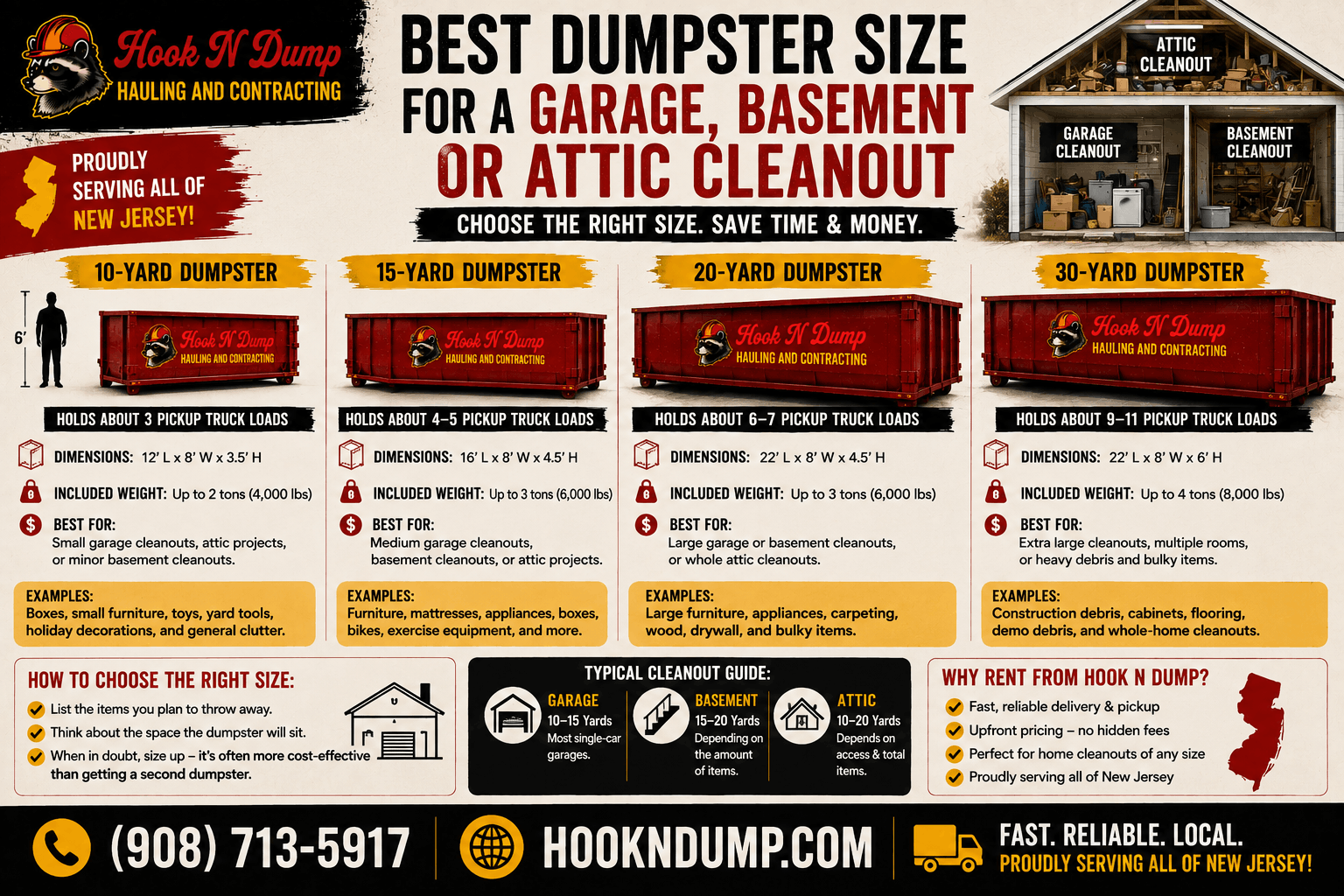
A 15-yard dumpster is usually the best starting point for an average garage, basement or attic cleanout.
Choose a 10-yard dumpster when clearing a small area, a partly filled one-car garage, several attic boxes or one section of a basement. Choose a 20-yard dumpster when the space is packed, includes bulky furniture or appliances, or when you are cleaning more than one area.
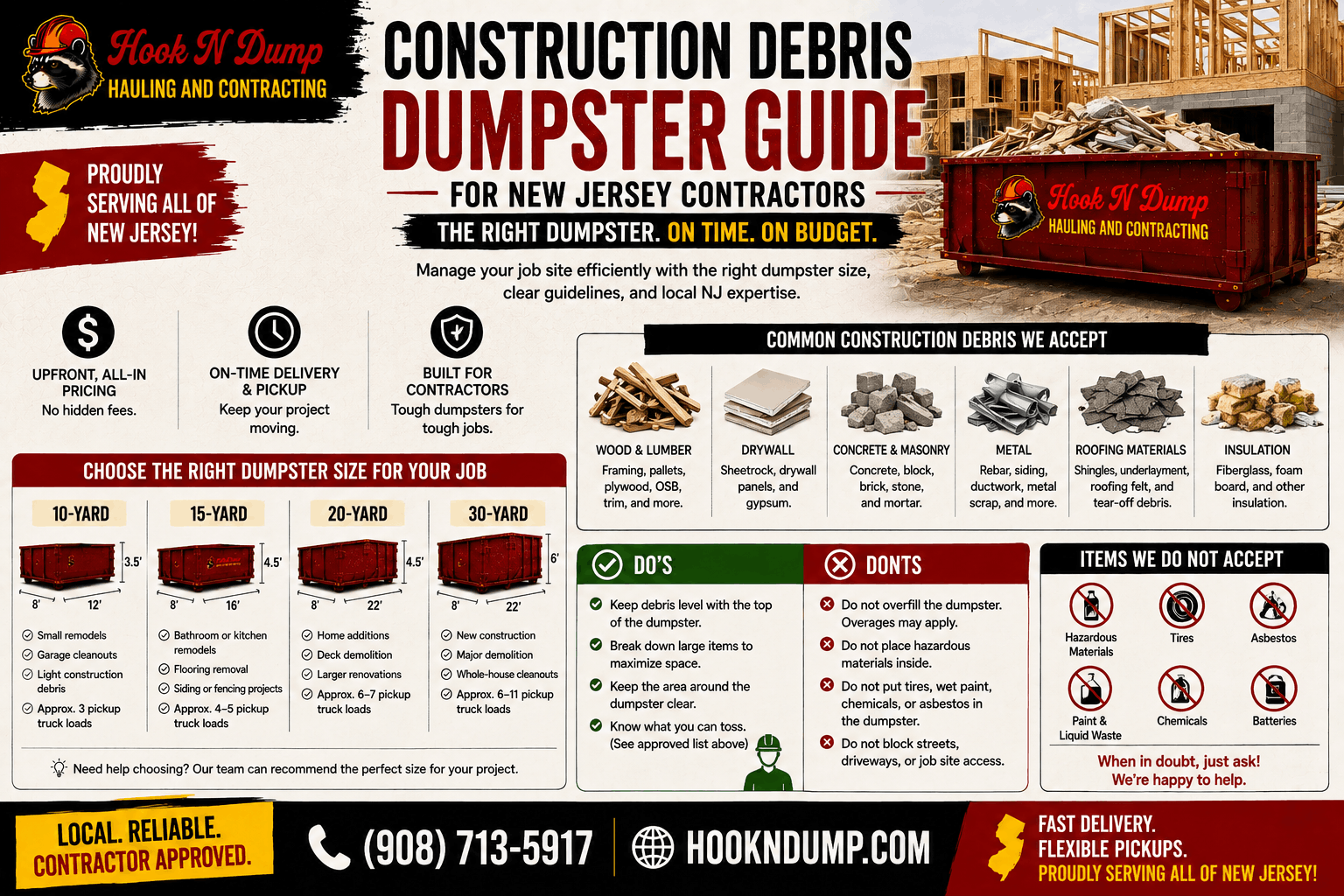
Hook N Dump currently recommends 10 or 15-yard dumpsters for most garage, attic, basement and household cleanouts. Its 20-yard container is listed for larger garage and basement projects and full-house cleanouts.
Quick answer: Rent 10 yards for a small or partial cleanout, 15 yards for an average full garage, basement or attic, and 20 yards for a packed space, several bulky objects or a combined cleanout.
The room’s square footage is only one part of the decision. The number of boxes, furniture pieces, storage shelves, appliances and years of accumulated belongings usually matters more.
Dumpster Size Comparison
| Dumpster Size | Current Starting Price | Included Weight | Approximate Pickup Loads | Best Cleanout Use |
|---|---|---|---|---|
| 10-yard | $475 | 3,000 lbs. | About 3 | Small or partial cleanout |
| 15-yard | $550 | 4,000 lbs. | About 4 to 5 | Average garage, basement or attic |
| 20-yard | $625 | 5,000 lbs. | About 6 | Packed space or combined cleanout |
Hook N Dump’s current main pricing pages show 3, 7 and 10-day rental selections and an additional-day rate of $25. Prices should still be confirmed for the delivery address, debris type and requested dates. (Hook & DUMP)
Simple size rule
- 10 yards: One small area or a cleanout already in progress
- 15 yards: One average full garage, basement or attic
- 20 yards: One heavily packed area or two or more areas together
How Much Space Does Each Dumpster Provide?
Dumpster sizes are measured in cubic yards.
One cubic yard equals 27 cubic feet.
10-Yard Dumpster
10 × 27 = 270 cubic feet
Hook N Dump estimates that its 10-yard container holds about three pickup-truck loads. It is promoted for small garage cleanouts, attic clearing, room updates, flooring and weekend cleanup projects.
15-Yard Dumpster
15 × 27 = 405 cubic feet
The 15-yard container provides 50% more volume than the 10-yard dumpster. Hook N Dump estimates it holds approximately four to five pickup loads and lists garage, attic and basement cleanouts among its main uses.
20-Yard Dumpster
20 × 27 = 540 cubic feet
The 20-yard dumpster offers one-third more space than the 15-yard container. Hook N Dump estimates it holds around six pickup loads and recommends it for larger garage and basement cleanouts, remodeling and full-house cleanup work.
Pickup-load figures are rough planning estimates. Truck-bed size, side-wall height, debris shape and loading method can change the actual amount.
Current Cost Difference
Hook N Dump currently publishes:
10-yard dumpster: $475
15-yard dumpster: $550
20-yard dumpster: $625
The price increases by $75 at each step.
Moving from 10 to 15 yards
For $75 more, you currently receive:
- Five additional cubic yards
- 135 additional cubic feet
- About one to two more pickup loads of room
- 1,000 more pounds of included weight
Moving from 15 to 20 yards
For another $75, you currently receive:
- Five additional cubic yards
- 135 additional cubic feet
- About one to two more pickup loads of room
- 1,000 more pounds of included weight
Selecting the next size may cost less than ordering another container when the smaller option is likely to be filled completely.
Best Dumpster Size for a Garage Cleanout
Choose a 10-Yard Dumpster for a Small Garage Cleanout
A 10-yard container may be enough when:
- You are clearing one section of the garage.
- The garage is partly filled.
- Most debris consists of boxes and bags.
- Large shelving will remain.
- Furniture is limited.
- Tools and equipment will be kept.
- The cleanup is part of a move or seasonal purge.
- The estimated volume is about three pickup loads or less.
Hook N Dump lists small garage cleanouts as a primary use for its 10-yard container.
Typical items may include:
- Flattened cardboard
- Plastic storage containers
- Clothing
- Holiday decorations
- Toys
- Small furniture
- Nonhazardous household clutter
- Limited wood
- Garden tools without fuel or batteries
- Empty shelving sections
A 10-yard dumpster is less likely to work when the garage contains several large cabinets, workbenches, appliances, tires or years of unsorted belongings.
Choose a 15-Yard Dumpster for an Average Garage
A 15-yard dumpster is usually a good match for:
- A full one-car garage
- A moderately filled two-car garage
- Boxes and storage totes
- Old furniture
- Broken shelving
- Small workbenches
- Household junk
- Flooring or minor renovation debris
- Moving and downsizing waste
Hook N Dump positions the 15-yard container for garage cleanouts, attic cleanouts, basement cleanouts, room cleanouts and medium household projects.
Choose 15 yards when the garage contains more than a few pickup loads but does not include every item from another part of the house.
Choose a 20-Yard Dumpster for a Packed Garage
A 20-yard dumpster may be better when:
- The two-car garage is packed.
- Most contents will be discarded.
- Large cabinets and workbenches are included.
- Outdoor furniture is being removed.
- Exercise equipment is included.
- The garage and shed are being cleared together.
- The garage cleanout includes renovation debris.
- The total amount is uncertain.
- More than five pickup loads are expected.
Hook N Dump lists garage and basement cleanouts among the uses for its 20-yard container and estimates around six pickup loads of capacity.
Move to 20 yards when the 15-yard estimate leaves little room for bulky or irregular objects.
Best Dumpster Size for a Basement Cleanout
Basements can be difficult to estimate because furniture, boxes and renovation material may be spread across several rooms or hidden behind stored belongings.
Choose a 10-Yard Dumpster for a Partial Basement
A 10-yard container may fit:
- One storage room
- A utility-area cleanup
- Several boxes and bags
- Limited furniture
- A small moving purge
- Final debris after donations
- One section of an unfinished basement
Choose this size when the contents are visible and clearly limited.
Choose a 15-Yard Dumpster for an Average Basement
A 15-yard dumpster may suit:
- A standard unfinished basement
- Years of boxed storage
- Several shelves
- Small furniture
- Carpet or flooring
- Damaged household belongings
- A moderate amount of renovation waste
- Basement cleanup before moving or selling
Hook N Dump specifically lists basement cleanouts as a project for its 15-yard dumpster.
The 15-yard size gives you room to dismantle shelving and furniture without immediately filling the container.
Choose a 20-Yard Dumpster for a Full or Finished Basement
A 20-yard dumpster may be the better choice when removing:
- Sofas
- Beds
- Dressers
- Entertainment centers
- Cabinets
- Exercise equipment
- Carpet from several rooms
- Drywall
- Damaged flooring
- Water-damaged household contents
- Furniture plus stored boxes
Hook N Dump lists larger basement cleanouts and full-house cleanup work among the uses for the 20-yard container.
Water-damaged material may weigh more than dry household debris. Tell Hook N Dump when the basement has experienced flooding, leaks or prolonged moisture.
Best Dumpster Size for an Attic Cleanout
Attics often contain light but bulky material. Boxes, decorations, clothing and empty containers may fill the dumpster by volume before reaching its weight allowance.
Choose a 10-Yard Dumpster for Light Attic Storage
A 10-yard container may be enough for:
- Seasonal decorations
- Empty boxes
- Clothing
- Small storage totes
- Toys
- Books
- Light household belongings
- Limited old insulation approved for disposal
- One small attic
Hook N Dump lists attic clearing as a use for its compact 10-yard container.
Choose a 15-Yard Dumpster for a Full Attic
A 15-yard dumpster may suit:
- A full walk-up attic
- Boxes accumulated over many years
- Small furniture
- Bed frames
- Shelving
- Old carpet
- Stored doors or wood
- Moving and downsizing debris
- Several bulky but light items
Hook N Dump lists attic cleanouts as a main 15-yard use and notes that its lower side walls make household loading easier.
Choose a 20-Yard Dumpster for a Large Attic and Other Areas
Move to 20 yards when:
- The attic contains furniture.
- Nearly everything is being removed.
- The attic and garage are included.
- The attic and basement are being cleared together.
- Renovation material will be added.
- The amount cannot be estimated until boxes are opened.
- More than five pickup loads are expected.
A 20-yard dumpster is also more practical when the cleanout is part of a larger move, renovation or property sale.
Garage vs. Basement vs. Attic Size Guide
| Cleanup Area | 10-yard | 15-yard | 20-yard |
|---|---|---|---|
| One-car garage | Partial or lightly filled | Full or moderately filled | Packed with bulky items |
| Two-car garage | Small section | Moderate contents | Full or heavily packed |
| Basement | One room or section | Average storage basement | Full finished or packed basement |
| Attic | Boxes and light storage | Full attic with some furniture | Large attic plus other areas |
| Garage plus attic | Usually too small | Possible when lightly filled | Better for most combined jobs |
| Garage plus basement | Usually too small | Only when contents are limited | Better starting size |
| Basement plus attic | Partial cleanup only | Moderate combined cleanup | Full combined cleanout |
| Whole property | Too small | Small or partly cleared home | Small full-house cleanout |
Use Bulky Items to Estimate the Size
Large objects can use dumpster space faster than boxes and bags.
Count these separately:
- Sofas
- Recliners
- Mattresses
- Box springs
- Dressers
- Tables
- Cabinets
- Bookcases
- Workbenches
- Exercise equipment
- Large storage totes
- Outdoor furniture
- Appliances
- Carpet rolls
A garage with 50 boxes may fit into less space than a garage containing three sofas, two cabinets and a workbench.
Break furniture down where it can be done safely.
Sort the Space Before Ordering
Keep
Set aside:
- Personal documents
- Photographs
- Tools
- Seasonal items
- Family belongings
- Items needed for the move
- Keys and property records
Donate or Sell
Possible items include:
- Usable furniture
- Clothing
- Books
- Tools
- Working equipment
- Household supplies
- Sports equipment
Schedule donation pickup before the dumpster arrives where possible.
Recycle Separately
New Jersey directs televisions, computers, monitors, laptops, desktop printers and desktop fax machines into approved electronic-waste recycling channels. Batteries, pesticides, electronics, mercury equipment, aerosol cans and oil-based finishes also have separate Class D recycling routes.
Dispose
The dumpster may hold approved:
- Furniture
- Boxes
- Household clutter
- Wood
- Flooring
- Drywall
- Carpet
- General nonhazardous junk
Hook N Dump’s current disposal guide lists these as commonly accepted materials, subject to the rental terms and disposal facility.
Sorting first can reduce the required dumpster size and prevent prohibited items from being hidden beneath ordinary debris.
What Can Go in the Dumpster?
Common garage, basement and attic items that may be accepted include:
- Tables
- Chairs
- Sofas
- Cabinets
- Shelving
- Clothing
- Toys
- Books
- Cardboard
- Empty storage bins
- Wood
- Drywall
- Carpet
- Flooring
- Doors
- General household clutter
Keep every object within the container walls and below the approved fill line.
Items That Need Advance Approval
Tell Hook N Dump before loading:
- Mattresses
- Box springs
- Tires
- Televisions
- Computer monitors
- Refrigerators
- Freezers
- Air conditioners
- Dehumidifiers
- Large appliances
- Concrete
- Brick
- Soil
- Heavy tile
- Roofing shingles
These items may require added fees, separate recycling, another load or a material-specific weight limit.
Do not hide special items beneath furniture or bags.
Items That Should Not Go in the Dumpster
Do not load:
- Liquid paint
- Paint thinner
- Solvents
- Gasoline
- Motor oil
- Propane tanks
- Hazardous chemicals
- Pesticides
- Medical waste
- Loose needles
- Asbestos-containing material
- Flammable liquids
- Unknown chemical containers
- Contaminated soil
Hook N Dump lists hazardous chemicals, paint, asbestos, propane tanks, medical waste, fuel and flammable materials among prohibited waste types.
Garages and basements commonly contain paint, fuel, oil, pesticides and batteries, so check every shelf before loading.
Watch the Weight of Basement and Garage Debris
Most household cleanouts fill a dumpster by volume, but certain stored materials can create a heavy load.
Examples include:
- Floor tile
- Mortar
- Plaster
- Concrete pieces
- Landscaping stone
- Auto parts
- Roofing shingles
- Wet carpet
- Water-damaged furniture
- Boxes of books
- Metal equipment
Hook N Dump’s current standard allowances are 3,000 pounds for 10 yards, 4,000 pounds for 15 yards and 5,000 pounds for 20 yards.
Tell the company when dense materials make up a large part of the cleanout. The correct container may depend on weight rather than available space.
Which Rental Period Should You Choose?
Hook N Dump currently displays 3, 7 and 10-day rental choices for its 10, 15 and 20-yard dumpsters, with additional time listed at $25 per day.
Choose Three Days When:
- The area has already been sorted.
- Helpers are scheduled.
- Everything is easy to access.
- The cleanout covers one space.
- Donation pickups are complete.
Choose Seven Days When:
- Boxes still need to be checked.
- Family members are helping on different days.
- Furniture must be dismantled.
- The garage, attic or basement is full.
- The project will take a weekend plus several weekdays.
Choose Ten Days When:
- Several spaces are involved.
- The cleanout is part of a move.
- The property has years of stored items.
- Decisions must be made during loading.
- Renovation work will follow the cleanout.
Book enough time to sort safely rather than rushing through documents, photographs and family belongings.
How to Load the Dumpster Efficiently
Start With Flat Items
Load:
- Flattened boxes
- Doors
- Shelving panels
- Bed-frame pieces
- Folded carpet
- Flat wood
- Cabinet panels
Break Down Bulky Furniture
Where safe:
- Remove table legs.
- Separate sectional sofas.
- Remove shelves and drawers.
- Dismantle bed frames.
- Flatten storage units.
- Keep screws and sharp hardware contained.
Fill Gaps
Place smaller approved items:
- Between furniture
- Inside empty cabinet frames
- Around stacked boxes
- Along unused side space
Distribute Weight
Do not place all appliances, books or renovation material at one end.
Stay Below the Walls
Furniture, mattresses, bags and wood should not extend above the top edge. Hook N Dump’s current disposal instructions require debris to remain within the container and below its fill line.
Will the Dumpster Fit in the Driveway?
Hook N Dump advises customers to provide at least:
- 10 feet of unobstructed width
- 14 feet of overhead clearance
The company states that its containers range from approximately 12 to 16 feet in length.
Before delivery, check:
- Driveway width
- Available length
- Tree branches
- Utility wires
- Roof overhangs
- Basketball hoops
- Gates
- Parked vehicles
- Sidewalk access
- Pavement condition
- Space for opening the rear door
Ask for the exact dimensions of the assigned dumpster. Do not use old dimensions from earlier location pages because Hook N Dump’s current inventory and product setup may differ.
When Full-Service Junk Removal May Be Better
A dumpster works well when you have time and people available to carry and load the contents.
Full-service removal may be better when:
- Furniture must be carried up basement stairs.
- The attic has a narrow staircase.
- Heavy items cannot be moved safely.
- No one is available to help.
- The property must be emptied quickly.
- The customer lives outside New Jersey.
- There is no suitable dumpster placement area.
- Only a few large items need removal.
Hook N Dump provides both roll-off rentals and home or estate cleanout services covering houses, garages, basements, attics and storage spaces.
A combined plan may also work. A crew can remove heavy furniture while the dumpster holds boxes, household clutter and smaller approved debris.
Common Size-Selection Mistakes
Choosing by Floor Area Alone
A large empty basement may produce less debris than a small packed attic.
Count the actual contents rather than measuring only the room.
Forgetting Shelves and Cabinets
Removing built-in or freestanding storage can add substantial volume.
Ignoring Furniture Shapes
Sofas, chairs and cabinets create unused gaps unless dismantled.
Ordering Before Sorting
Donations and family pickups can reduce the required dumpster size.
Combining Extra Areas Later
A dumpster selected for the garage may become too small after basement and attic contents are added.
Failing to Declare Heavy Items
Tile, books, stone, auto parts and water-damaged belongings can push the load above its included weight.
Hiding Electronics or Hazardous Waste
Televisions, monitors, batteries, paint, fuel and chemicals require separate handling.
Filling Above the Walls
An overfilled dumpster may not be safe to collect.
Final Size Checklist
Choose a 10-yard dumpster when:
- One small area is being cleared.
- The garage, basement or attic is partly filled.
- Furniture is limited.
- The contents equal about three pickup loads or less.
- No other room will be added.
- The load should remain within 3,000 pounds.
Choose a 15-yard dumpster when:
- One average full garage, basement or attic is being cleared.
- Several furniture pieces are included.
- The cleanout equals roughly four to five pickup loads.
- More space than 10 yards is needed.
- The project does not cover the whole house.
- The load should remain within 4,000 pounds.
Choose a 20-yard dumpster when:
- The area is heavily packed.
- Several large furniture pieces are included.
- Two or more areas are being cleaned together.
- The final amount is uncertain.
- Renovation debris will be added.
- About six pickup loads are expected.
- The load should remain within 5,000 pounds.
FREQUENTLY ASKED QUESTIONS
What size dumpster is best for a garage cleanout?
A 15-yard dumpster is usually the best starting point for an average garage cleanout. Choose 10 yards for a small or partial garage and 20 yards for a packed two-car garage or a cleanup that includes other rooms.
What size dumpster is best for a basement cleanout?
Choose 10 yards for one basement room, 15 yards for an average storage basement and 20 yards for a full finished basement with furniture or renovation debris.
What size dumpster is best for an attic cleanout?
A 10-yard dumpster may hold boxes and light attic storage. Choose 15 yards for a full attic with some furniture and 20 yards when the attic is large or combined with another cleanout area.
Is a 10-yard dumpster large enough for a garage cleanout?
It may be enough for a partly filled garage or approximately three pickup loads of debris. A full or heavily packed garage will usually need 15 or 20 yards.
Is a 15-yard dumpster good for a basement cleanout?
Yes. Hook N Dump specifically lists basement cleanouts among the uses for its 15-yard dumpster.
How much does a 10-yard dumpster cost?
Hook N Dump currently lists its 10-yard container starting at $475 with 3,000 pounds included on its homepage and main size guide.
How much does a 15-yard dumpster cost?
Hook N Dump currently lists its 15-yard dumpster starting at $550 with 4,000 pounds included.
How much does a 20-yard dumpster cost?
Hook N Dump currently lists its 20-yard dumpster starting at $625 with 5,000 pounds included.
Can furniture go in a cleanout dumpster?
Most ordinary household furniture can usually be loaded. Mattresses, box springs and certain appliances should be disclosed before ordering because separate handling or fees may apply.
Can televisions go in the dumpster?
Do not place televisions, computers or monitors into ordinary mixed waste. New Jersey provides approved electronic-waste collection and recycling routes for covered devices.
Can paint and chemicals go in the dumpster?
No. Liquid paint, solvents, fuel, pesticides and hazardous chemicals should be kept out and routed through an approved collection program.
Can I clean the garage and basement with one dumpster?
Yes. A 20-yard dumpster is usually the better starting size for a combined garage and basement cleanout. A 15-yard container may work when both areas are lightly filled.
Should I choose a larger dumpster when unsure?
Move up one size when the smaller estimate leaves little room, bulky furniture is included or more debris may be found while sorting.
Is junk removal better for an attic or basement?
It may be better when heavy objects must be carried on stairs or when no one can perform the loading. Hook N Dump provides both dumpster rentals and full-service property cleanouts.
Choose the Right Container for Your Cleanout
Use this starting point:
- 10 yards: Small or partial garage, basement or attic
- 15 yards: Average full garage, basement or attic
- 20 yards: Packed area or combined cleanout
Hook N Dump currently offers all three sizes with published starting prices from $475 to $625 and included weight allowances from 3,000 to 5,000 pounds.
Call (973) 477-6805 or request a quote online. Provide:
- Delivery address
- Area being cleaned
- Number of boxes
- Furniture count
- Appliances or electronics
- Heavy materials
- Project photographs
- Preferred rental period
- Proposed placement location
Reviewed by Hook N Dump
Prices, weight allowances, availability and accepted materials may change. Confirm the current written rental terms before ordering.
Cleaning Out a Garage, Basement or Attic?
Send Hook N Dump photos of the space and a list of large items. The team will recommend a 10, 15 or 20-yard container for your cleanup.