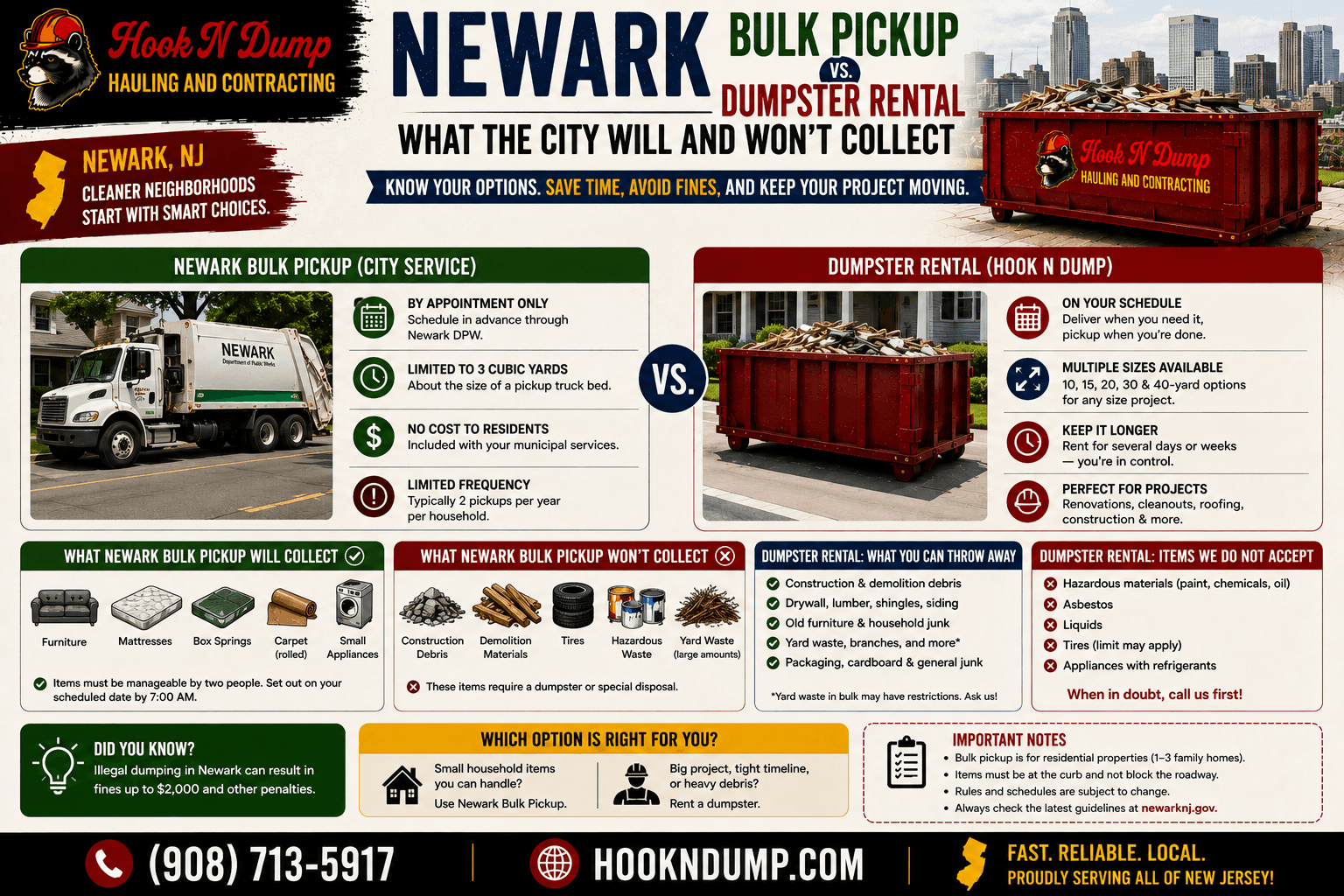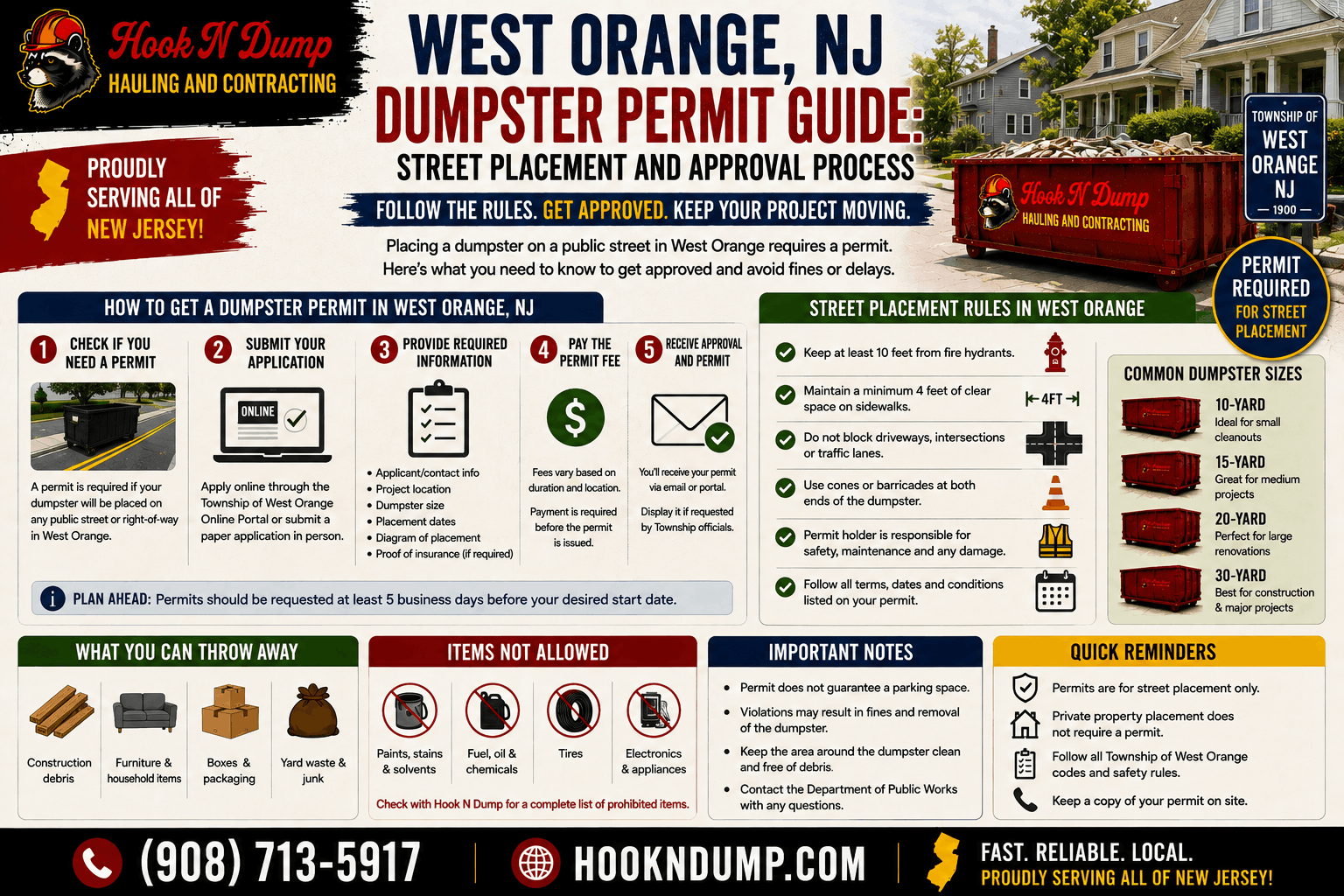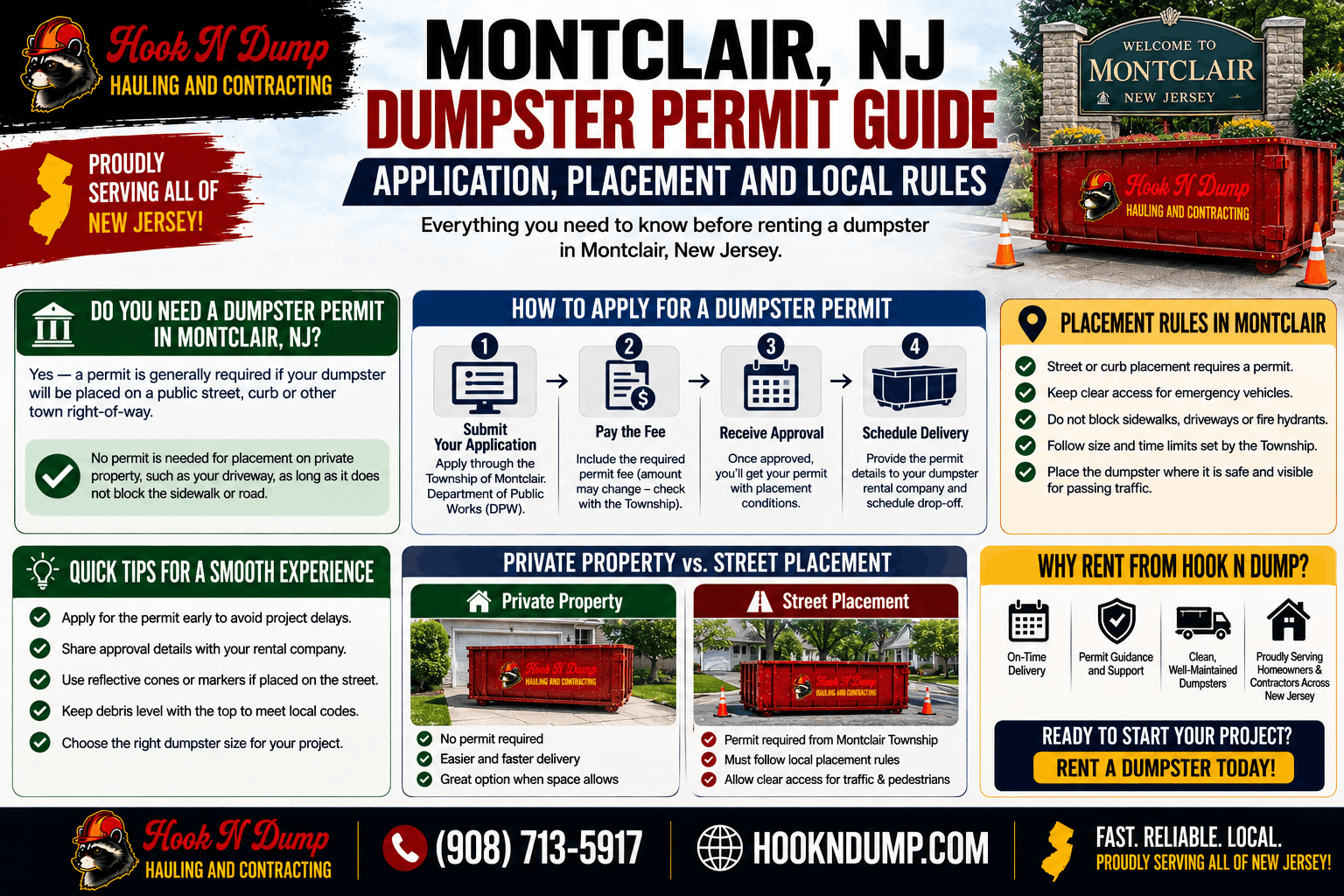
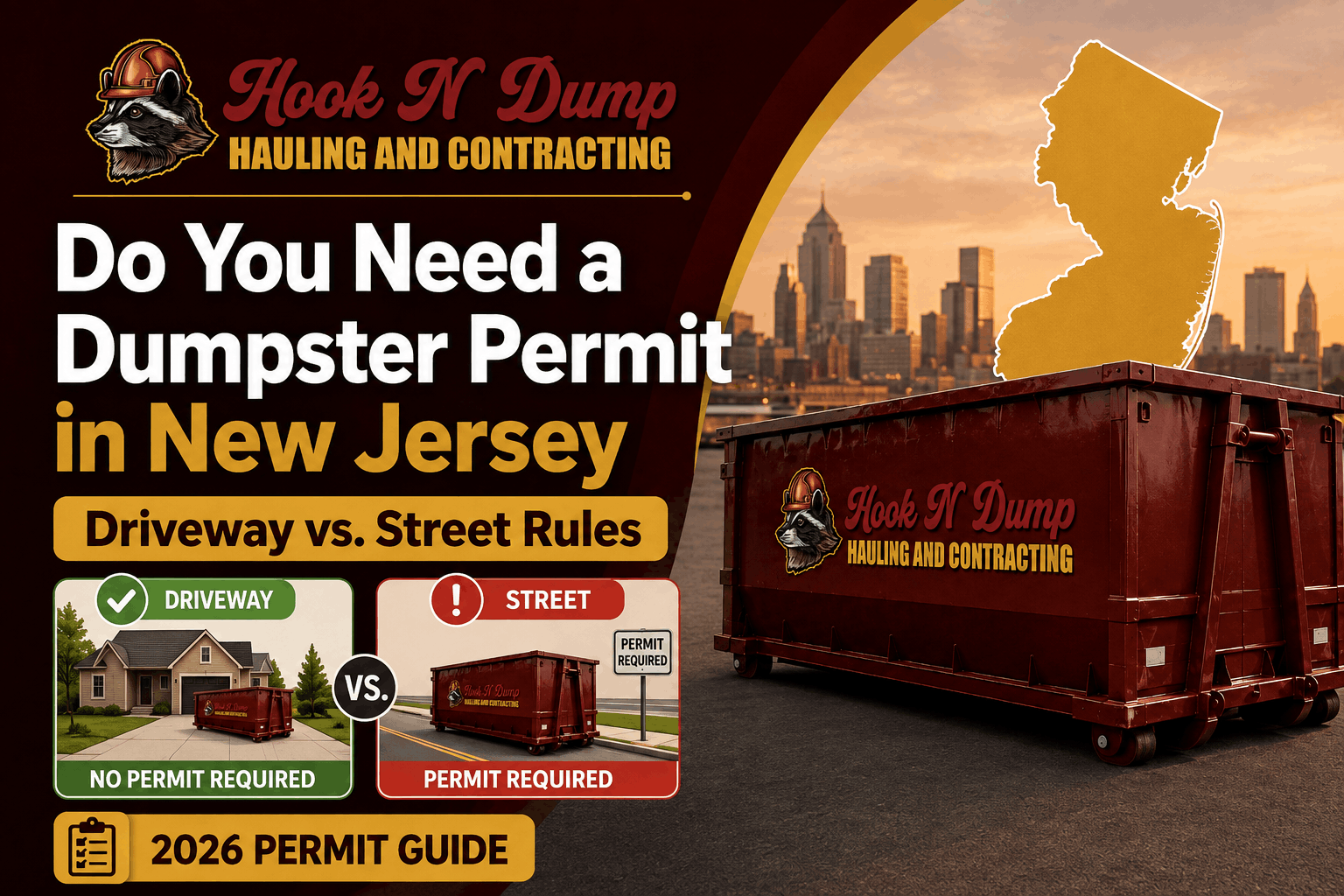
You may need a permit before placing a roll-off dumpster in New Jersey, but the answer depends on the municipality, the placement location, the road owner, and the type of property.
A container placed fully within a private residential driveway often does not need a street-use permit. However, some towns may still require zoning approval, a property survey, or another local review for dumpsters on private property.
A dumpster placed on a public street, sidewalk, parking lane, or municipal right-of-way is much more likely to require approval. The permit may be handled by the municipal clerk, police department, traffic bureau, engineering department, construction office, or an online permit portal.
For example, Maplewood states that driveway placement does not require a dumpster permit, while street placement requires a permit, insurance, and a fee. West Orange lists dumpsters among the items that need zoning approval and uses a separate Traffic Bureau and Engineering process for an on-street container.
Quick answer: A dumpster on private property usually has fewer permit requirements than one placed on a public street. Do not assume that “private property” always means no approval. Contact the municipality before delivery, especially when the container will occupy a road, sidewalk, parking area, easement, or other public space.
Rules reviewed: July 2026. Permit fees, forms, departments, insurance limits, and allowed placement periods may change.
Do You Need a Dumpster Permit in New Jersey?
There is no single permit procedure that works for every New Jersey municipality. Towns and cities use their own forms, fees, placement standards, and reviewing departments.
A homeowner in Maplewood may follow a different process from a customer in Montclair, West Orange, Elizabeth, or Jersey City. Municipality websites show dumpster permits being handled by clerks, police departments, traffic units, engineering departments, construction offices, and online infrastructure portals.
Your first step should be identifying exactly where the dumpster will sit:
- Fully inside a private driveway
- On another private paved area
- In a private commercial parking lot
- In an apartment or condominium parking area
- On a public street
- In a public parking space
- Across a sidewalk
- Within a municipal, county, or state right-of-way
The answer determines which property owner or government office may need to approve the placement.
Driveway vs. Street Dumpster Placement
| Placement Location | Is a Permit Commonly Needed? | What to Check |
|---|---|---|
| Private residential driveway | Often not, but town rules vary | Zoning, property line, HOA, access and surface protection. |
| Private commercial lot | Possibly | Property-owner approval, zoning, fire access and parking rules. |
| Apartment or condominium lot | Possibly | Landlord or association permission and municipal rules. |
| Public street | Usually | Municipal dumpster or right-of-way permit. |
| Public parking space | Usually | Parking, police or traffic approval. |
| Sidewalk or pedestrian area | Usually restricted | Pedestrian access and accessibility requirements. |
| County road | Additional approval may apply | Contact the town and county road department. |
| State highway right-of-way | NJDOT authorization may apply | Contact NJDOT before placement. |
NJDOT states that work or temporary activity affecting a state roadway or NJDOT right-of-way may require a highway occupancy permit or other authorization. A municipal permit by itself may not cover placement affecting state-controlled property.
Dumpster Placement on a Private Driveway
Is a Permit Required for Driveway Placement?
A permit is often not required when the entire dumpster is placed on a privately owned driveway, but this is not a statewide guarantee.
Maplewood explicitly states that a dumpster placed in a driveway does not need a dumpster permit. Hook N Dump also advises customers that permits are usually unnecessary for private-property placement, while street placement may need local approval.
West Orange shows why customers must still check locally. The township lists dumpsters among the items requiring zoning approval and asks applicants to provide a property survey showing the exact location and dimensions for zoning review.
Before treating driveway placement as permit-free, ask the municipality:
- Is a zoning permit or approval required?
- Must the container remain behind the property line?
- Is there a limit on how long it may remain?
- Are setbacks required from sidewalks, streets, hydrants or neighboring properties?
- Is a property survey or placement sketch required?
- Do local property-maintenance rules limit temporary containers?
- Are there special rules for corner properties or busy roads?
Keep the Dumpster Within the Property Line
A driveway dumpster should not extend into the sidewalk, curb lane, roadway, neighboring property, or public easement without approval.
Measure the proposed placement area before ordering. Check the dumpster body, rear door, delivery truck path, and the room needed to load safely.
A container that physically fits on the paved driveway can still cause a problem when:
- Its rear section extends over the sidewalk
- The delivery truck must cross another property
- The open dumpster door blocks pedestrian access
- The container occupies part of a public apron or curb area
- Vehicles cannot safely enter or leave the property
- The placement blocks fire, utility or emergency access
Check Driveway Width and Overhead Clearance
Hook N Dump asks customers to provide a clear opening at least 10 feet wide and at least 14 feet high, free from overhead obstructions. Its containers range from approximately 12 to 16 feet in length.
Before delivery, check for:
- Utility wires
- Tree branches
- Roof overhangs
- Basketball hoops
- Gates
- Parked vehicles
- Low signs
- Narrow driveway entrances
- Sharp turns
- Soft or damaged pavement
Do not assume the truck can place a dumpster wherever a passenger vehicle can park. Roll-off delivery requires room for the truck, container rails, and unloading movement.
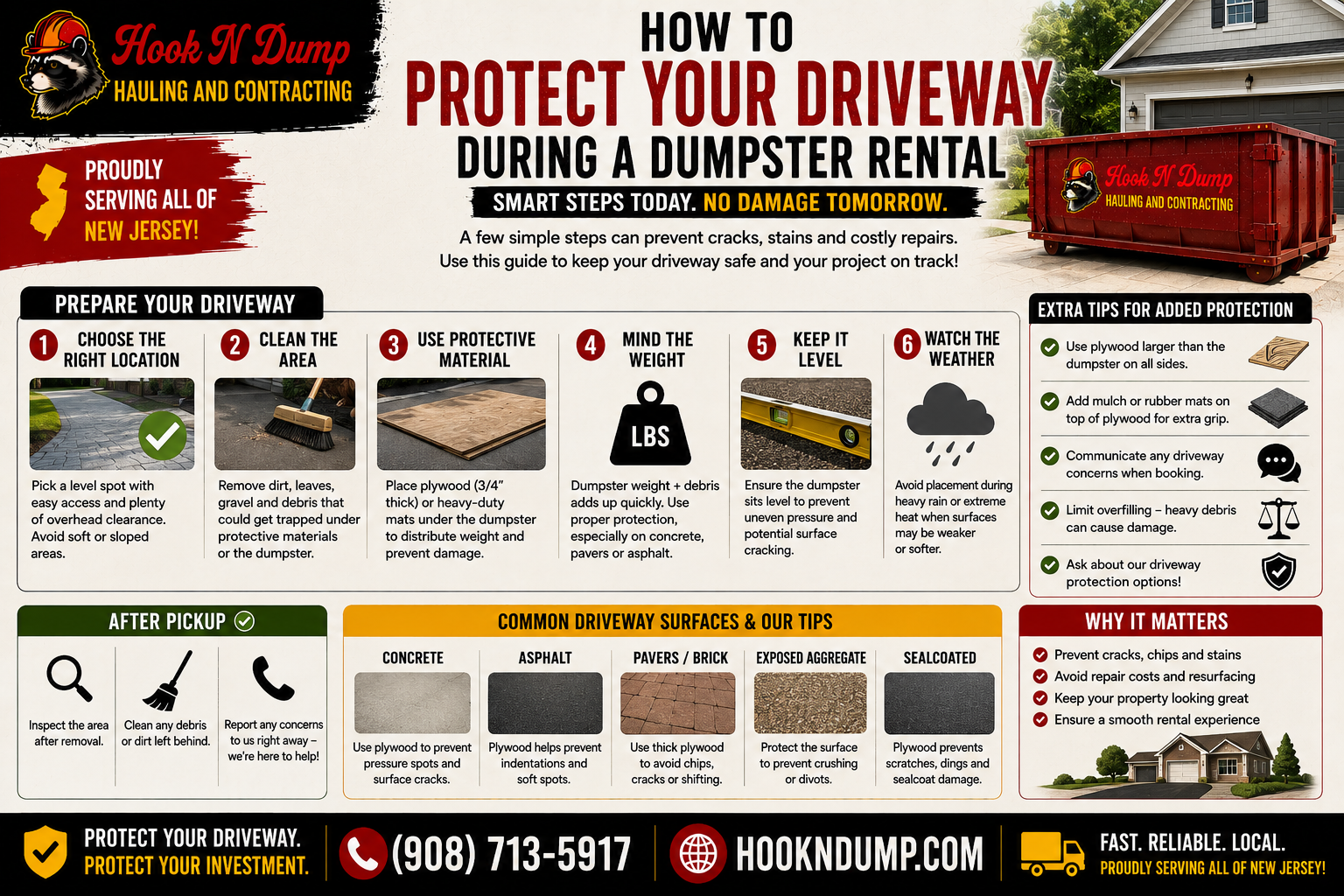
Protect the Driveway Surface
Ask whether boards or other surface-protection methods are available. Protection may reduce direct contact between the dumpster and pavement, but it cannot guarantee that an old, thin, cracked, soft, or recently paved driveway will not be damaged.
Discuss surface conditions before delivery when the property has:
- Asphalt softened by hot weather
- Existing cracks
- Decorative pavers
- Sloped pavement
- Underground drainage
- A septic system
- A weak retaining edge
- Recently poured concrete
- An underground garage or structure
Dumpster Placement on a Public Street
A Street Permit Is Usually Required
A dumpster occupying a public roadway or curbside parking area normally requires municipal approval because it affects traffic, parking, visibility, emergency access, and public use.
Maplewood allows a dumpster or Bagster on a public street for up to seven days per application. The township currently lists a $50 fee, a certificate of insurance naming Maplewood as an additional insured for at least $300,000, and cones and lighting around an approved container.
Montclair requires an application through its Police Department. Its permit form asks why the dumpster cannot be placed on private property, requests the proposed location and dates, and requires a hold-harmless agreement and certificate of insurance.
cants to obtain approval from the Traffic Bureau first and then submit the approved application to the Engineering Department for the on-street permit.
Why Towns Regulate Street Dumpsters
Street placement can affect:
- Traffic flow
- Parking availability
- Sight lines
- Pedestrian access
- Bicycle lanes
- Snow removal
- Street sweeping
- Fire hydrants
- Driveways
- Bus routes
- School zones
- Emergency vehicles
- Utility work
- Planned road projects
A town may deny the requested location even when it offers dumpster permits. Maplewood states that a dumpster cannot be placed on certain active roads, using Boyden Avenue as an example.
Street Placement May Require Safety Markers
The Montclair permit form provides a useful example of the safety conditions a municipality may impose.
Its listed restrictions include:
- Placement at least 25 feet from an intersection
- Placement only where parking is not otherwise prohibited
- A maximum dumpster width of eight feet
- Yellow reflective diamond-shaped panels facing traffic
- No obstruction of the sidewalk
- A tarp or tight cover to control debris, dust and odors
- An approved extension before the permit expires
These are Montclair requirements and should not be copied as the official rules for another municipality. Your town may use different distances, marker types, permit periods, or covering requirements.
What Does a New Jersey Dumpster Permit Usually Require?
Permit applications differ, but you may be asked to provide the following information.
Applicant and Property Details
Prepare:
- Applicant name
- Property owner name
- Contractor name
- Address of the placement
- Telephone number
- Email address
- Block and lot number
- Residential or commercial property type
Dumpster Information
The town may ask for:
- Dumpster company
- Container size
- Width and length
- Delivery date
- Removal date
- Reason street placement is needed
- Exact proposed location
- Type of project or debris
Montclair’s application requests the proposed location, placement and removal dates, and the reason the container cannot be placed on private property.
Site Plan, Survey or Sketch
Some municipalities may request:
- Property survey
- Hand-drawn placement sketch
- Scaled plan
- Street-width information
- Distance from an intersection
- Distance from a fire hydrant
- Sidewalk and curb location
- Nearby driveways
- Traffic direction
- Container dimensions
West Orange states that a property survey and, where applicable, scaled plans showing the exact placement and dimensions must accompany zoning review.
Certificate of Insurance
A municipality may require a certificate of insurance naming the town as an additional insured.
Maplewood requires at least $300,000 for its street dumpster permit. Montclair also requires a certificate of insurance for the placement location, though applicants should confirm the current coverage amount directly with the township.
Ask the permit office for its exact certificate wording before requesting the document. A certificate prepared for another municipality may not be accepted.
Hold-Harmless or Indemnification Agreement
The permit holder may be required to accept responsibility for claims, losses or property damage connected with the dumpster’s use of public space.
Montclair includes a hold-harmless agreement as part of its application package.
Permit Fee
Fees vary by municipality and sometimes by the number of days.
Examples found on official municipal pages include:
- Maplewood: $50 for each seven-day period on a public road
- Montclair: The published permit form shows a $25 fee
Confirm the amount when applying because online forms and fee schedules may be revised.
New Jersey Municipality Examples
The table below shows why every customer should check the town where the dumpster will be delivered.
| Municipality | Current Published Process |
|---|---|
| Maplewood | No dumpster permit for driveway placement. Street placement requires a permit, insurance, and a $50 fee for each seven-day period. |
| Montclair | Apply through the Police Department Uniform Division. The form includes insurance, hold-harmless, and street-safety conditions. |
| West Orange | Zoning approval is listed for dumpsters. For street placement, contact the Traffic Bureau first and then Engineering. |
| Jersey City | Dumpster permits are managed through the Department of Infrastructure and its online permitting system. |
| Elizabeth | The Bureau of Construction provides an online Dumpster Permit application through GovPilot. |
Official sources: Maplewood Township, Montclair Township, West Orange Township, Jersey City and the City of Elizabeth.
This table is not a substitute for confirmation from the permit office. It shows the department and general process published when this guide was prepared.
Maplewood Dumpster Permit Example
Maplewood provides one of the clearest driveway-versus-street distinctions.
Private Driveway
The township says a dumpster placed in a driveway does not require a dumpster permit.
Public Street
For placement on a public street, Maplewood currently requires:
- A dumpster permit application
- A $50 fee for each seven-day period
- A certificate of insurance
- Maplewood named as an additional insured for at least $300,000
- Cones and lighting around the container when approved
Maplewood also says some roads with heavier traffic may not be approved for street placement.
Montclair Dumpster Permit Example
Montclair directs applicants to complete its dumpster placement permit and submit it to the Police Department Uniform Division.
The published form currently shows:
- A $25 permit fee
- Proposed delivery and removal dates
- The requested street location
- A reason the dumpster cannot be placed on private property
- A certificate of insurance
- A hold-harmless agreement
- Placement at least 25 feet from an intersection
- No placement where parking is prohibited
- Reflective markers
- No sidewalk obstruction
- A cover over the container
- An extension application before the permit expires
Customers should contact Montclair before ordering because the municipality may attach location-specific conditions after reviewing the street.
West Orange Dumpster Permit Example
West Orange lists dumpsters among projects requiring zoning approval. The zoning submission may require a property survey and scaled plans showing the exact location and dimensions.
For an on-street dumpster, the municipality directs applicants to:
- Contact the West Orange Traffic Bureau for an application and approval.
- Take the approved application to the Engineering Department.
- Obtain the dumpster permit before placement.
This process shows why customers should not rely on the general statement that private driveways never require local review.
Jersey City and Elizabeth Permit Examples
Jersey City manages dumpster permits through its Department of Infrastructure. The city states that permit applications must be submitted using its online permitting system and warns applicants to plan ahead because reviews can take time.
The City of Elizabeth lists a Dumpster Permit among the applications available online through its Bureau of Construction and GovPilot.
Customers in either city should obtain the current form and approval before scheduling public-space placement.
What If the Property Is on a County or State Road?
The road in front of a property may look like a local street but be maintained by a county or the State of New Jersey.
Before applying, ask:
- Who owns and controls the road?
- Is the proposed location within a municipal, county or state right-of-way?
- Is municipal approval enough?
- Does the road agency prohibit containers at that location?
- Is a separate traffic-control plan required?
NJDOT states that work within a state roadway or NJDOT right-of-way may require permission or a highway occupancy permit. Contact NJDOT when the proposed placement could affect state-controlled property.
Do not schedule street delivery until all reviewing agencies have approved the location.
Do You Need a Permit for a Bagster?
A Bagster or similar temporary waste bag may be treated like a dumpster when placed on a public street.
Maplewood allows Bagsters, but states that a bag placed on the street must follow the same procedures and requirements as a dumpster.
Even when a flexible waste bag sits on private property, verify that the collection vehicle can reach it without blocking traffic, crossing restricted property, contacting overhead lines, or lifting over structures.
Do You Need Permission From an HOA, Landlord or Property Manager?
Municipal approval and private-property permission are separate matters.
A permit from the town does not automatically give you permission to place a dumpster on:
- A rented driveway
- A condominium parking space
- A shared driveway
- An apartment complex
- A commercial parking lot
- A managed community
- Property owned by another person
Obtain written approval from the owner, landlord, association or property manager before delivery. Ask whether there are rules about container color, delivery hours, duration, parking-space use, surface protection or contractor insurance.
When Should You Apply for the Permit?
Apply before reserving a street placement date whenever possible.
Permit review may take longer when:
- Several departments must approve the application
- Insurance documents need correction
- A traffic officer must inspect the location
- The road is narrow or busy
- The property is near an intersection
- Parking spaces must be reserved
- A state or county road is involved
- The municipality requests a survey
- The delivery overlaps street work, an event or snow restrictions
Jersey City specifically advises permit applicants to plan for added review time because of application volume.
A safe workflow is:
- Choose the intended placement area.
- Confirm who owns the property and road.
- Contact the municipal permit office.
- Obtain the current application.
- Request insurance documents where needed.
- Submit the fee and supporting paperwork.
- Wait for written approval.
- Send the approved placement instructions to Hook N Dump.
- Schedule delivery after approval.
Can Hook N Dump Obtain the Permit for You?
Permit responsibility differs by town and rental arrangement.
The homeowner, property owner, contractor or dumpster company may be asked to file the application. Some forms require information and signatures from more than one party.
Before ordering, ask the municipality:
- Who must be listed as the applicant?
- Who must sign the hold-harmless form?
- Whose insurance certificate is required?
- Does the permit belong to the address, contractor or container company?
- Who receives the approved document?
- Must the permit be posted at the property?
Hook N Dump can provide container and company information needed for an application, but the customer should confirm who is legally responsible for filing and maintaining the permit.
What Happens If You Place a Dumpster Without a Permit?
Possible outcomes depend on the municipality and location. They may include:
- A warning
- A summons
- A fine
- An order to move the dumpster
- An order to remove it immediately
- Delayed work
- Added hauling charges
- Loss of parking access
- Liability for damage or obstruction
Montclair’s published form states that a summons may be issued when a dumpster remains on the street after expiration without a timely extension request.
It is usually less expensive to obtain approval before delivery than to relocate a loaded container.
How Long Can a Street Dumpster Remain?
Permit periods are set locally.
Maplewood permits street placement for up to seven days per application. Montclair’s form requires original placement and removal dates and provides a process for requesting an extension before expiration.
Do not assume that the dumpster rental period and municipal permit period are the same.
For example:
- Your rental may be booked for 10 days.
- The street permit may cover only seven days.
- You may need a permit extension or a shorter rental period.
Compare both dates before delivery.
Street Dumpster Safety Checklist
Before delivery to a permitted street location, confirm:
- The permit has been approved in writing.
- Delivery and removal dates match the permit.
- The approved location is clearly marked.
- Required parking spaces are available.
- The container will not block a fire hydrant.
- The container will not obstruct the sidewalk.
- Intersection clearance is maintained.
- Required cones, lights and reflectors are ready.
- The tarp or cover requirements are understood.
- Snow, sweeping and parking rules have been checked.
- The permit is posted if required.
- The dumpster company has received the approved instructions.
Use the municipality’s conditions when they differ from this general checklist.
Driveway Dumpster Checklist
Before scheduling a private-property delivery:
- Confirm whether zoning or another local approval is needed.
- Verify property boundaries.
- Obtain landlord, HOA or property-manager approval.
- Measure the driveway width and placement area.
- Provide at least 10 feet of clear width for Hook N Dump’s truck.
- Provide at least 14 feet of overhead clearance.
- Move vehicles, branches and temporary obstructions.
- Check for weak pavement, pavers or underground structures.
- Decide whether driveway protection is needed.
- Keep the container, door and debris off the sidewalk and street.
Hook N Dump publishes its 10-foot width and 14-foot height guidance on its website.
FREQUENTLY ASKED QUESTIONS
Do I need a permit for a dumpster in my driveway in New Jersey?
A driveway dumpster often does not require a street-use permit, but municipal rules vary. Maplewood says no dumpster permit is needed for driveway placement, while West Orange lists dumpsters among items requiring zoning approval. Contact your municipality before delivery.
Do I need a permit to put a dumpster on the street?
Street placement usually requires municipal approval. The application may be handled by the clerk, police, traffic, engineering, infrastructure or construction department.
How much does a dumpster permit cost in New Jersey?
Fees are set locally. Maplewood currently lists $50 for each seven-day street-placement period, while Montclair’s published application shows a $25 fee. Confirm the current fee directly with your municipality.
How long does a dumpster permit last?
The approved period differs by town. Maplewood allows up to seven days per street permit application. Montclair requires placement and removal dates and provides an extension process.
Do I need insurance for a street dumpster permit?
Some municipalities require it. Maplewood requires a certificate naming the township as an additional insured for at least $300,000. Montclair’s application also requires a certificate of insurance.
Can a dumpster block part of the sidewalk?
Do not block a sidewalk without express municipal approval. Montclair’s permit conditions state that a roll-off dumpster must not obstruct the sidewalk or adjacent sidewalk area.
Can I place a dumpster near an intersection?
Municipal separation rules may apply. Montclair’s published agreement requires curbside placement at least 25 feet from an intersection. Other towns may use a different distance or prohibit the location.
Who applies for the dumpster permit?
The applicant may be the homeowner, property owner, contractor or dumpster company, depending on the municipality. Ask the permit office whose name, signature and insurance are required.
Can I schedule delivery before receiving the permit?
It is better to wait for written approval. A denied or delayed permit can lead to rescheduling or relocation charges.
Do I need a separate permit on a state highway?
Activity affecting NJDOT property or a state roadway right-of-way may require NJDOT authorization in addition to local approval.
Schedule Your New Jersey Dumpster Rental
Once the placement has been approved, Hook N Dump can help you select the right container size and arrange delivery.
Hook N Dump provides 10, 15, 20, 30 and 40-yard roll-off dumpsters for residential, commercial and construction projects across North and Central New Jersey. Its service area includes Essex, Union, Bergen, Passaic, Morris, Middlesex and Somerset counties and nearby communities. (Hook & DUMP)
Call (973) 477-6805 or request a quote online. Provide the delivery address, proposed placement location, project type and approved permit instructions when booking.
Reviewed by Hook N Dump
Permit rules can change and may differ by municipality, road owner and property type. Confirm current requirements with the local permit office before delivery.