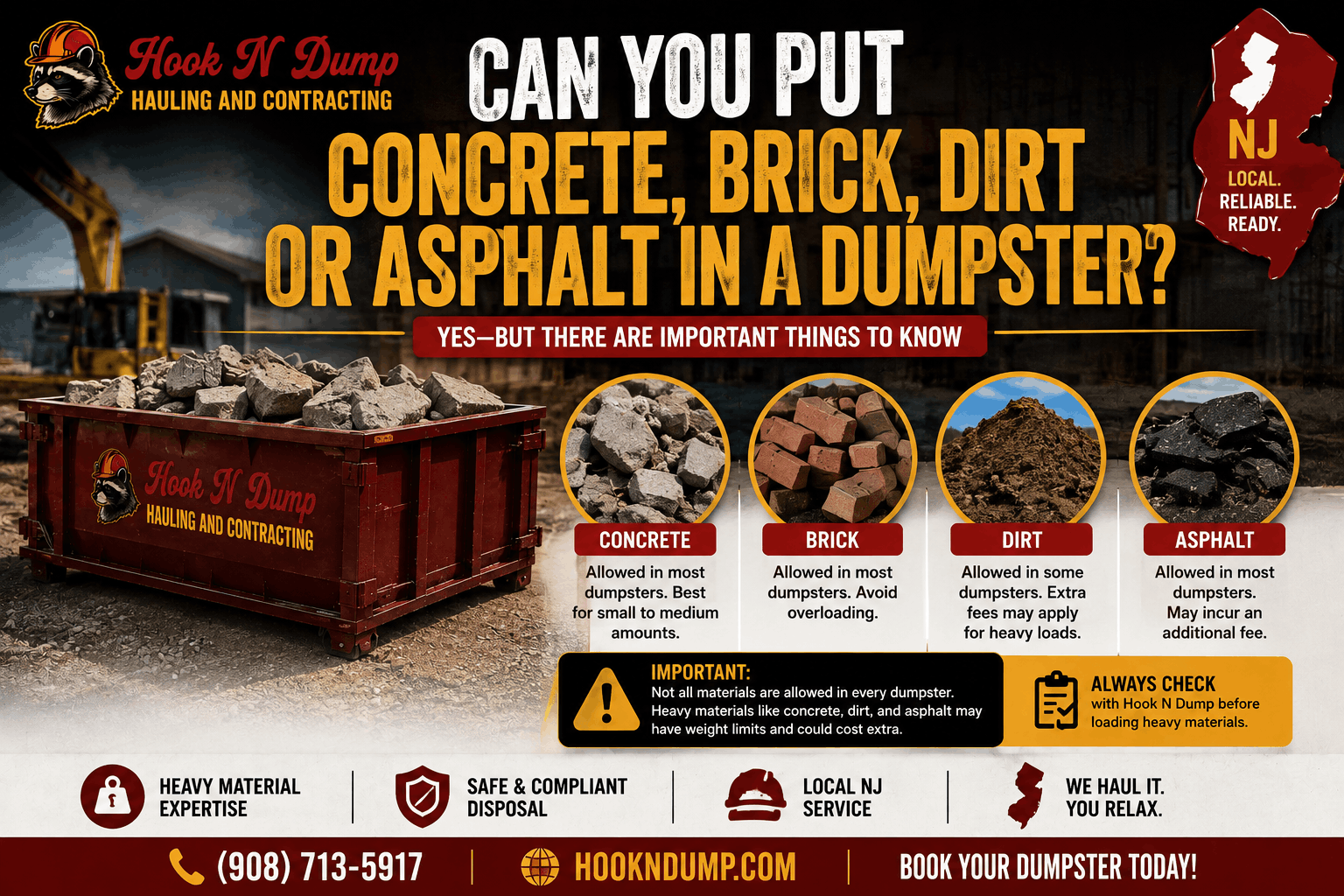
Concrete, brick, clean dirt and asphalt may be accepted in a roll-off dumpster, but they should never be treated like ordinary household junk.
These materials are dense. A container can reach its legal or safe hauling weight while appearing only partly full. The debris may also need to remain separate from furniture, drywall, garbage, wood and other waste so it can be taken to the correct recycling or disposal facility.
Hook N Dump states that concrete, brick and soil may be accepted, but weight restrictions and special pricing can apply. Customers are asked to contact the company before loading heavy debris.
New Jersey identifies source-separated concrete, asphalt, brick and block as Class B recyclable materials. Approved Class B facilities can process these materials into products such as aggregate, gravel or fill.
Quick answer: Yes, Hook N Dump may accept concrete, brick and soil with advance approval. Asphalt should also be discussed before ordering. The material may require a dedicated container, a lower fill level, special pricing and separation from other debris.
Do not load these materials until Hook N Dump has approved the material type, estimated amount and container size.
Quick Heavy-Debris Disposal Chart
| Material | Can It Go in a Dumpster? | Main Condition |
|---|---|---|
| Broken concrete | Usually with approval | May require a concrete-only load. |
| Concrete with rebar | Ask first | Protruding metal and processing rules may apply. |
| Brick | Usually with approval | Keep clean brick separate when instructed. |
| Concrete block | Usually with approval | Weight and load separation matter. |
| Pavers | Usually with approval | Treated as dense masonry debris. |
| Ceramic tile | Ask first | Heavy and may contain adhesive or mortar. |
| Clean excavated soil | Ask first | Source and contamination history must be known. |
| Soil from an oil-tank area | Not as ordinary clean dirt | Testing and another disposal route may be required. |
| Pavement asphalt | Ask first | May require an asphalt-only load. |
| Asphalt millings | Ask first | Recycling and facility rules apply. |
| Asphalt roofing shingles | Often accepted | Different from pavement asphalt. |
| Mixed household junk and concrete | Only when approved | A clean heavy-debris load may be required. |
| Asbestos-containing masonry material | No standard dumpster | Requires regulated handling. |
Acceptance depends on the source, amount, contamination risk, receiving facility and Hook N Dump’s current hauling rules.
Why Heavy Debris Needs Special Planning
A standard cleanout dumpster is commonly filled with materials that take up considerable space without reaching extreme weight, such as furniture, boxes, wood and household clutter.
Concrete, brick, soil and asphalt behave differently. They use less container space per pound, so the dumpster may become too heavy before reaching its top edge.
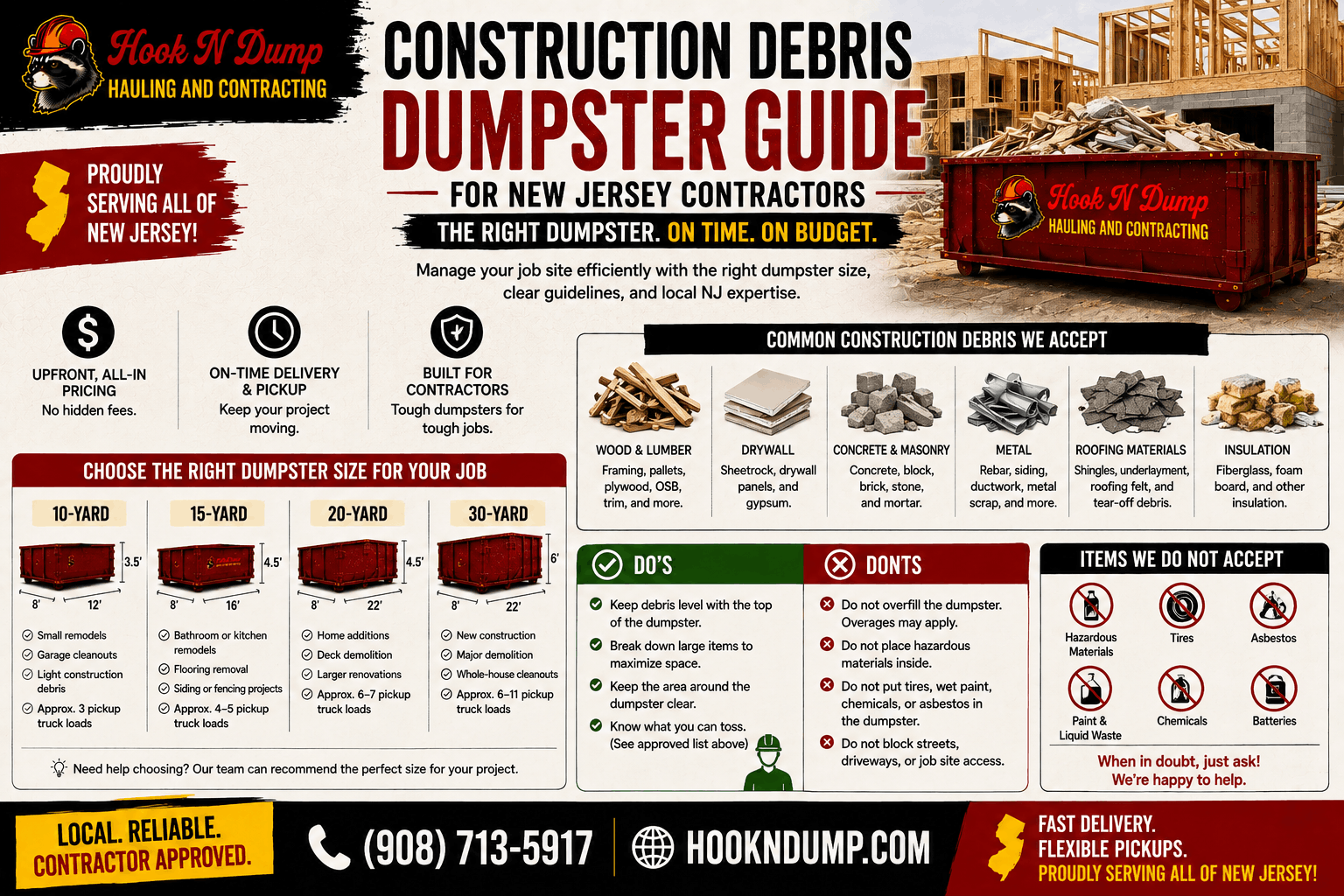
Hook N Dump’s standard dumpster lineup currently includes weight allowances ranging from 3,000 pounds in a 10-yard container to 9,000 pounds in a 40-yard container. These published allowances apply to the normal rental options shown on the website, but a heavy-debris order may receive different instructions or pricing. (Hook & DUMP)
The driver must be able to:
- Lift the container safely
- Carry it without exceeding equipment limits
- Transport it within road-weight rules
- Unload it at an approved facility
- Prevent loose material from falling during transit
This is why a large 30 or 40-yard container is not automatically the right choice for concrete or dirt.
Can You Put Concrete in a Dumpster?
Yes, broken concrete may be accepted after Hook N Dump approves the project.
New Jersey lists concrete with asphalt, brick and block under recyclable material code 22. The state also notes that concrete can be taken to an approved Class B recycling center or an authorized solid-waste facility, depending on how the material is handled.
Concrete projects may include:
- Sidewalk removal
- Patio demolition
- Driveway sections
- Concrete steps
- Footings
- Curbs
- Garage floors
- Small slabs
- Retaining-wall material
- Broken concrete block
What Hook N Dump Needs to Know
Before ordering, provide:
- Approximate slab length and width
- Approximate concrete thickness
- Whether steel reinforcement is present
- Whether the load contains soil or gravel
- Whether the concrete is painted, coated or contaminated
- Whether other demolition debris will be included
- Delivery address
- Truck-access conditions
Photographs can help the team assess the project before delivery.
Concrete With Rebar
Before ordering, provide:
- Approximate slab length and width
- Approximate concrete thickness
- Whether steel reinforcement is present
- Whether the load contains soil or gravel
- Whether the concrete is painted, coated or contaminated
- Whether other demolition debris will be included
- Delivery address
- Truck-access conditions
Photographs can help the team assess the project before delivery.
Painted or Coated Concrete
Tell Hook N Dump when concrete is:
- Painted
- Sealed
- Covered with adhesive
- Attached to insulation
- Contaminated by oil
- Taken from an industrial site
- Suspected of containing hazardous material
A recycling facility may treat coated or contaminated concrete differently from clean concrete.
Can You Put Brick in a Dumpster?
Brick can generally be placed in an approved heavy-debris dumpster.
New Jersey includes brick and cinder block within its concrete, asphalt, masonry and paving material category. These materials can be processed by approved Class B recycling operations when they meet the facility’s acceptance rules.
Brick debris may come from:
- Chimney removal
- Fireplace demolition
- Brick walls
- Walkways
- Patios
- Steps
- Garden borders
- Exterior renovation
- Building demolition
- Masonry repairs
Keep the Brick Load Clean When Required
A brick-only or masonry-only load may be easier to recycle than a mixed load containing:
- Plastic bags
- Household garbage
- Furniture
- Drywall
- Insulation
- Food waste
- Paint containers
- Yard waste
- Roofing debris
Ask whether mortar attached to the bricks is acceptable. Small amounts may be allowed, while another facility may have different terms.
Reusable Brick
Before disposing of undamaged brick, consider whether it can be:
- Reused on the property
- Donated
- Sold as reclaimed material
- Used for landscaping
- Taken by a masonry contractor
Do not reuse painted, fire-damaged or contaminated brick without checking whether it is suitable for the planned use.
Can You Put Dirt in a Dumpster?
Clean excavated soil may be accepted, but dirt needs more review than many customers expect.
You should know:
- Where the soil came from
- What the property was used for
- Whether an underground tank was present
- Whether there was a spill
- Whether the soil has an unusual odor or color
- Whether demolition material is mixed into it
- Whether laboratory testing has been completed
New Jersey regulates soil and fill recycling services and distinguishes non-restricted soil and fill from petroleum-contaminated and other regulated materials. The state warns that soil that appears clean can still contain debris or contaminants.
Dirt That May Be Suitable for Approval
Examples can include soil from:
- Small landscaping projects
- Garden-bed removal
- Shallow residential excavation
- Patio preparation
- Fence-post excavation
- Non-contaminated grading work
Approval is still required. Hook N Dump’s website states that soil may be accepted, but weight limits and special pricing may apply.
Dirt That Should Not Go Into a Standard Dumpster
Do not load soil from:
- A leaking heating-oil tank area
- A gasoline or chemical spill
- An industrial property
- A former repair shop
- A fire-damaged site
- An unknown stockpile
- A remediation project
- An area with visible staining
- A site with chemical odors
Unknown or contaminated soil may need sampling, documentation and transport to a facility authorized for that material.
Dirt Mixed With Roots, Sod or Stone
Tell Hook N Dump whether the load includes:
- Sod
- Roots
- Brush
- Large rocks
- Concrete pieces
- Clay
- Landscaping fabric
- Plastic edging
- Household waste
A clean-soil load and a mixed landscaping load may be priced or routed differently.
Can You Put Asphalt in a Dumpster?
Asphalt may be accepted with advance approval, but it is important to identify which type of asphalt you have.
Pavement Asphalt
Pavement asphalt may come from:
- Driveway removal
- Parking-lot repairs
- Walkway demolition
- Roadwork
- Patching projects
- Asphalt curbs
New Jersey includes pavement asphalt and asphalt millings in its masonry and paving material recycling category. Asphalt can be incorporated into asphalt production or taken to an approved Class B facility for aggregate processing.
Ask Hook N Dump whether:
- The load must contain asphalt only
- Concrete may be mixed with the asphalt
- Soil or gravel is allowed
- A maximum fill line applies
- The pieces must be broken to a certain size
Asphalt Roofing Shingles
Asphalt roofing shingles are different from pavement asphalt.
Hook N Dump currently lists asphalt roofing shingles as a common use for its 20 and 30-yard dumpsters. Roofing loads can still become heavy, particularly when a roof has several shingle layers.
Before ordering a roofing dumpster, provide:
- Roof square count
- Number of existing shingle layers
- Building size
- Whether plywood will be removed
- Whether gutters and flashing are included
- Whether the shingles may contain asbestos
Older roofing products suspected of containing asbestos should not be loaded as standard shingles without testing and an approved disposal plan.
What Is a Clean-Load Dumpster?
A clean load contains one approved material type, or a small group of compatible materials, kept separate from general waste.
Examples include:
- Concrete only
- Brick and block
- Concrete and brick
- Pavement asphalt only
- Approved concrete, asphalt, brick and block
- Clean soil only
New Jersey’s Class B definition refers to these construction materials as source-separated recyclable materials. In practical terms, that generally means they are separated from unrelated waste where the debris is generated.
Why Clean Loads Matter
A clean load may:
- Be easier to recycle
- Go to a facility designed for masonry material
- Avoid contamination from household waste
- Reduce sorting at the facility
- Follow a different pricing structure
- Keep prohibited materials out
Do not assume that all masonry materials can be mixed. The approved combination depends on the receiving facility and rental terms.
Can Heavy Debris Be Mixed With Household Junk?
Only when Hook N Dump approves the mixed load.
A few bricks inside a renovation load are different from a dumpster holding several tons of concrete with furniture and household garbage stacked above it.
Mixing materials can create problems because:
- The total weight becomes harder to estimate.
- The load may no longer qualify for masonry recycling.
- Household items can hide heavy material.
- The receiving facility may reject the debris.
- Disposal pricing may change.
- The container can become unevenly loaded.
Tell Hook N Dump about every material before delivery.
What Dumpster Size Should You Use for Concrete or Dirt?
Do not select a container based only on cubic-yard capacity.
For normal rentals, Hook N Dump offers 10, 15, 20, 30 and 40-yard containers. The larger options provide more space and higher published weight allowances, but they are not necessarily approved for being filled with concrete, dirt or asphalt.
A smaller container is often easier to control for dense debris because:
- The material cannot be stacked as high.
- The load is less likely to exceed equipment limits.
- Weight distribution is easier to manage.
- The company can provide a clear fill line.
The final recommendation should come from Hook N Dump after reviewing:
- Material type
- Estimated volume
- Estimated weight
- Contamination risk
- Delivery location
- Disposal facility
- Available container inventory
How High Can You Fill a Heavy-Debris Dumpster?
Use the fill line or loading instructions given by Hook N Dump.
Do not assume you can fill the container to the top. Heavy material may have to remain well below the side walls.
General loading rules include:
- Keep all debris inside the container.
- Do not build material above the side walls.
- Spread the load across the dumpster floor.
- Avoid placing all dense material at one end.
- Keep the rear door and hardware clear.
- Do not add material after reaching the approved fill line.
- Do not conceal heavy debris beneath household junk.
When the approved level has been reached, stop loading even when empty space remains above it.
How to Estimate Concrete Before Ordering
You do not need a perfect estimate, but you should provide enough information for Hook N Dump to review the job.
For a slab, measure:
- Length
- Width
- Thickness
For irregular pieces, provide:
- Number of piles
- Approximate pile dimensions
- Photographs with a visible scale reference
- Source of the material
- Whether rebar is attached
Avoid guessing based only on how small the broken pieces look. Breaking a slab changes its shape, not its total mass.
How to Estimate Brick or Block
Record:
- Approximate number of bricks or blocks
- Wall length and height
- Wall thickness
- Whether mortar is attached
- Whether concrete footings are included
- Whether the material is reusable
- Whether household or demolition debris is mixed in
Photograph both the structure before demolition and the debris pile afterward when possible.
How to Estimate Dirt
Provide:
- Excavation length and width
- Average excavation depth
- Soil type when known
- Whether the soil is dry or wet
- Source location
- Property history
- Presence of sod, stone or roots
- Any signs of contamination
Wet soil can be much harder to transport than dry soil. Discuss recent rain, drainage conditions and standing water with Hook N Dump before loading.
Extra Charges That May Apply
Hook N Dump states that heavy materials can be subject to special pricing, and its standard prices are based on the container, rental period, address and debris type.
Possible heavy-debris costs can relate to:
- Material-specific disposal
- Weight above the agreed allowance
- Dedicated clean-load service
- Contaminated loads
- Sorting or rejected debris
- Additional hauling
- A second container
- Failed pickup caused by excessive weight
- Extended rental time
- Distance to the receiving facility
Request a written quote that identifies:
- Approved material
- Container size
- Maximum loading level
- Included weight
- Overage rate
- Rental period
- Delivery and pickup
- Materials that must remain separate
Materials That Should Never Be Hidden in a Heavy Load
Do not place these underneath concrete, brick, dirt or asphalt:
- Paint
- Solvents
- Fuel
- Motor oil
- Batteries
- Propane tanks
- Asbestos
- Medical waste
- Chemical containers
- Electronics
- Household garbage
- Refrigerant appliances
Hook N Dump lists hazardous chemicals, paint, asbestos, propane tanks, medical waste, fuel and flammable materials among its restricted items.
Hidden prohibited material can cause the load to be rejected or require separate handling.
Project Recommendations
Concrete Patio Removal
Before ordering, confirm:
- Patio dimensions
- Slab thickness
- Reinforcement
- Concrete-only requirements
- Access for the dumpster and delivery truck
Keep soil, furniture and landscaping waste out unless mixing is approved.
Brick Chimney Removal
Tell Hook N Dump whether the project includes:
- Brick
- Mortar
- Flue liner
- Metal flashing
- Roofing material
- Wood framing
- Suspected asbestos
The chimney’s masonry material may need to remain separate from the remaining demolition debris.
Asphalt Driveway Removal
Provide:
- Driveway dimensions
- Asphalt thickness
- Base material
- Amount of attached soil or gravel
- Whether concrete curbs are included
Ask whether the asphalt must remain separate from soil and concrete.
Landscaping Excavation
Identify whether the load contains:
- Clean soil
- Sod
- Roots
- Brush
- Stone
- Clay
- Concrete edging
- Landscaping fabric
A landscaping debris load may be handled differently from a clean-soil load.
Bathroom Tile Removal
Tile and mortar are dense. Tell Hook N Dump whether the project includes:
- Ceramic tile
- Stone tile
- Mortar bed
- Cement board
- Drywall
- Fixtures
- Cast-iron tub
A mixed renovation load may be approved, but the weight estimate must include the tile and mortar.
Heavy-Debris Loading Checklist
Before delivery:
- Identify every material.
- Confirm whether the load must remain clean and separate.
- Measure the project.
- Send photographs.
- Disclose rebar, coatings and contamination risks.
- Obtain the approved container size.
- Confirm the maximum fill level.
- Review included weight and overage pricing.
- Clear the truck’s delivery path.
- Keep prohibited items away from the loading area.
During loading:
- Spread dense material evenly.
- Keep debris below the assigned fill line.
- Do not add household garbage.
- Do not load unknown soil.
- Keep long rebar inside the container.
- Stop when the approved level is reached.
- Contact Hook N Dump before adding another material type.
FREQUENTLY ASKED QUESTIONS
Can concrete go in a dumpster?
Yes, concrete may be accepted with advance approval. It may require a dedicated heavy-debris container, a lower fill limit and special pricing.
Can brick and concrete go in the same dumpster?
They may be accepted together when Hook N Dump and the receiving facility approve the combination. Keep household garbage and unrelated debris out of a clean masonry load.
Can I fill a dumpster to the top with concrete?
No. Concrete is too dense to load based on volume alone. Follow the heavy-material fill line supplied by Hook N Dump, even when unused space remains.
Can dirt go in a dumpster?
Clean soil may be accepted after review. Soil from an unknown, industrial, oil-tank or spill area should not be treated as ordinary clean dirt.
Can asphalt go in a dumpster?
Pavement asphalt may be accepted after approval and may require a separate load. Asphalt roofing shingles are handled differently and are listed by Hook N Dump as a use for certain standard dumpster sizes.
Can concrete and household junk be mixed?
Only when approved. A concrete-only or masonry-only load may be required so the material can be recycled or routed correctly.
What size dumpster should I rent for concrete?
The right size depends on the amount, thickness, reinforcement and disposal route. Do not select the largest container automatically. Send project measurements and photographs to Hook N Dump first.
Does concrete cost more to dispose of?
Special pricing may apply because concrete is heavy and may require a dedicated load or specific facility. Request the price and included weight in writing.
Can I put concrete with rebar in a dumpster?
Possibly, but advance approval is required. Long or protruding reinforcement may need to be cut or separated before loading.
Can I put asphalt roofing shingles with pavement asphalt?
Do not mix them without approval. Roofing shingles and pavement asphalt may follow different recycling or disposal processes.
Can contaminated soil go in a standard dumpster?
No. Soil suspected of containing petroleum, chemicals or other contamination needs review, and testing or another disposal route may be required.
What happens if the dumpster is too heavy?
Pickup may be delayed until material is removed, and added hauling or service charges may apply. A load must remain within the approved transport and equipment limits.
Order a Heavy-Debris Dumpster in New Jersey
Concrete, brick, soil and asphalt projects require more planning than ordinary household cleanouts.
Before ordering, send Hook N Dump:
- Delivery address
- Material type
- Project measurements
- Photographs
- Estimated amount
- Details about coatings or reinforcement
- Soil source and property history
- Preferred delivery dates
- Proposed placement location
Hook N Dump provides dumpster rental and construction debris removal across North and Central New Jersey. Its website states that concrete, brick and soil may be accepted with weight restrictions and special pricing.
Call (973) 477-6805 or request a quote online before loading heavy debris.
Reviewed by Hook N Dump
Accepted materials, container selection, fill limits, disposal routes and pricing can change. Obtain approval for the exact material before delivery.