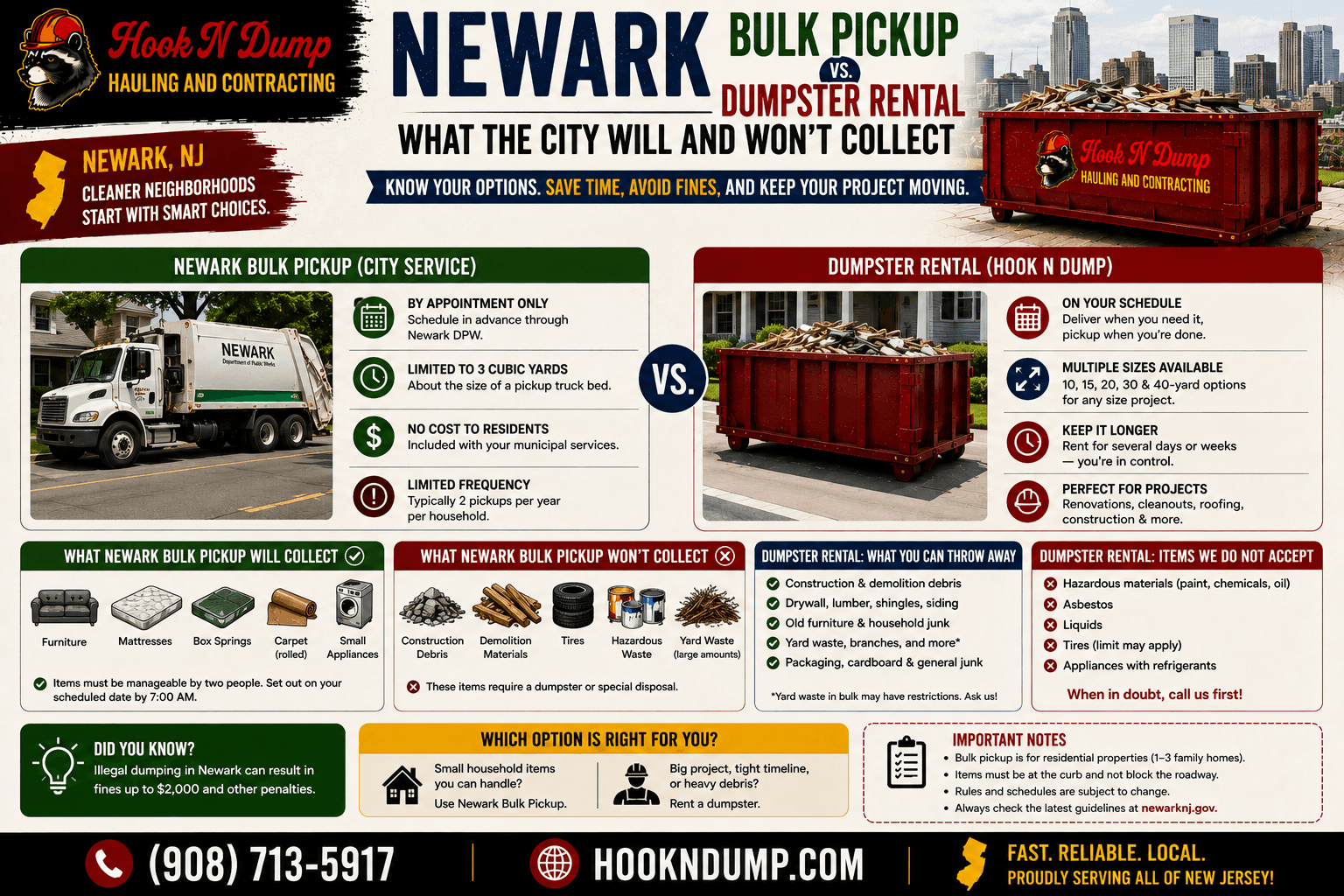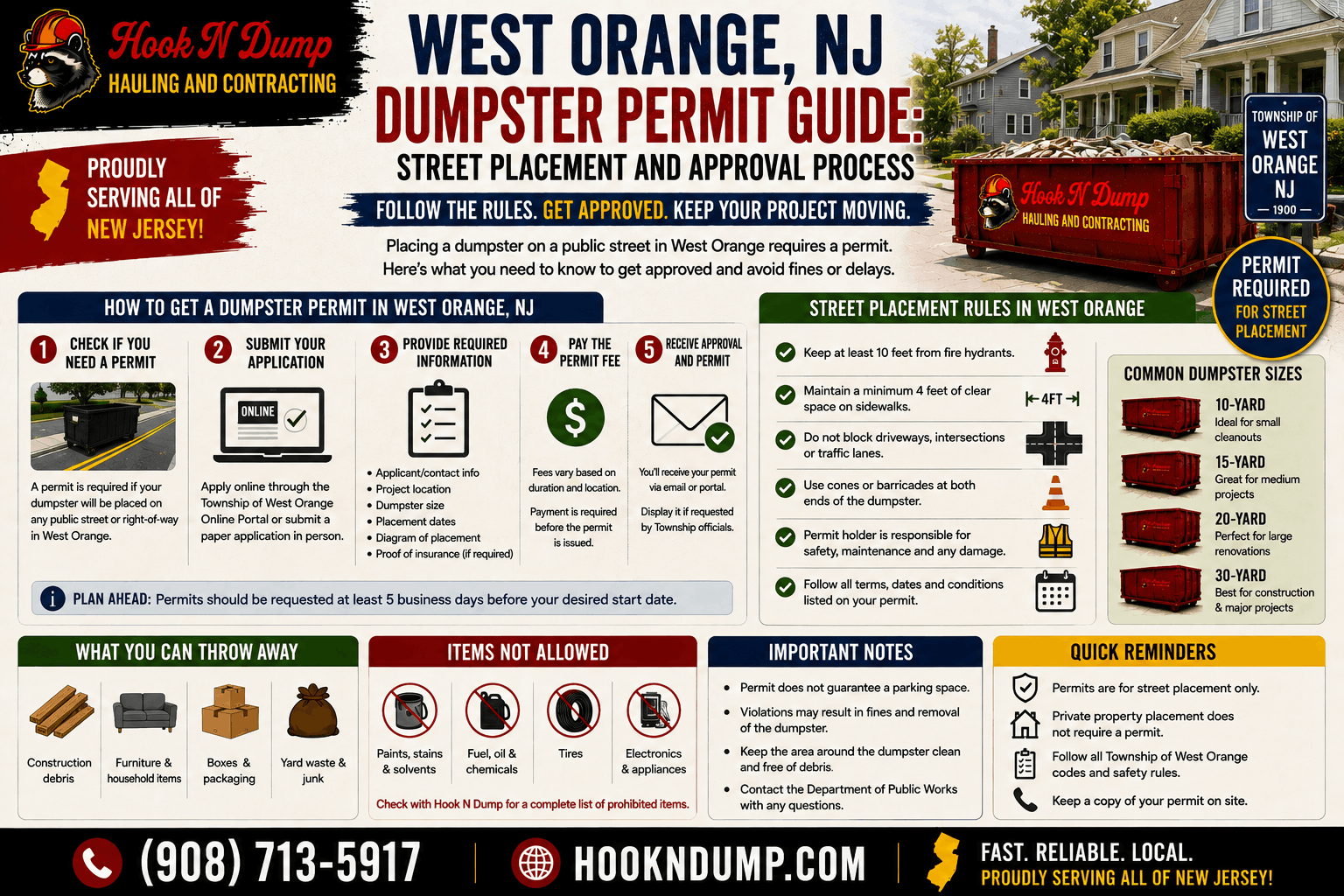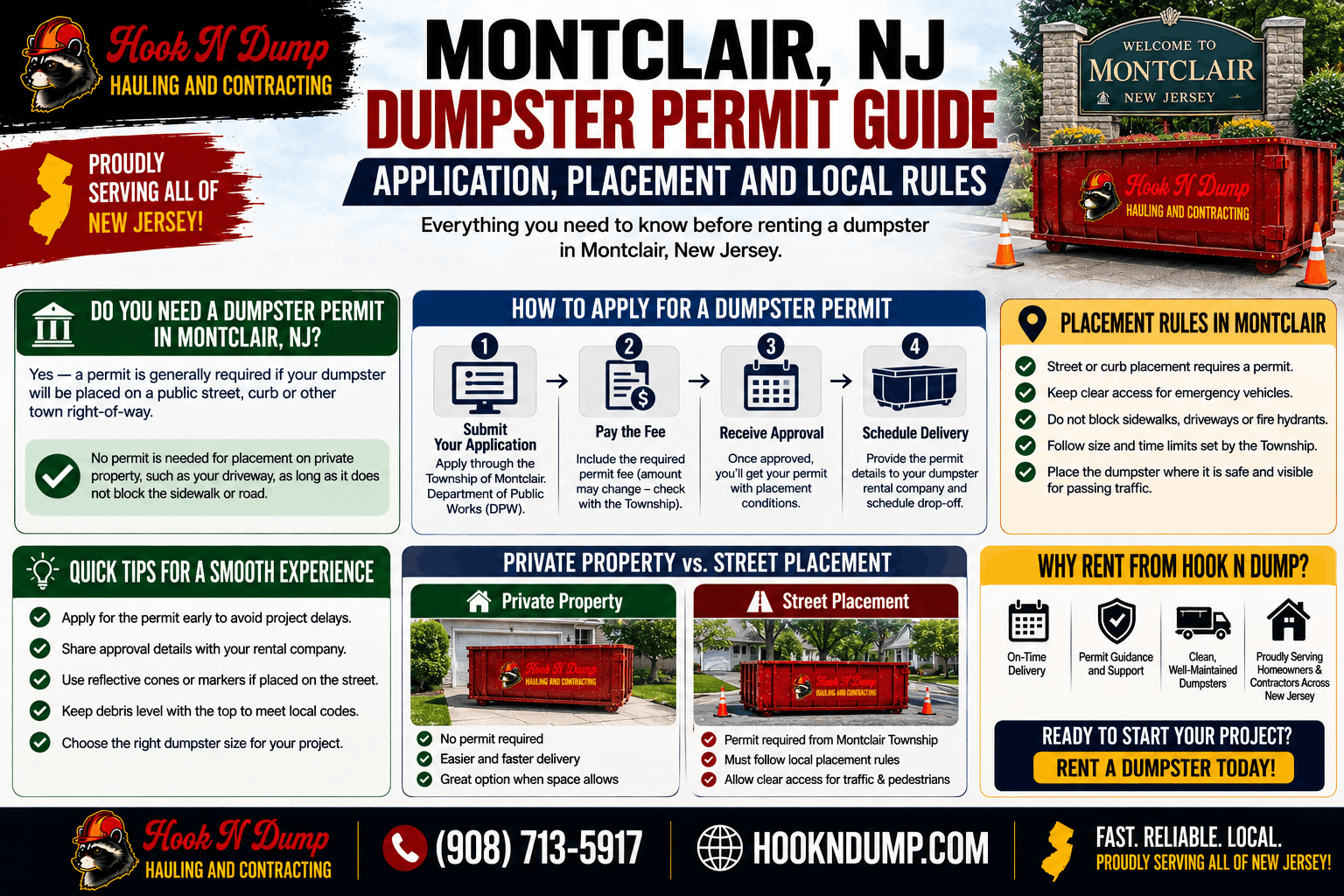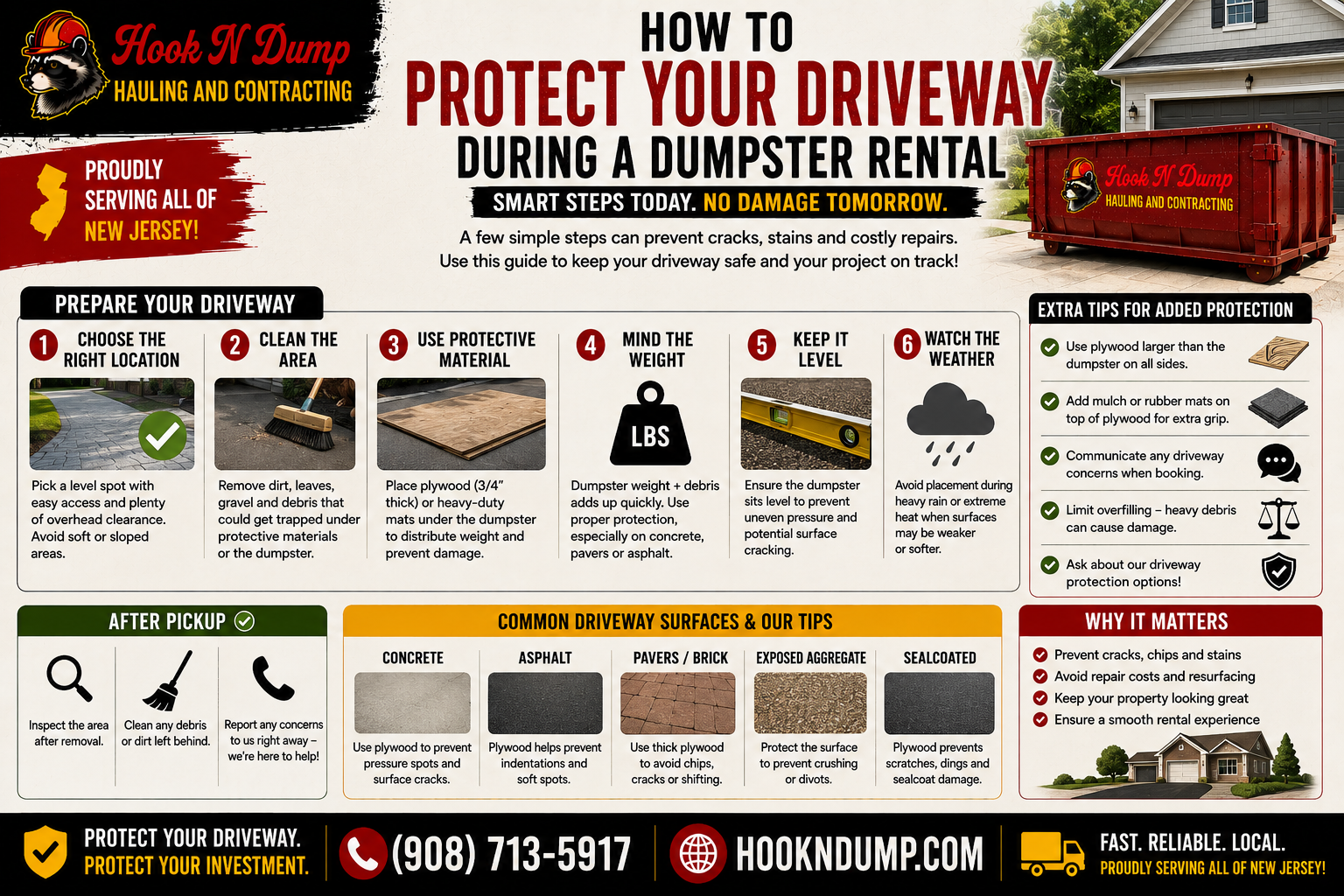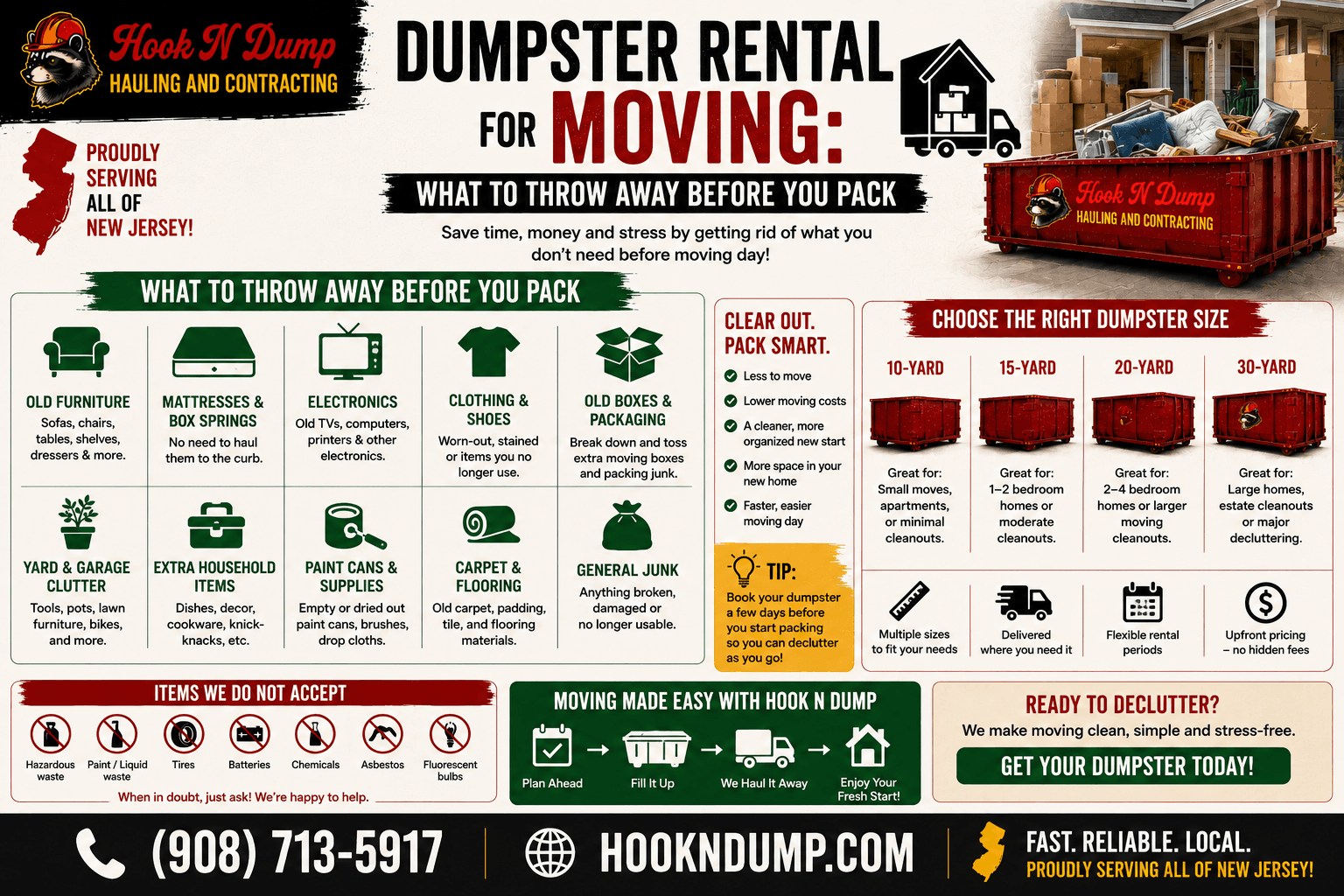
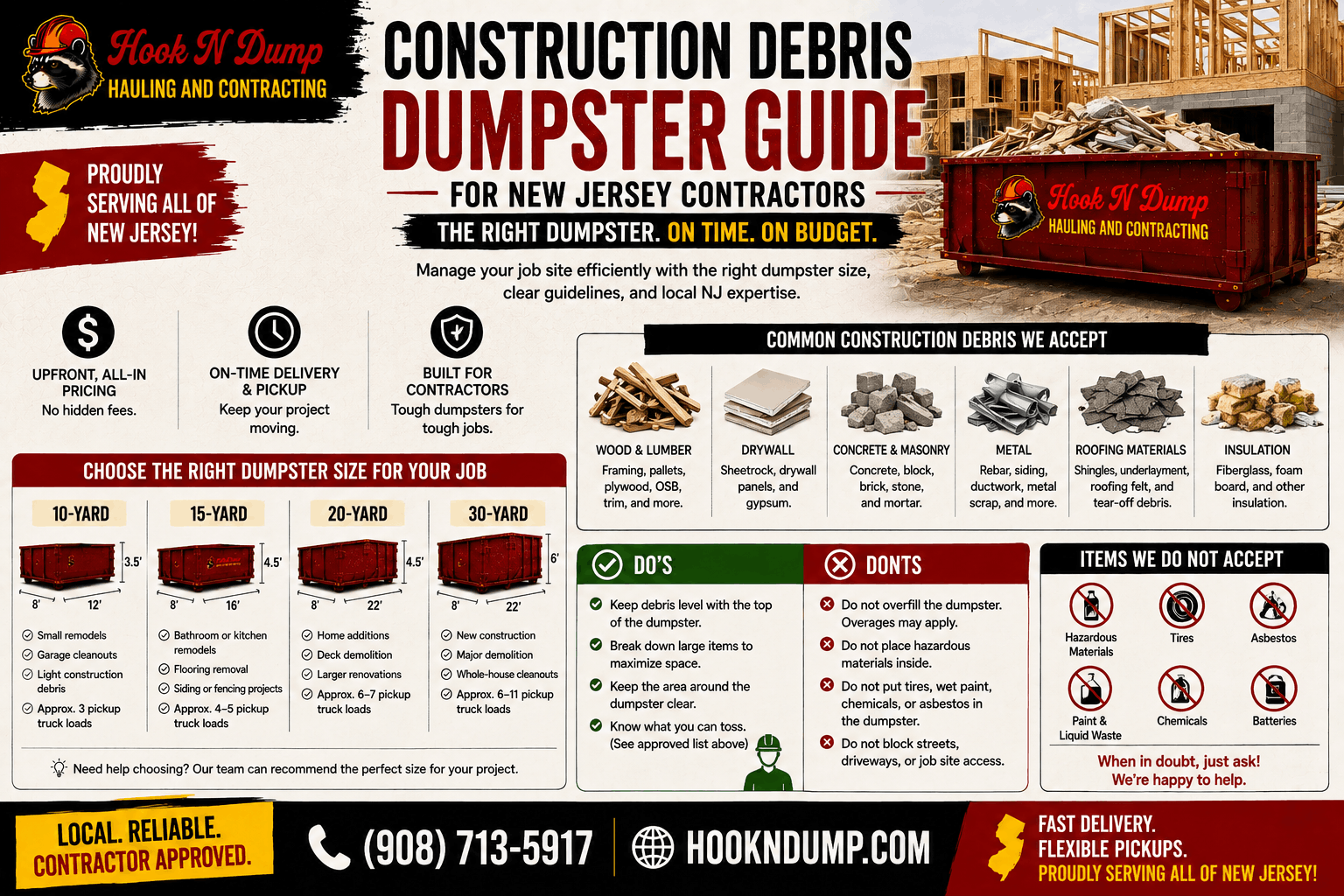
Most New Jersey remodeling and construction projects fit into a 20 or 30-yard dumpster, but the correct container depends on the material, project stage, debris weight and available placement space.
A 20-yard dumpster is commonly used for kitchen and bathroom remodeling, deck removal, flooring and asphalt roofing. A 30-yard container is better suited to commercial construction, large additions and higher-volume renovation debris. Hook N Dump reserves its 40-yard category for major construction, whole-home demolition and commercial roofing.
Use this starting point:
- 10 yards: Punch-list waste, one-room repair or a small tear-out
- 15 yards: Small renovation, flooring or light exterior work
- 20 yards: Standard residential remodel, deck demolition or roofing
- 30 yards: Large addition, commercial buildout or major renovation
- 40 yards: High-volume construction, commercial roofing or demolition
- Material-specific load: Concrete, brick, block, asphalt, soil, slate or other dense debris
The largest container is not always the correct one. Dense material may reach the approved transport weight while much of the dumpster remains empty.
Hook N Dump Construction Dumpster Comparison
| Dumpster Size | Current Starting Price | Included Weight | Contractor Use |
|---|---|---|---|
| 10-yard | $475 | 3,000 lbs. | Small repairs and controlled tear-outs |
| 15-yard | $550 | 4,000 lbs. | Small renovations and flooring |
| 20-yard | $625 | 5,000 lbs. | Residential remodeling, decks and roofing |
| 30-yard | $725 | 7,000 lbs. | Commercial construction and large additions |
| 40-yard | $875 | 9,000 lbs. | Major construction and demolition |
Hook N Dump currently displays 3, 7 and 10-day rental choices for all five sizes and lists additional rental time at $25 per day. Its public pricing should be confirmed for the project address, debris type, rental dates and planned load.
Current price differences
Moving from one size to the next currently costs:
- 10 to 15 yards: $75
- 15 to 20 yards: $75
- 20 to 30 yards: $100
- 30 to 40 yards: $150
Ordering the next size may be less costly than requesting a second container when the project is volume-driven. That does not apply automatically to concrete, masonry, soil or other dense debris.
What New Jersey Defines as Construction and Demolition Waste
New Jersey identifies construction and demolition waste as ID 13C. It covers building material and rubble produced by construction, remodeling, repair and demolition work on homes, commercial buildings, pavement and other structures.
Materials listed within that category include:
- Treated and untreated wood
- Concrete
- Asphalt
- Brick and block
- Masonry
- Plaster and wallboard
- Roofing materials
- Cardboard and paper
- Ferrous and nonferrous metal
- Non-asbestos insulation
- Plastic construction scrap
- Dirt
- Carpet and padding
- Window and door glass
- Other building debris
The ID 13C category does not make hazardous waste, asbestos or every specialty material suitable for an ordinary mixed dumpster. Those materials can fall under separate rules.
Hook N Dump currently identifies wood, drywall, concrete, brick and roofing material as common construction-removal materials. Its dumpster-rental page also lists siding, flooring, packaging and other nonhazardous job-site waste.
Construction Materials Commonly Accepted
The following materials may normally be approved for a contractor dumpster:
- Dimensional lumber
- Plywood and OSB
- Drywall
- Wallboard
- Plaster
- Cabinets
- Doors
- Windows
- Flooring
- Carpet and padding
- Siding
- Non-asbestos insulation
- Roofing shingles
- Underlayment
- Metal framing
- Pipes and fixtures
- Packaging
- Cardboard
- General renovation waste
Contractors should still provide the full material list before delivery. A container carrying lumber and drywall follows a different weight plan from one carrying tile, plaster, masonry and shingles.
Materials That Need Advance Approval
Tell Hook N Dump before loading:
- Concrete
- Brick
- Block
- Asphalt
- Soil
- Clay
- Stone
- Tile and mortar
- Cement board
- Plaster
- Roofing shingles
- Slate
- Concrete or clay roof tile
- Wet building material
- Large metal pieces
- Appliances
- Tires
- Treated or painted lumber
- Railroad ties
- Stumps or land-clearing debris
These materials may require:
- A dedicated container
- Source separation
- A lower fill line
- A smaller container
- Material-based pricing
- A clean-load rule
- More than one haul
- A different receiving facility
Hook N Dump’s disposal guidance states that concrete, brick, block, asphalt, dirt and similar dense materials may need a dedicated container, controlled loading level or prior approval.
Materials That Should Not Be Loaded
Do not place the following in a standard Hook N Dump construction container:
- Hazardous chemicals
- Liquid paint
- Paint thinner
- Solvents
- Gasoline
- Diesel fuel
- Motor oil
- Propane tanks
- Flammable liquids
- Medical waste
- Loose needles
- Unknown chemical containers
- Unapproved electronics
- Suspected asbestos material
Hook N Dump currently lists hazardous waste, chemicals, paint, asbestos, propane tanks, medical waste and flammable materials as prohibited from ordinary dumpster loads.
Inspect cabinets, utility rooms, garages and demolition areas before workers begin loading. Restricted products are often hidden inside storage units, maintenance rooms or abandoned containers.
Best Dumpster Size by Contractor Project
10-Yard Dumpster
Best for: Small repairs, punch-list work and controlled tear-outs
A 10-yard container may work for:
- One-room flooring removal
- Small bathroom update
- Cabinet replacement
- Minor drywall work
- Window or door replacement
- Small porch or landing
- Repair debris
- End-of-project cleanup
- Light packaging waste
A 10-yard dumpster provides 270 cubic feet of volume. Hook N Dump currently prices it at $475 with 3,000 pounds included.
Choose this size when the scope is fixed and the load does not include large quantities of tile, plaster, concrete or roofing.
15-Yard Dumpster
Best for: Small renovations and multi-room flooring
A 15-yard container may suit:
- Standard bathroom renovation
- Partial kitchen renovation
- Several rooms of flooring
- Drywall and trim removal
- Light siding project
- Small office update
- Apartment turnover
- Minor exterior work
Hook N Dump lists small home renovations, multi-room flooring and minor exterior projects for the 15-yard container. It currently starts at $550 with 4,000 pounds included.
Move to 20 yards when the project includes full cabinetry, wall demolition, bulky fixtures or another room.
20-Yard Dumpster
Best for: Standard residential remodeling
A 20-yard dumpster is often the strongest starting choice for:
- Full kitchen remodel
- Kitchen and bathroom project
- Deck or patio demolition
- Whole-floor flooring removal
- Residential roofing
- Interior wall removal
- Small home addition
- Moderate demolition
- Several rooms of mixed renovation waste
Hook N Dump lists kitchen and bathroom remodeling, deck or patio demolition and asphalt roofing shingles for its 20-yard container. The current starting price is $625 with 5,000 pounds included.
This size gives contractors enough room for common residential work without occupying as much job-site space as the 30 or 40-yard options.
30-Yard Dumpster
Best for: Large renovations and commercial construction
A 30-yard container may fit:
- Large home addition
- Commercial interior buildout
- Retail renovation
- Office renovation
- Multi-room gut project
- Larger residential roofing job
- Large siding project
- Framing and drywall debris
- Contractor packaging and job-site waste
- Renovation involving several trades
Hook N Dump currently lists commercial construction, large home additions and asphalt roofing shingles for the 30-yard size. It starts at $725 with 7,000 pounds included.
A 30-yard dumpster works best for bulky debris. It should not be filled to the top with concrete, soil or masonry without a written material plan.
40-Yard Dumpster
Best for: High-volume construction and demolition
A 40-yard container may be appropriate for:
- Major commercial construction
- Whole-home demolition
- Commercial roofing
- Warehouse renovation
- Large office demolition
- Multi-unit property work
- High-volume framing and drywall
- Large quantities of packaging
- Bulky demolition waste
Hook N Dump currently categorizes its 40-yard dumpster for major construction, whole-home demolition and commercial roofing. It starts at $875 with 9,000 pounds included.
A 40-yard container requires substantial placement and truck-access space. Confirm the assigned container measurements and delivery route before reserving it.
Project-by-Project Size Guide
| Contractor Project | Suggested Starting Size |
|---|---|
| Small repair or punch-list cleanup | 10-yard |
| One bathroom remodel | 10 or 15-yard |
| Partial kitchen remodel | 15-yard |
| Full kitchen remodel | 20-yard |
| Kitchen and bathroom together | 20-yard |
| Multi-room flooring | 15 or 20-yard |
| Small office renovation | 15 or 20-yard |
| Deck or patio demolition | 20-yard |
| Standard residential roof | 20 or 30-yard after weight review |
| Large home addition | 30-yard |
| Commercial buildout | 30-yard |
| Major commercial renovation | 30 or 40-yard |
| Whole-home demolition | 40-yard or exchange plan |
| Concrete, brick or block | Material-specific container |
| Slate, tile or dense roofing | Weight-based plan |
| Several project phases | Scheduled exchanges |
Mixed Construction Debris vs. Clean Loads
Mixed construction load
A mixed load may include approved combinations of:
- Wood
- Drywall
- Flooring
- Cabinets
- Siding
- Packaging
- Nonhazardous fixtures
- General renovation debris
Hook N Dump states that wood, drywall, construction debris and other ordinary waste can often be combined, though restrictions apply to hazardous and specialty materials.
Mixed loads are useful when several trades are producing debris at the same time.
Clean load
A clean load contains one separated material stream, such as:
- Concrete only
- Brick and block only
- Asphalt only
- Asphalt shingles only
- Wood only
- Metal only
New Jersey’s Class B recycling rules cover source-separated concrete, asphalt, brick, block, asphalt-based roofing scrap, wood waste and other nonputrescible construction material accepted by approved facilities.
A clean load can support recycling and may be required by the receiving facility. Contaminating it with food, household trash, drywall or unrelated waste can change the load’s destination and price.
Concrete, Brick, Block and Asphalt
Dense masonry must be planned separately from ordinary construction volume.
Before ordering, provide:
- Material type
- Estimated cubic yards
- Estimated dimensions
- Whether the load is clean
- Whether soil or rebar is attached
- Whether asphalt is mixed with concrete
- Loading equipment
- Job-site photographs
New Jersey permits source-separated concrete, asphalt, brick and block to move through approved Class B recycling routes. The state also provides a limited exemption for contractors storing and processing their own source-separated material when all stated conditions are met.
Do not order a 30 or 40-yard dumpster simply because the project has a large amount of concrete. The safer setup may be a smaller box with a controlled fill line and several exchanges.
Wood, Framing and Carpentry Debris
Wood debris often uses container volume before reaching the weight allowance.
Common materials include:
- Studs
- Joists
- Rafters
- Plywood
- OSB
- Pallets
- Cabinets
- Doors
- Trim
- Form lumber
- Shipping crates
To use space efficiently:
- Cut long pieces to an approved length.
- Lay flat panels along the floor.
- Place framing lumber in one direction.
- Remove large empty cabinet sections.
- Control protruding nails.
- Keep every piece below the walls.
- Separate clean wood when requested.
Finished, painted, stained, glued and treated wood may follow different recycling routes from clean unfinished lumber. Disclose the material rather than labeling every wood load as recyclable.
Drywall, Wallboard and Plaster
Drywall is common in remodeling and interior-demolition loads.
A drywall project may include:
- Gypsum board
- Joint compound
- Metal corner bead
- Wood or metal framing
- Insulation
- Fasteners
- Trim
- Ceiling tile
- Plaster and lath
New Jersey includes plaster and wallboard within ID 13C construction and demolition waste. Gypsum is also listed among materials processed by some approved Class B facilities.
Wet drywall and plaster can weigh more than dry material. Tell Hook N Dump when the waste follows a leak, flood or fire response.
Roofing Debris
Roofing dumpsters should be chosen by:
- Roof squares
- Shingle type
- Number of layers
- Underlayment
- Decking replacement
- Final estimated weight
Hook N Dump lists asphalt roofing shingles for its 20 and 30-yard dumpsters and commercial roofing for its 40-yard size.
Do not mix unrelated job-site trash into a roofing-only load without approval. A clean asphalt-shingle load may be directed to a Class B recycling facility authorized to receive asphalt-based roofing scrap.
Flooring, Tile and Mortar
Flooring debris can be light, bulky or very dense.
Volume-driven materials
- Carpet
- Padding
- Laminate
- Hardwood
- Vinyl plank
- Lightweight underlayment
Weight-driven materials
- Ceramic tile
- Porcelain tile
- Stone
- Mortar
- Mud beds
- Cement board
- Concrete underlayment
- Plaster
A 15-yard container may fit several rooms of carpet or hardwood. A large tile project may require a smaller container with a lower fill line rather than a 20 or 30-yard box filled to capacity.
Demolition Debris
Demolition work can produce several waste streams:
- Framing
- Drywall
- Roofing
- Flooring
- Cabinets
- Fixtures
- Concrete
- Brick
- Metal
- Glass
- Insulation
- Soil
- Utility components
Hook N Dump provides dumpsters and demolition service for residential, commercial, industrial, selective and interior-demolition projects.
Before the project begins, decide whether you need:
- One mixed construction dumpster
- Separate masonry and mixed-debris boxes
- Scheduled exchanges
- Metal separation
- Roofing-only loads
- Asbestos or specialty-waste contractors
Asbestos and Suspected Building Materials
Do not place suspected asbestos into a standard Hook N Dump container.
Possible asbestos-containing materials may include certain:
- Floor tiles
- Sheet flooring
- Flooring adhesive
- Pipe insulation
- Boiler insulation
- Cement products
- Roofing products
- Siding
- Fireproofing
- Textured coatings
New Jersey separates asbestos-containing waste from ordinary construction debris under defined conditions. NJDEP’s rules cover testing, wetting, packaging, labeling, transport, notification and authorized disposal based on the material type and project.
For Hook N Dump orders, disclose suspected or confirmed asbestos before delivery and use the approved regulated-waste route rather than an ordinary mixed dumpster.
New Jersey Waste-Transport Rules for Contractors
Contractors who haul their own job-generated waste should verify their NJDEP transporter status before using company trucks or trailers.
NJDEP states that companies transporting waste generated through their own operations are self-generators and must register equipment and obtain decals. The state lists home builders, remodelers and construction companies as self-generator examples. Self-generators cannot use that status to transport waste generated by unrelated people or businesses.
Companies transporting waste generated by others generally need an A-901 license, applicable public-convenience authorization or exemption, registration and decals for the equipment used. NJDEP states that waste picked up or delivered to a New Jersey facility must be transported by a registered company using properly decaled equipment.
Contractors should verify their exact classification with NJDEP before self-hauling. Cleanouts, property trash-outs and third-party junk removal may not qualify as self-generator work.
Using a registered dumpster provider removes the need for the contractor to make repeated disposal runs, but the contractor must still provide an accurate debris list and follow the container rules.
How to Choose the Dumpster Before the Job Starts
1. Define the demolition scope
List every area being removed:
- Rooms
- Walls
- Flooring
- Cabinets
- Fixtures
- Roofing
- Exterior components
- Foundations
- Site material
2. Identify each waste stream
Separate the estimate into:
- Light mixed debris
- Wood
- Drywall
- Roofing
- Metal
- Concrete and masonry
- Soil
- Restricted or regulated material
3. Estimate volume
Use:
Length × Width × Height = Cubic feet
Then:
Cubic feet ÷ 27 = Cubic yards
Do not use this calculation alone for masonry, shingles, tile or soil. Those materials require a weight review.
4. Estimate project phases
Decide whether the dumpster will serve:
- Demolition only
- Rough construction
- Finish work
- Packaging
- Final cleanup
One scheduled exchange may work better than leaving one container on site for the full build.
5. Check the placement area
Confirm:
- Level ground
- Container footprint
- Truck approach
- Turning room
- Overhead wires
- Tree branches
- Gates
- Fencing
- Scaffolding
- Material deliveries
- Worker and pedestrian routes
- Rear-door access
Ask Hook N Dump for the exact dimensions and truck-clearance needs of the assigned container.
Job-Site Dumpster Placement
Place the dumpster where it supports the work without blocking:
- Material deliveries
- Concrete trucks
- Cranes
- Lifts
- Worker parking
- Emergency access
- Sidewalks
- Building entrances
- Fire lanes
- Utility work
- Neighboring properties
A central location can reduce carrying distance, but the box must remain accessible for exchange or final pickup.
Confirm local rules before placing any container in a street, parking lane or public right-of-way.
Contractor Rental-Period Planning
Hook N Dump currently displays 3, 7 and 10-day rental choices, plus $25 for each additional day.
Three-day rental
May fit:
- Small tear-out
- Roofing job
- Scheduled deck demolition
- One-room remodel
- Debris already staged
Seven-day rental
May fit:
- Kitchen or bathroom remodel
- Multi-room flooring
- Standard residential demolition
- Small commercial project
- One full demolition phase
Ten-day rental
May fit:
- Large addition
- Multi-trade renovation
- Commercial buildout
- Larger roofing project
- Phased interior demolition
For longer projects, scheduled exchanges may control the load better than keeping one box until the end.
When to Schedule a Dumpster Exchange
Plan an exchange when:
- The project has separate demolition phases.
- The first load is roofing or masonry.
- Clean materials must remain separated.
- The container will block the next phase.
- A large crew will fill the box quickly.
- The site lacks room for two containers.
- The final load will contain packaging and lighter waste.
- Work cannot pause while waiting for pickup.
Tell Hook N Dump the expected fill date rather than waiting until debris reaches the walls.
How to Load Construction Debris
Load flat materials first
Place approved:
- Plywood
- Doors
- Cabinets
- Drywall sections
- Flooring
- Flat lumber
- Sheet material
Break down bulky debris
Reduce:
- Cabinets
- Shelving
- Framing assemblies
- Doors with attached frames
- Large crates
- Packaging
Spread weight evenly
Distribute:
- Tile
- Plaster
- Roofing
- Masonry
- Heavy wood
- Metal
Do not create one dense pile at the front, rear or one side.
Control sharp objects
- Bend exposed nails where safe.
- Keep metal edges inside the box.
- Contain loose screws and fasteners.
- Do not leave pipe or rebar projecting above the walls.
Stay below the loading line
All debris must remain below the top edge or any lower material-specific fill line assigned by Hook N Dump.
Keep pickup access open
Before pickup:
- Move work vehicles.
- Remove stored materials.
- Unlock gates.
- Close the rear door.
- Clear scaffolding and equipment.
- Remove overhead obstructions.
- Keep workers away from the truck route.
How Contractors Can Control Dumpster Costs
Select by material first
Choose the waste stream before choosing the container size.
Avoid paying for empty volume
Break down cabinets, framing and packaging so the debris packs efficiently.
Avoid weight overage
Declare shingles, plaster, tile, concrete, wet material and masonry before delivery.
Keep clean loads clean
Do not mix food, household trash, drywall or plastic into a concrete, asphalt, shingle or wood load unless approved.
Schedule around active work
Deliver shortly before demolition and request pickup when the phase ends.
Prevent unauthorized dumping
Use signs, barriers, controlled placement or job-site supervision when the container is accessible from the street.
Put load rules in the subcontractor briefing
Every crew should know:
- Approved materials
- Prohibited materials
- Fill line
- Clean-load requirements
- Appliance rules
- Pickup date
- Who may request an exchange
Review the written quote
Confirm:
- Container size
- Included weight
- Rental period
- Additional-day charge
- Added-weight rate
- Special-material charges
- Exchange charge
- Blocked-service charge
- Delivery area
- Pickup procedure
Hook N Dump’s public pages list current starting prices, included weights and added-day pricing, but contractors should confirm project-specific charges in writing.
Contractor Ordering Checklist
Provide Hook N Dump with:
- Company name
- Job-site address
- Site contact
- Project type
- Demolition scope
- Debris list
- Dense-material quantities
- Roofing squares and layers
- Concrete or masonry details
- Suspected regulated material
- Preferred dumpster size
- Delivery date
- Expected fill date
- Exchange schedule
- Final pickup date
- Placement photographs
- Gate and access instructions
- Purchase-order or billing requirements
FREQUENTLY ASKED QUESTIONS
What size dumpster is best for construction debris?
A 20-yard dumpster is commonly suited to standard residential remodeling. Choose 30 yards for large additions or commercial construction and 40 yards for major construction or demolition.
Can wood, drywall and flooring go in one dumpster?
These approved materials can often be combined in a mixed construction load. Confirm the full material list because clean recycling loads and specialty materials may need separation.
Can concrete, brick and block go in a construction dumpster?
They may be accepted with advance approval. Dense masonry often requires a dedicated container, a lower fill line or material-specific pricing.
Is a 20-yard dumpster good for remodeling?
Yes. Hook N Dump lists kitchen and bathroom remodeling, deck or patio demolition and asphalt roofing among its current 20-yard uses.
When should a contractor choose a 30-yard dumpster?
Choose 30 yards for commercial construction, large home additions, multi-room renovation and bulky debris that is likely to exceed a 20-yard container.
When is a 40-yard dumpster appropriate?
A 40-yard container may fit major construction, whole-home demolition, commercial roofing and other high-volume projects with enough placement space.
Can asbestos go in a Hook N Dump construction container?
Do not load suspected or confirmed asbestos into a standard container. Disclose it before ordering and use the required testing, transport and disposal process.
Can New Jersey contractors haul their own construction waste?
Contractors transporting waste generated through their own operations may need NJDEP self-generator registration and decals. Hauling third-party waste can require additional licensing. Verify the applicable classification with NJDEP.
How can contractors avoid dumpster overage charges?
Declare dense materials, follow the assigned fill line, distribute weight evenly, keep clean loads separated and confirm the included weight and added-weight rate in writing.
What information should a contractor provide when ordering?
Provide the address, project scope, debris types, estimated volume, dense materials, delivery date, exchange plan, placement photos and site-access instructions.
Choose the Right Contractor Dumpster
Use this starting guide:
- 10 yards: Small repair or controlled tear-out
- 15 yards: Small renovation or flooring project
- 20 yards: Standard residential remodeling
- 30 yards: Large addition or commercial construction
- 40 yards: Major construction and demolition
- Separate load: Concrete, brick, asphalt, soil and other dense materials
Hook N Dump currently recommends 20 or 30-yard dumpsters for many construction and renovation projects and provides 40-yard containers for larger construction and demolition work.
Call (973) 477-6805 and provide the project address, debris list, estimated volume, rental schedule and placement photographs. Hook N Dump publishes this phone number and its contractor-service information on its current website.
Need a Dumpster for Your Next New Jersey Job Site?
Send Hook N Dump the project scope, debris list, delivery address and expected schedule. The team will match the container and exchange plan to your construction phase.