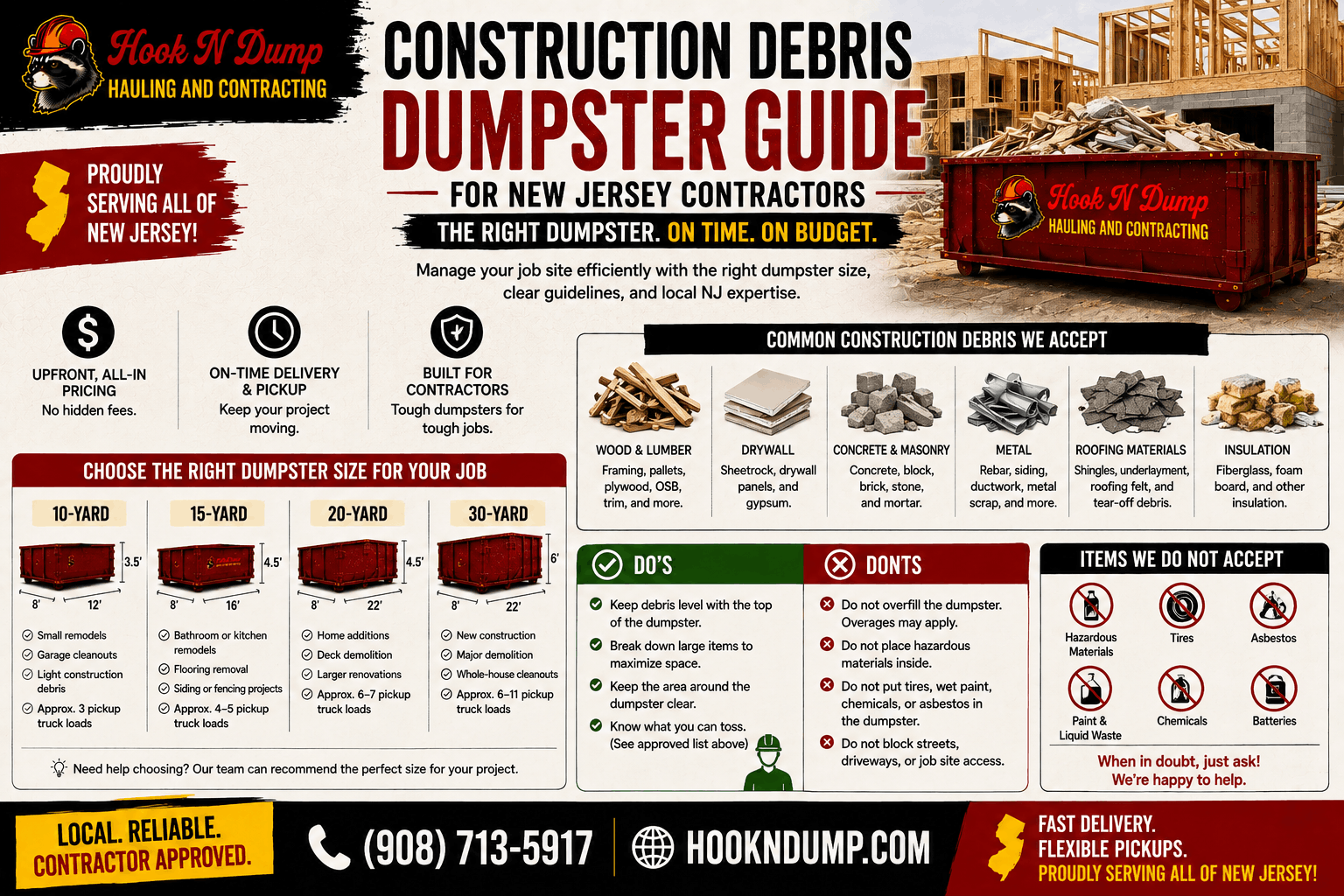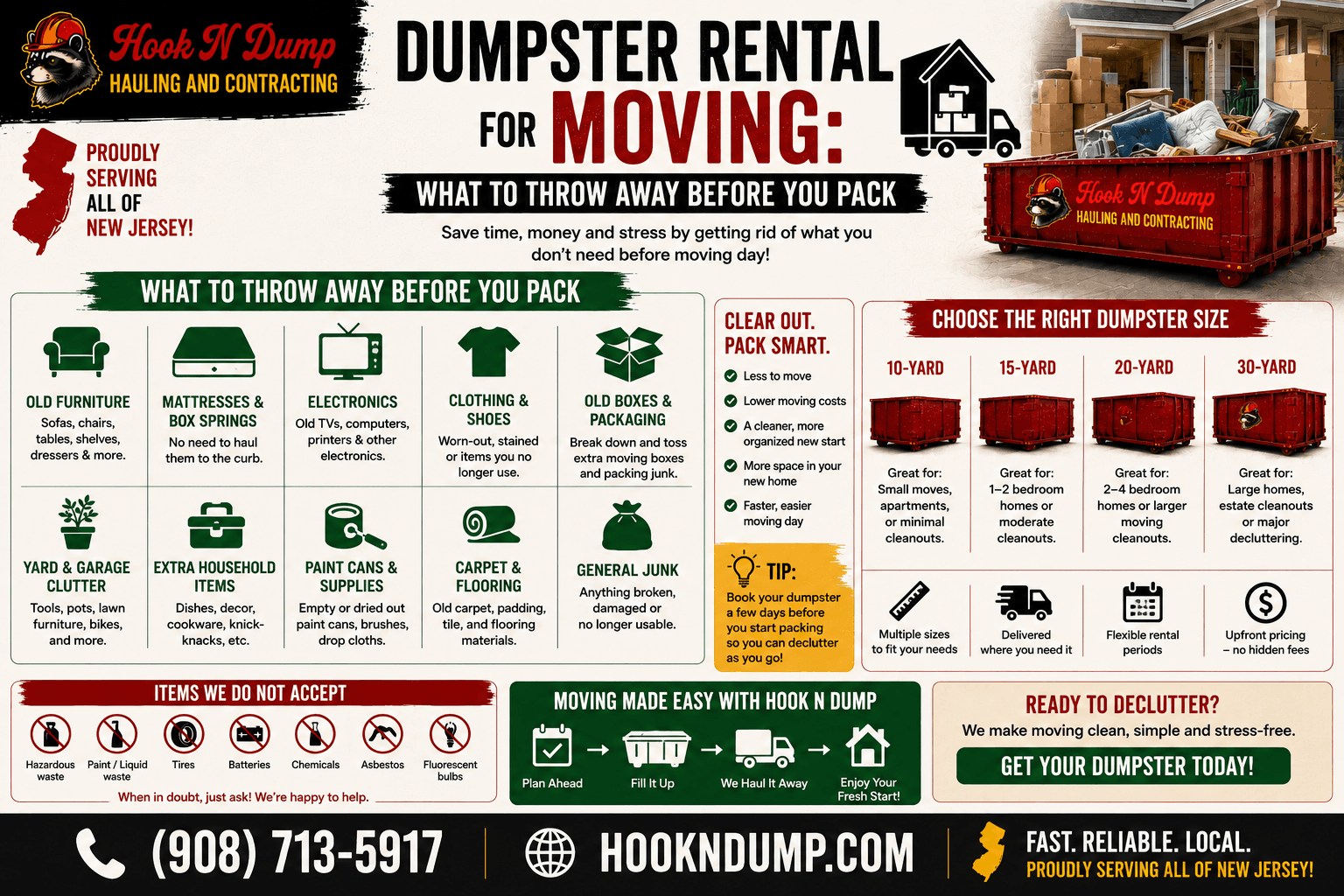
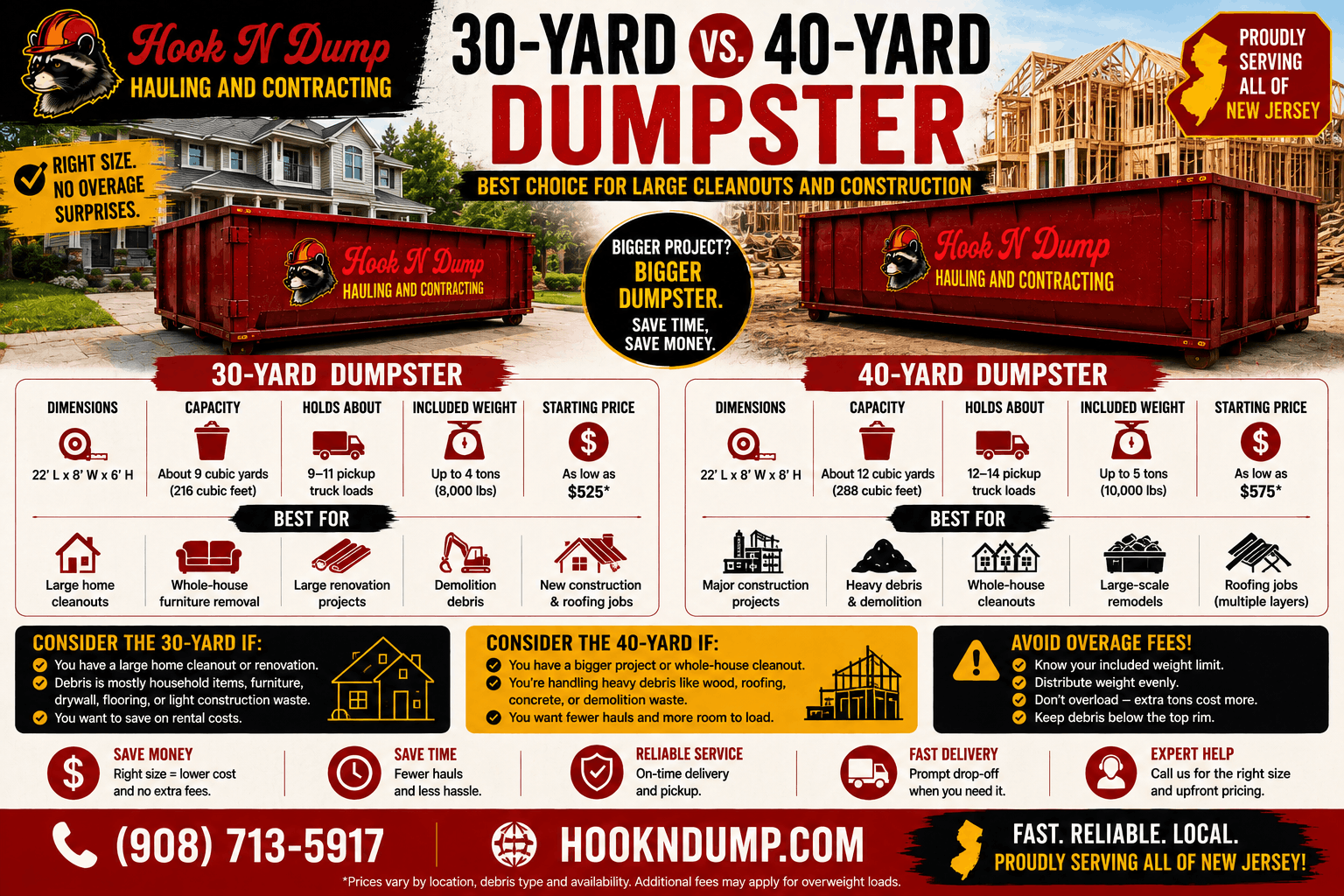
A 30-yard dumpster is usually the better choice for estate cleanouts, large home cleanouts, major renovations, home additions, roofing work and medium-to-large construction projects.
A 40-yard dumpster is intended for projects that produce the highest waste volume, including whole-home demolition, major commercial construction, warehouse cleanouts, commercial roofing and very large estate or property cleanouts.
Hook N Dump currently lists its 30-yard dumpster at $725 with 7,000 pounds included. Its 40-yard dumpster starts at $875 with 9,000 pounds included. The main dumpster-size table currently displays 3, 7 and 10-day rental choices, with additional time priced at $25 per day.
Quick answer: Choose the 30-yard dumpster for a large residential cleanup, estate cleanout, home addition or major renovation. Choose the 40-yard dumpster when the project involves whole-building demolition, commercial construction, warehouse debris or more material than a 30-yard container can safely hold.
The 40-yard option provides 10 additional cubic yards and 2,000 more pounds of included weight for $150 more under Hook N Dump’s current published pricing.
30-Yard vs. 40-Yard Dumpster Comparison
Feature | 30-yard dumpster | 40-yard dumpster |
Current starting price | $725 | $875 |
Included weight | 7,000 lbs. | 9,000 lbs. |
Included tonnage | 3.5 tons | 4.5 tons |
Cubic capacity | 30 cubic yards | 40 cubic yards |
Capacity in cubic feet | 810 cu. ft. | 1,080 cu. ft. |
Approximate pickup loads | Around 9 | Around 12 |
Rental choices shown | 3, 7 or 10 days | 3, 7 or 10 days |
Additional rental time | $25 per day | $25 per day |
Best for | Large cleanouts and renovations | Largest cleanouts and construction jobs |
Typical residential use | Estate or fully furnished home | Very large estate or heavily filled property |
Typical construction use | Home addition or major remodel | Major construction or demolition |
Placement needs | Large driveway or jobsite | Substantial placement and truck space |
Main benefit | Large capacity without ordering the largest container | Highest volume in Hook N Dump’s lineup |
Hook N Dump says a 30-yard dumpster commonly holds around nine pickup-truck loads, while a 40-yard container holds approximately twelve. These are planning estimates because truck-bed sizes and loading methods differ.
What Does 30 or 40 Cubic Yards Mean?
Dumpster sizes refer to interior volume.
One cubic yard equals:
3 feet × 3 feet × 3 feet = 27 cubic feet
A 30-yard dumpster provides:
30 × 27 = 810 cubic fee
A 40-yard dumpster provides:
40 × 27 = 1,080 cubic feet
The difference is:
1,080 − 810 = 270 additional cubic feet
The 40-yard dumpster therefore holds about 33.3% more physical volume than the 30-yard container.
That extra space may hold approximately three additional pickup-truck loads under Hook N Dump’s current capacity estimates.
The added volume is most useful for light or moderately heavy material that takes up considerable space, such as:
- Furniture
- Framing lumber
- Drywall
- Siding
- Roofing material
- Packaging
- Shelving
- Commercial inventory
- Office fixtures
- Large demolition pieces
- Household contents
- Storm debris
More volume does not mean unlimited weight. Concrete, dirt, masonry, asphalt, tile and plaster may need a dedicated heavy-material plan rather than a larger container.
Current Hook N Dump Price Difference
Hook N Dump currently publishes:
30-yard dumpster: $725
40-yard dumpster: $875
Price difference: $150
For the extra $150, the 40-yard container currently includes:
- 10 additional cubic yards
- 270 additional cubic feet
- About three more pickup-truck loads of volume
- 2,000 additional pounds of included weight
- More room for bulky commercial or demolition waste
- A lower chance of needing another container on a very large job
These figures come from Hook N Dump’s current dumpster-size and product pages.
Starting Price per Cubic Yard
Using only the advertised starting prices:
30-yard: $725 ÷ 30 = about $24.17 per cubic yard
40-yard: $875 ÷ 40 = about $21.88 per cubic yard
The 40-yard container provides more volume per starting-price dollar. That does not make it the cheaper choice when much of the container would remain empty.
Final pricing can also depend on the delivery location, debris type, rental length, special items and final load weight.
When Should You Rent a 30-Yard Dumpster?
The 30-yard dumpster is suited to large projects that exceed a 20-yard container but do not require Hook N Dump’s largest available option.
Hook N Dump lists estate cleanouts, commercial construction, large home additions and asphalt roofing shingles among its primary 30-yard uses. Its product page also lists full-home cleanouts, major renovations, interior demolition, small-structure removal and storm debris.
Choose a 30-Yard Dumpster When:
- You are emptying a fully furnished home.
- You are handling an average estate cleanout.
- The project includes a garage, basement or attic.
- You are completing a large renovation.
- A home addition is being built.
- You are removing siding, flooring or drywall.
- You have a medium-to-large construction job.
- The project contains bulky furniture or building waste.
- A 20-yard dumpster would be too small.
- The load should remain within the current 7,000-pound allowance.
- You have enough placement space for the assigned container.
Large Home Cleanout
A 30-yard dumpster may work well for:
- Several bedrooms
- Living-room furniture
- Dining-room furniture
- Garage contents
- Basement storage
- Attic boxes
- Cabinets
- Shelving
- Outdoor furniture
- General household junk
- Rental-property turnover
- Foreclosure cleanup
Hook N Dump lists full-home cleanouts and household contents among the common 30-yard projects.
Choose 40 yards when the property is very large, most rooms are heavily filled, an outbuilding is included or almost all household contents will be discarded.
Estate Cleanout
A 30-yard dumpster is often the starting point for an average estate cleanout.
It provides room for:
- Beds and dressers
- Couches
- Tables and chairs
- Cabinets
- Clothing
- Books
- Household boxes
- Kitchen contents
- Garage storage
- Basement and attic items
Hook N Dump directly lists estate cleanouts for its 30-yard dumpster and provides both dumpster rental and full-service estate cleanout work.
The 30-yard option is more likely to fit when:
- Donation pickups have already occurred.
- Some furniture is being kept.
- The property is average in size.
- The garage and basement are moderately filled.
- No large workshop or outbuilding is included.
Major Home Renovation
A 30-yard dumpster may suit:
- Whole-floor renovation
- Large kitchen and bathroom project
- Interior wall removal
- Siding replacement
- Window and door replacement
- Flooring throughout several rooms
- Drywall and insulation
- Cabinet and fixture removal
- Small garage demolition
- Shed removal
Hook N Dump lists cabinets, flooring, drywall, wood, fixtures, insulation, siding and demolition debris among suitable 30-yard materials.
Dense tile, plaster, concrete and masonry should be declared before loading because the container may reach its weight allowance before it reaches its volume limit.
Home Addition
A home addition may create:
- Framing lumber
- Drywall
- Siding
- Roofing
- Flooring
- Insulation
- Doors and windows
- Packaging
- Interior demolition debris
Hook N Dump identifies large home additions as a standard 30-yard use.
Concrete foundations, excavated soil, brick and block may require a dedicated load rather than being mixed into the main construction container.
Commercial Construction
A 30-yard dumpster may work for:
- Office renovation
- Retail remodeling
- Small commercial buildout
- Property-management cleanup
- Roofing project
- Drywall and framing waste
- Flooring replacement
- Siding
- Packaging
- Contractor jobsite waste
Hook N Dump describes the 30-yard container as useful for contractors, remodelers, property managers and commercial cleanup crews.
Move to 40 yards when the site generates a larger daily debris volume or several crews are producing waste at the same time.
When Should You Rent a 40-Yard Dumpster?
The 40-yard dumpster is Hook N Dump’s highest-volume container.
The company lists major construction, whole-home demolition, commercial roofing and very large estate cleanouts as its main uses. The 40-yard product page also identifies warehouse cleanouts, industrial cleanouts, office renovations, apartment-complex cleanouts and storm cleanup.
Choose a 40-Yard Dumpster When:
- The project involves whole-home demolition.
- You are managing major commercial construction.
- A warehouse or industrial property is being cleared.
- You are replacing a large commercial roof.
- The property contains an unusually high debris volume.
- A very large estate is being emptied.
- Several units or commercial spaces are being cleared.
- The project has a large crew producing debris.
- The 30-yard estimate would be close to full.
- The site has substantial placement and truck access.
- The load should remain within the current 9,000-pound allowance.
Whole-Home Demolition
Hook N Dump lists whole-home demolition as a core 40-yard use.
A demolition project may produce:
- Framing lumber
- Drywall
- Insulation
- Siding
- Roofing
- Doors and windows
- Cabinets
- Flooring
- Fixtures
- Packaging
- Mixed approved building debris
The 40-yard dumpster can reduce the number of container exchanges when the material is bulky and the site has room for the larger box.
Concrete foundations, dirt, brick and masonry should not automatically be loaded into the 40-yard container. Hook N Dump’s disposal guide states that dense material may require a smaller dumpster, a strict fill line, a clean load and advance approval.
Major Commercial Construction
A 40-yard dumpster may suit:
- New commercial construction
- Large retail renovation
- Office-building work
- Multi-unit residential construction
- Warehouse renovation
- Large framing project
- Commercial interior demolition
- Ongoing contractor waste
- High-volume packaging
Hook N Dump describes the 40-yard option as a choice for contractors, developers, property managers and large commercial renovation projects.
The larger container may reduce job interruptions caused by frequent pickups, provided the site has enough room and the debris remains within the agreed weight and material rules.
Warehouse or Industrial Cleanout
A 40-yard dumpster may be appropriate when removing:
- Old shelving
- Packaging
- Outdated inventory
- Nonhazardous equipment
- Office furniture
- Pallets
- Wood
- Drywall
- Light fixtures
- General commercial debris
Hook N Dump specifically lists warehouse and industrial cleanouts among the uses for its 40-yard container.
Hazardous chemicals, fuel, paint, pressurized tanks and unidentified industrial materials should not be placed in the dumpster. Hook N Dump lists hazardous waste, chemicals, liquid paint, asbestos, propane tanks, medical waste and flammable material as prohibited or separately managed waste.
Very Large Estate Cleanout
Choose 40 yards when the estate includes:
- A large multi-story house
- Heavily furnished rooms
- Packed garage
- Full basement
- Full attic
- Shed or workshop
- Outdoor furniture
- Years of stored belongings
- Heavy clutter
- Several disposal areas
Hook N Dump lists very large estate cleanouts and large property cleanups for the 40-yard container.
A 30-yard dumpster may still be enough when many items will be kept, donated or sold before disposal.
Commercial Roofing
Hook N Dump lists commercial roofing as a primary 40-yard use.
Before ordering, provide:
- Roof area
- Roofing material
- Number of layers
- Insulation type
- Whether decking will be removed
- Whether flashing or gutters are included
- Whether the material is wet
- Jobsite access details
A commercial roofing load can be bulky and heavy. The correct container and loading height should be based on material weight as well as roof area.
Storm and Disaster Cleanup
A 40-yard container may suit cleanup involving:
- Damaged roofing
- Fencing
- Branches
- Building material
- Water-damaged furniture
- Drywall
- Flooring
- Damaged household contents
- Commercial-property debris
Hook N Dump lists storm-related waste and large outdoor debris among the uses for its 30 and 40-yard containers.
Water-damaged material may weigh more than dry material. The debris list should be reviewed before loading.
Project-by-Project Size Guide
Project | Choose 30 yards when | Choose 40 yards when |
Home cleanout | Large or furnished home | Very large or heavily filled property |
Estate cleanout | Average full estate | Large estate with several storage areas |
Foreclosure cleanup | One large house | Several units or severe clutter |
Renovation | Major residential remodel | Whole-building or commercial renovation |
Home addition | Large addition | Multi-stage or high-volume construction |
Demolition | Interior or small-structure removal | Whole-home or major structural demolition |
Commercial construction | Medium-to-large job | Major ongoing project |
Roofing | Large residential roof | Commercial or very large roof |
Warehouse cleanup | Small or moderate section | Full warehouse or large inventory removal |
Office cleanout | Large office suite | Whole building or several floors |
Apartment cleanup | One or several units | Large multi-unit cleanup |
Storm debris | Large residential cleanup | Large property or commercial damage |
Siding removal | Large house | Commercial building or several structures |
These recommendations assume the materials are accepted and the load remains below the assigned weight and fill limits.
30-Yard vs. 40-Yard for a Large Home Cleanout
Choose a 30-yard dumpster when:
- The home is average or moderately large.
- Most rooms contain furniture.
- The garage, attic or basement is included.
- Some items will be donated.
- The property has already been partly sorted.
- There is no large workshop or detached building.
Choose a 40-yard dumpster when:
- The house is very large.
- Nearly all contents are being discarded.
- Several storage spaces are packed.
- The property includes a shed or workshop.
- Heavy clutter affects most rooms.
- A 30-yard dumpster would probably need another haul.
The 40-yard container gives you 10 more cubic yards, or about 33% more volume, than the 30-yard option.
30-Yard vs. 40-Yard for Construction
Choose 30 yards for:
- Large residential renovation
- Home addition
- Interior demolition
- Roofing
- Siding
- Drywall and framing waste
- Small commercial buildout
- Contractor cleanup
Choose 40 yards for:
- Major commercial construction
- Whole-home demolition
- Warehouse renovation
- Large retail buildout
- Several active work areas
- Large commercial roofing
- High-volume demolition debris
- Ongoing site waste
Hook N Dump positions the 30-yard dumpster for large residential and commercial work, while the 40-yard option is aimed at the biggest commercial and demolition projects.
30-Yard vs. 40-Yard for Demolition
A 30-yard dumpster may be enough for:
- Interior wall demolition
- Shed removal
- Small garage demolition
- Large kitchen removal
- Several-room gutting
- Flooring and drywall
- Nonstructural demolition
A 40-yard dumpster may be better for:
- Whole-home demolition
- Large structural removal
- Commercial interior demolition
- Several units
- Warehouse demolition
- Large building renovation
- High-volume framing and wall debris
The material type is just as important as the debris volume.
A large container may hold plenty of wood and drywall, but concrete, brick, dirt and masonry may make the load too heavy. Hook N Dump advises customers to request approval and follow material-specific loading limits for dense debris.
30-Yard vs. 40-Yard for Roofing
Choose a 30-yard dumpster when:
- The project is a large residential roof.
- Asphalt shingles are being removed.
- Plywood removal is limited.
- The total roof area fits the approved weight plan.
- The site has residential placement limits.
Choose a 40-yard dumpster when:
- The project is a commercial roof.
- The roofing material is bulky.
- A large decking area is being removed.
- Several roof sections are involved.
- The load is approved for the container.
- The site has enough room.
Hook N Dump lists asphalt roofing shingles for the 30-yard container and commercial roofing for the 40-yard option.
Do not choose by volume alone. Shingles and wet roofing debris may reach the included weight before the dumpster looks full.
Included Weight Comparison
Hook N Dump currently includes:
30-yard dumpster: 7,000 lbs. or 3.5 tons
40-yard dumpster: 9,000 lbs. or 4.5 tons
The difference is:
9,000 − 7,000 = 2,000 additional pounds
The 40-yard container has about 33% more volume but only about 28.6% more included weight.
These allowances are published on Hook N Dump’s current size and product pages.
Volume Does Not Equal Weight
A 40-yard dumpster can have empty physical space and still exceed its weight allowance.
Materials that can create a heavy load include:
- Concrete
- Dirt
- Soil
- Brick
- Block
- Asphalt
- Stone
- Ceramic tile
- Mortar
- Plaster
- Roofing shingles
- Wet drywall
- Water-damaged furniture
Hook N Dump’s current disposal guide says dense debris may require a smaller container, lower fill limit, clean load or separate price.
Do not use a 40-yard container as a way to dispose of more concrete or soil without written instructions.
Which Dumpster Costs Less Overall?
The 30-Yard Dumpster Costs Less When:
- The project fits below 30 cubic yards.
- You are handling a standard estate cleanout.
- The renovation is large but controlled.
- The job does not involve a whole-building demolition.
- The load should remain within 7,000 pounds.
- The 40-yard container would remain partly empty.
- Placement space is limited.
- Lower container capacity will not interrupt the job.
The 40-Yard Dumpster May Cost Less Overall When:
- The 30-yard container would be filled quickly.
- The project generates more than nine pickup loads.
- Several crews are creating waste.
- The job involves major construction or demolition.
- A second 30-yard rental would otherwise be needed.
- The property has a high volume of bulky debris.
- The load can stay within the approved 9,000-pound allowance.
- The jobsite has enough placement room.
The current starting-price difference is $150. Another container can involve a new delivery, pickup, disposal cycle and project delay, so moving to 40 yards may make sense when the 30-yard estimate is close.
Which Size Is Easier to Load?
The 30-yard dumpster will usually be easier for residential customers to fill because it contains less overall volume and may be easier to position on a large driveway.
The 40-yard container requires more property and truck space. Hook N Dump states that the 30-yard dumpster may fit in larger driveways, while the 40-yard container needs substantial placement space.
Rear-door loading may help with:
- Furniture
- Lumber
- Drywall
- Cabinets
- Carpet rolls
- Shelving
- Commercial inventory
- Large boxes
- Demolition debris
Ask Hook N Dump for the exact dimensions and loading-door instructions for the assigned container. Do not copy dimensions from old location pages because current container inventory may differ.
Will a 30 or 40-Yard Dumpster Fit on Your Property?
Before ordering either size, check:
- Clear driveway or jobsite width
- Available container length
- Truck turning room
- Overhead utility wires
- Tree branches
- Roof overhangs
- Gates
- Parked vehicles
- Sidewalk clearance
- Underground utilities
- Pavement condition
- Space for the rear door
- Public street restrictions
Hook N Dump’s general delivery guidance asks customers to provide at least 10 feet of clear width and 14 feet of overhead clearance for the delivery truck. The company also asks customers to discuss placement before delivery.
For a 30 or 40-yard dumpster, request the exact assigned-container measurements rather than relying only on the general clearance guidance.
Street placement may require municipal approval.
What Can Go in Both Sizes?
Hook N Dump lists many ordinary nonhazardous materials for 30 and 40-yard rentals, including:
- Furniture
- Household junk
- Wood
- Drywall
- Flooring
- Siding
- Roofing materials
- Construction waste
- Demolition waste
- Commercial cleanup debris
The 40-yard page also lists warehouse inventory, shelving, office fixtures and large property-cleanout material.
All debris should remain below the walls and within the assigned weight and material rules.
Items That Need Advance Approval
Tell Hook N Dump before loading:
- Mattresses
- Box springs
- Tires
- Televisions
- Computer monitors
- Refrigerators
- Freezers
- Air conditioners
- Dehumidifiers
- Concrete
- Dirt
- Soil
- Brick
- Block
- Pavement asphalt
- Heavy tile
- Large roofing loads
These materials may need another disposal route, a special fee, a clean load or a lower loading line.
Items That Should Not Go in the Dumpster
Do not load:
- Liquid paint
- Paint thinner
- Solvents
- Gasoline
- Diesel fuel
- Motor oil
- Propane tanks
- Hazardous chemicals
- Medical waste
- Loose needles
- Asbestos-containing material
- Flammable liquids
- Unknown chemical containers
- Contaminated soil
Hook N Dump identifies these materials as prohibited or separately managed waste.
When Neither Size Is Right
Choose a 20-Yard Dumpster When:
- The project is an average home cleanout.
- You are remodeling one kitchen or bathroom.
- The job includes a small deck or patio.
- Furniture is moderate.
- A 30-yard container would remain mostly empty.
Request More Than One Container When:
- The project has separate waste streams.
- Dense and light debris cannot be mixed.
- Demolition will occur in several stages.
- The job will run for an extended period.
- A single 40-yard container cannot stay on-site long enough.
- The waste volume exceeds one safe load.
Request a Heavy-Debris Container When:
- Concrete is the main material.
- Dirt or soil is being excavated.
- Brick or block is being removed.
- Pavement asphalt is involved.
- Large amounts of tile or stone are present.
The right answer for dense debris may be a smaller approved dumpster rather than a 30 or 40-yard container.
Questions to Ask Before Choosing
1. What type of project are you completing?
Estate cleanouts and demolition jobs can create similar volume but very different load weights.
2. How much material is visible?
Closed rooms, storage spaces and active demolition can hide more debris.
3. How many bulky items are included?
Furniture, shelving and commercial fixtures create unused gaps.
4. Is the material light, bulky or dense?
Wood and furniture use volume. Concrete and masonry use weight.
5. Will several crews use the dumpster?
Construction sites may fill a container faster than a homeowner cleanout.
6. Can the debris be separated?
Clean masonry, electronics and restricted items may need other disposal routes.
7. Will a 40-yard dumpster fit?
Confirm the exact container dimensions and truck access before delivery.
8. How long will the project take?
Hook N Dump currently displays 3, 7 and 10-day selections and an added-day rate of $25, but availability should be confirmed for the delivery address.
9. Would another haul interrupt the job?
The 40-yard size may be preferable when a second 30-yard container would delay demolition or construction.
Common Size-Selection Mistakes
Choosing by Price Alone
The 30-yard dumpster saves $150 at the starting-price level, but a second rental may cost more than choosing 40 yards initially.
Assuming 40 Yards Means Unlimited Weight
The 40-yard rental currently includes 9,000 pounds, not unlimited debris.
Filling a Large Container With Concrete
Dense material may need a smaller container and strict fill line.
Ignoring Placement Space
A 40-yard dumpster needs more room for delivery, loading and pickup.
Mixing Restricted Materials
Electronics, paint, fuel, propane tanks and hazardous waste require other handling.
Failing to Count Storage Areas
Garages, basements, attics, sheds and warehouses can contain more material than the main property.
Loading Above the Walls
Debris should remain inside the container and below the assigned fill line.
Final Size Checklist
Choose the 30-yard dumpster when:
- You are clearing a large furnished home.
- The project is an average estate cleanout.
- A large home renovation is planned.
- You are building a home addition.
- The project includes interior demolition.
- The construction volume is large but controlled.
- The load should remain within 7,000 pounds.
- The 30-yard container leaves some spare room.
Choose the 40-yard dumpster when:
- The project involves whole-home demolition.
- You are managing major commercial construction.
- A warehouse or industrial property is being cleared.
- The project is a commercial roof replacement.
- The property has a very high debris volume.
- The estate includes several packed storage areas.
- The 30-yard container would probably require another haul.
- The load should remain within 9,000 pounds.
- The jobsite can accommodate the largest container.
FREQUENTLY ASKED QUESTIONS
What is the main difference between a 30-yard and 40-yard dumpster?
A 40-yard dumpster holds 10 additional cubic yards, giving it about 33% more physical capacity. Hook N Dump’s 40-yard option also includes 2,000 more pounds of debris weight.
How much does a 30-yard dumpster cost?
Hook N Dump currently lists its 30-yard dumpster starting at $725 with 7,000 pounds included.
How much does a 40-yard dumpster cost?
Hook N Dump currently lists its 40-yard dumpster starting at $875 with 9,000 pounds included.
How much more does the 40-yard dumpster cost?
The current published price difference is $150.
How much does a 30-yard dumpster hold?
Hook N Dump says its 30-yard dumpster generally holds around nine pickup-truck loads, depending on the material and loading method.
How much does a 40-yard dumpster hold?
Hook N Dump says its 40-yard dumpster generally holds around twelve pickup-truck loads.
Is a 30-yard dumpster large enough for an estate cleanout?
A 30-yard dumpster is commonly suited to an average furnished estate. A large or heavily filled property may require a 40-yard container.
When should I choose a 40-yard dumpster?
Choose 40 yards for whole-home demolition, major commercial construction, warehouse cleanouts, commercial roofing and very large property cleanouts.
Which size is better for construction?
Use 30 yards for large residential work, home additions and medium commercial projects. Use 40 yards for major commercial construction, demolition and high-volume jobsite waste.
Which size is better for demolition?
A 30-yard dumpster may work for interior or small-structure demolition. A 40-yard container is generally better for whole-home or major commercial demolition.
Will a 40-yard dumpster fit in a driveway?
A 40-yard dumpster requires substantial placement space. Hook N Dump recommends confirming the property and truck-access requirements before delivery.
Can concrete go in a 30 or 40-yard dumpster?
Only with advance approval. Concrete may require a smaller dedicated container, a lower fill limit and clean-load terms.
Can household junk and construction debris be mixed?
They can often be combined when all materials are approved, but dense, hazardous and restricted items may need separate handling.
Should I choose 40 yards when I am unsure?
Choose 40 yards when the estimate is close to 30 cubic yards, the project contains bulky material, the site has enough room and another haul would disrupt the work.
Choose the Right Hook N Dump Container
Choose the 30-yard dumpster for estate cleanouts, large home cleanouts, major renovations, home additions, roofing and medium-to-large construction jobs.
Choose the 40-yard dumpster for whole-home demolition, major commercial construction, warehouse cleanouts, commercial roofing and the largest property cleanups.
Under Hook N Dump’s current pricing, the 40-yard dumpster costs $150 more while providing 10 additional cubic yards and 2,000 more pounds of included weight.
Call (973) 477-6805 or request a quote online. Provide:
- Delivery address
- Project type
- Debris list
- Property or building size
- Furniture or fixture count
- Heavy-material details
- Project photographs
- Rental dates
- Placement location
- Jobsite access information
Reviewed by Hook N Dump
Prices, weight allowances, availability, dimensions and accepted materials may change. Confirm the written rental terms before ordering.
Need a 30 or 40-Yard Dumpster?
Send Hook N Dump your project photos, debris list and delivery address. The team will compare both sizes and confirm which container fits your cleanup or construction site.